Clumping vs Crystal vs Tofu vs Wood Pellet Cat Litter NZ: Which is Best?
Confused by cat litter options in NZ? Compare clumping clay, crystal, tofu, wood pellet & recycled paper — benefits, drawbacks & Kiwi council tips.
Choosing the right cat litter in New Zealand can feel like standing in front of an overwhelming wall of options at your local pet store. From traditional clay to modern biodegradable soybean fibres, the variety of textures, scents, and clumping abilities is vast. The honest truth? The best cat litter is the one your cat will actually use consistently. Cats are highly fastidious creatures of habit, and a sudden, unmanaged switch in litter substrate can trigger litter-box avoidance, leading to stressful accidents on your carpets or furniture.
If you are setting up a home for a new kitten, see our New Kitten Checklist NZ and read the foundational Cat Care NZ Complete Guide to prepare your environment. In this guide, we provide a plain-language comparison of clumping clay, crystal, tofu, wood pellet, and recycled paper cat litters available in NZ, helping you make a balanced choice for your household budget, lifestyle, and your cat’s preferences.
---
The 5 Main Cat Litter Types in New Zealand
1. Clumping Clay Litter (The NZ Supermarket Standard)
Clumping clay litter, typically made from bentonite clay, is the most widely used litter type across Kiwi households. When liquids hit the clay, it expands and forms solid, scoopable lumps, leaving the remaining dry litter clean.
- Texture & Feel: Fine, sandy texture that closely mimics natural soil. It is highly appealing to most cats because it is soft on sensitive paw pads.
- Odour Control: Excellent. The clumping action traps moisture rapidly, locking in ammonia odours, especially when combined with carbon or baking soda additives.
- Tracking & Dust: Can range from low to high. Fine clay grains easily stick to paws and track out of the tray. Dusty grades can trigger sneezing in cats and owners with respiratory conditions.
- Environmental & Waste Impact: Clay is non-biodegradable and is sourced via open-pit mining. It must go in your general landfill rubbish bin. Never flush clay litter down Kiwi toilets, as bentonite clay expands in water and will completely block your pipes.
- Best For: The default choice for most cats. If your cat is using it reliably and you do not mind daily scooping, there is rarely a reason to change.
2. Crystal / Silica Gel Litter (High Absorbency, Low Mess)
Crystal litter is made from synthetic silica gel beads (similar to the desiccant packets found in new shoeboxes). Instead of clumping, the porous crystals absorb urine, allowing water to evaporate while trapping odour molecules inside.
- Texture & Feel: Coarse, hard, gravel-like crystals. The crunching sound and hard texture underfoot can be unpopular with some cats, particularly young kittens.
- Odour Control: Outstanding. It actively absorbs moisture and dries out solid waste quickly.
- Tracking & Dust: Virtually dust-free. The larger crystals are too heavy to cling to cat fur, though individual crystals can roll or be kicked out of the tray.
- Environmental & Waste Impact: Non-biodegradable synthetic material. While you do not scoop urine clumps daily (you only scoop solids and stir the remaining crystals to distribute moisture), the entire tray must be discarded and replaced every 2 to 4 weeks.
- Best For: Owners wanting a low-maintenance routine (no daily urine scooping) and homes with respiratory sensitivities. Not recommended for kittens or cats with sensitive paws.
3. Tofu / Soy-Based Litter (Biodegradable & Flushable)
A modern, eco-friendly option made from compressed, recycled soybean pulp (a byproduct of tofu manufacturing). Tofu litter usually comes in small, soft cylindrical pellets that clump when they come into contact with liquids.
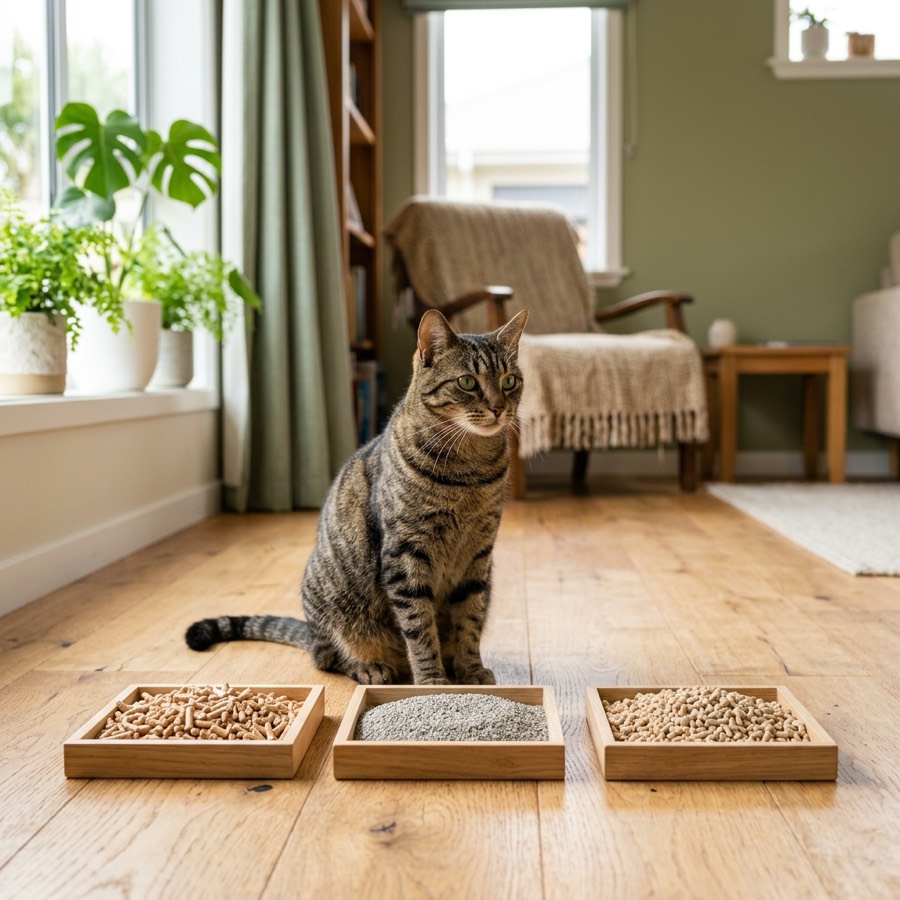
- Texture & Feel: Soft, lightweight pellets that are comfortable on paws. It is naturally low-dust.
- Odour Control: Good. Often infused with subtle scents (such as green tea, vanilla, or charcoal) to mask odours naturally.
- Tracking & Dust: Very low tracking. The pellets are too large to get stuck in paw webs, although they can occasionally be kicked out.
- Environmental & Waste Impact: 100% biodegradable and compostable (pet-only compost). It dissolves in water, meaning it can be flushed in small amounts. However, Auckland's Watercare and other NZ local councils strongly advise against flushing cat waste or litter into public wastewater networks. Check your local council rules first.
- Best For: Eco-conscious owners and apartments. In humid New Zealand regions (like Auckland and Northland summers), tofu litter can absorb ambient humidity and grow mould if left in the tray too long; increase ventilation and clean the tray weekly.
4. Wood Pellet Litter (Natural Scent & Budget-Friendly)
Wood pellet litter is made from compressed pine or recycled wood shavings. When wet, the pellets break down and dissolve into fine sawdust. It is commonly used with a two-part sifting litter box where the sawdust falls through a mesh screen into a lower tray for easy removal.
- Texture & Feel: Large, firm timber cylinders. Some cats refuse to step on them if they are used to sandy clay.
- Odour Control: Very high. The natural pine oils help neutralize ammonia odours without synthetic perfumes.
- Tracking & Dust: Low tracking as intact pellets, but the damp sawdust can track on paws if the sifting tray is not emptied regularly.
- Environmental & Waste Impact: Highly eco-friendly, biodegradable, and often sourced from NZ forestry waste.
- Best For: Budget-conscious owners wanting a natural product, and cats that were raised on it from kittenhood. Switching an adult cat from clay to wood pellets requires a very slow, patient transition.
5. Recycled Paper Litter (Gentle on Recovering Paws)
Recycled paper litter is processed into soft pellets or granules. It does not clump; instead, it absorbs urine like a sponge, swelling slightly.
- Texture & Feel: Extremely soft, pillowy paper rolls. This is the gentlest texture on paws.
- Odour Control: Moderate. Because it does not clump or lock in moisture as tightly as clay or crystal, it needs more frequent full-tray changes.
- Tracking & Dust: Very low dust, but lightweight paper pellets can track out of the tray easily.
- Environmental & Waste Impact: Biodegradable and made from recycled newsprint, making it highly sustainable.
- Best For: Kittens, senior cats with sensitive joints, and cats recovering from surgeries (like desexing) where NZ vets advise avoiding dusty clay particles that could contaminate healing incisions.
---
Head-to-Head Comparison Table
To help you compare your options at a glance, here is a breakdown of clumping ability, tracking, environmental footprint, and typical availability in New Zealand:
| Litter Type | Clumping? | Texture / Paw Feel | Dust & Tracking | Eco-Friendly? | Supermarket Availability | Relative Cost in NZ |
|---|---|---|---|---|---|---|
| Clumping Clay | Yes | Soft, sandy (Preferred) | Medium dust / High tracking | No | Very High | Low to Medium |
| Crystal / Silica | No (Absorbs) | Hard, gravelly | Low dust / Low tracking | No | High | Medium to High |
| Tofu / Soybean | Yes | Soft, small cylinders | Low dust / Very low tracking | Yes | Medium (Specialty shops) | High |
| Wood Pellet | No (Dissolves) | Large, firm cylinders | Low dust / Low tracking | Yes | Medium | Low |
| Recycled Paper | No | Soft, papery | Very low dust / Low tracking | Yes | High | Low to Medium |
---
Critical NZ-Specific Factors for Pet Owners
1. Wastewater Regulations and the "Flushable" Myth
While tofu and some wood litters are marketed globally as "flushable," New Zealand's plumbing systems and municipal bylaws have strict guidelines. Watercare in Auckland and Wellington Water emphasize that only toilet paper, pee, and poo should go down the toilet. Cat faeces can contain *Toxoplasma gondii*, a parasite that municipal water treatment facilities cannot always filter out, posing a threat to marine life like Maui dolphins. The safest, most compliant choice in NZ is to bag cat waste and dispose of it in the household rubbish bin.
2. Managing New Zealand's Climate and Mould
If you live in the humid North Island (Auckland, Bay of Plenty, Northland), organic litters like tofu or wood pellet can absorb moisture from the air. In humid conditions, a damp litter tray can become a breeding ground for mould or bacteria. NZ owners using natural litters should scoop daily, keep the litter box in a well-ventilated area, and completely empty and scrub the tray with pet-safe disinfectant every 7 to 10 days.
3. Veterinary Recovery Guidance
If your cat or kitten is recovering from a veterinary procedure, such as a routine spay or neuter, NZ vets recommend removing clay and crystal litters temporarily. Fine clay or silica dust can stick to surgical sites and cause infection or irritation. Switch to a recycled paper litter like *Yesterday's News* or *Tidy Cats Paper* for 7 to 14 days post-op to ensure clean healing.
4. What Cats Themselves Prefer
Most litter is marketed to people, not to cats. The AAFP/ISFM house-soiling guidelines — the reference document vets use when a cat starts toileting outside the box — recommend "a fine, sand-like, non-scented, clumping material to a depth of at least 1.25 inches (3 cm)", and warn that cats often find scented litters and deodorising powders offensive. If your cat has started avoiding the box, the fragrance and the depth are worth checking before you blame the cat. Where preferences are unclear, the guidelines suggest offering several boxes with different litters and depths and letting the cat choose.
---
How to Switch Your Cat's Litter Safely
Cats are famously resistant to sudden changes in their toilet environment. An abrupt switch to a new texture can lead to your cat refusing to use the box, choosing instead to urinate on carpets, beds, or laundry. To transition successfully, use this simple 14-day staging method:
- Days 1–3 (80/20 Mix): Fill the box with 80% of the old litter and 20% of the new litter. Mix them together thoroughly.
- Days 4–7 (50/50 Mix): Increase the ratio to a 50/50 mix. Observe your cat's behavior—ensure they are still digging and covering comfortably.
- Days 8–11 (20/80 Mix): Shift to 20% of the old litter and 80% of the new litter.
- Day 12 onwards (100% New): Fill the tray entirely with the new litter.
[!TIP]
Always keep a second "fallback" litter box filled with the original litter during the transition period. If your cat shows signs of hesitation or avoids the mixed box, go back one step and slow down the transition. For more advice on litter box placement and setup, consult Kitten Litter Training NZ.
---
Key Takeaways
- Cat Preference Rules: Your cat has the final veto. A litter that is eco-friendly or cheap is useless if your cat refuses to step in it.
- Clay is the Easiest Starting Point: Most kittens and shelter cats are familiar with clay, making it the most reliable default.
- Crystal is Low Maintenance: Great for busy owners who want to avoid daily liquid scooping, provided the cat tolerates the gravelly texture.
- Natural Litters Need Humid Care: Tofu and wood pellet litters are excellent for the environment but require regular full tray replacements in Auckland's humid summers.
- Do Not Flush: Regardless of packaging claims, bag and bin cat waste to protect NZ's marine ecosystems and prevent drainage blockages.
- Multi-Cat Rule: Maintain one litter tray per cat plus one extra (e.g., three trays for two cats) to prevent territory disputes. If you are introducing a new pet, read How to Introduce a New Cat NZ.
---
Related Guides
- Cat Litter Guide NZ — The complete guide to tray placement and maintenance.
- Kitten Litter Training NZ — Step-by-step toilet training for young cats.
- How to Introduce a New Cat NZ — Reducing multi-cat household tension.
- Best First Cat Breeds NZ — Finding the right breed fit.
Shop Cat Litter at PetMall
Ready to find the perfect litter for your cat? PetMall offers a wide range of clay, crystal, tofu, and wood pellet litters with prompt delivery across New Zealand.
→ Browse Cat Litter on PetMall
---
Sources
- Watercare Auckland, *What Not to Flush: Protecting Wastewater Infrastructure*, checked 2026-06-15: https://www.watercare.co.nz/residents/learn/what-not-to-flush
- Carney HC, Sadek TP, Curtis TM, et al., *AAFP and ISFM Guidelines for Diagnosing and Solving House-Soiling Behavior in Cats*, Journal of Feline Medicine and Surgery, 2014, checked 2026-08-02: https://pmc.ncbi.nlm.nih.gov/articles/PMC11148882/
Free PetMall tools
Related guides
petmall.co.nz
Shop at PetMall
The products below are practical support items for your pet. PetMall ships across New Zealand.
- Cat LitterClumping or crystal, most cats prefer an unscented litter and a clean tray — one tray per cat plus one spare is the NZ rule of thumb.
- Cat FoodStart with food that matches your cat's life stage — change brands slowly over 7–10 days to avoid digestive upset.
- Cat TreatsGreat for bonding and training — keep treats under 10% of daily calories to protect your cat's waistline.
- Cat ToysA small rotation of toys (feather wand, puzzle feeder, and comfort toy) usually works better than buying many at once.
- Cat GroomingRegular brushing cuts hairballs and shedding — essential for long-haired breeds like Ragdolls and British Longhairs.
- Flea & Worm TreatmentFor NZ conditions, choose protection that fits your cat's weight and lifestyle (indoor vs outdoor) and keep it regular.