Free NZ cat behaviour tool
Cat Behaviour Decoder — Understand Your Cat's Behaviour Clues
Wondering why your cat is hiding, spraying, meowing at night, or suddenly acting differently? The Cat Behaviour Decoder helps you make sense of the behaviour clues you're seeing at home. Answer a short series of questions about your cat's body language, recent behaviour, living setup, and the situations where it happens — and we'll suggest possible reasons, what to watch for, and practical things you can try.
This tool is built for New Zealand cat owners, drawing on widely accepted feline behaviour and body language guidance. It is general guidance only — not a veterinary diagnosis. Cats hide illness well, so if your cat's signs are sudden, severe, or worsening, please contact a registered NZ veterinarian.
Whether you're settling a new kitten in Auckland, sorting out tension between two cats in a Wellington flat, or puzzled by an older cat that has started yowling at night — start with the decoder, then explore our PetMall Knowledge Hub guides for deeper help.
Takes about 2 minutes • Anonymous • Free
Before you start
The Cat Behaviour Decoder offers general guidance based on the behaviour clues you describe. It is not a veterinary diagnosis and does not replace professional veterinary or behavioural advice. Cats are very good at hiding pain and illness.
By using this tool you understand:
What the Cat Behaviour Decoder Actually Does
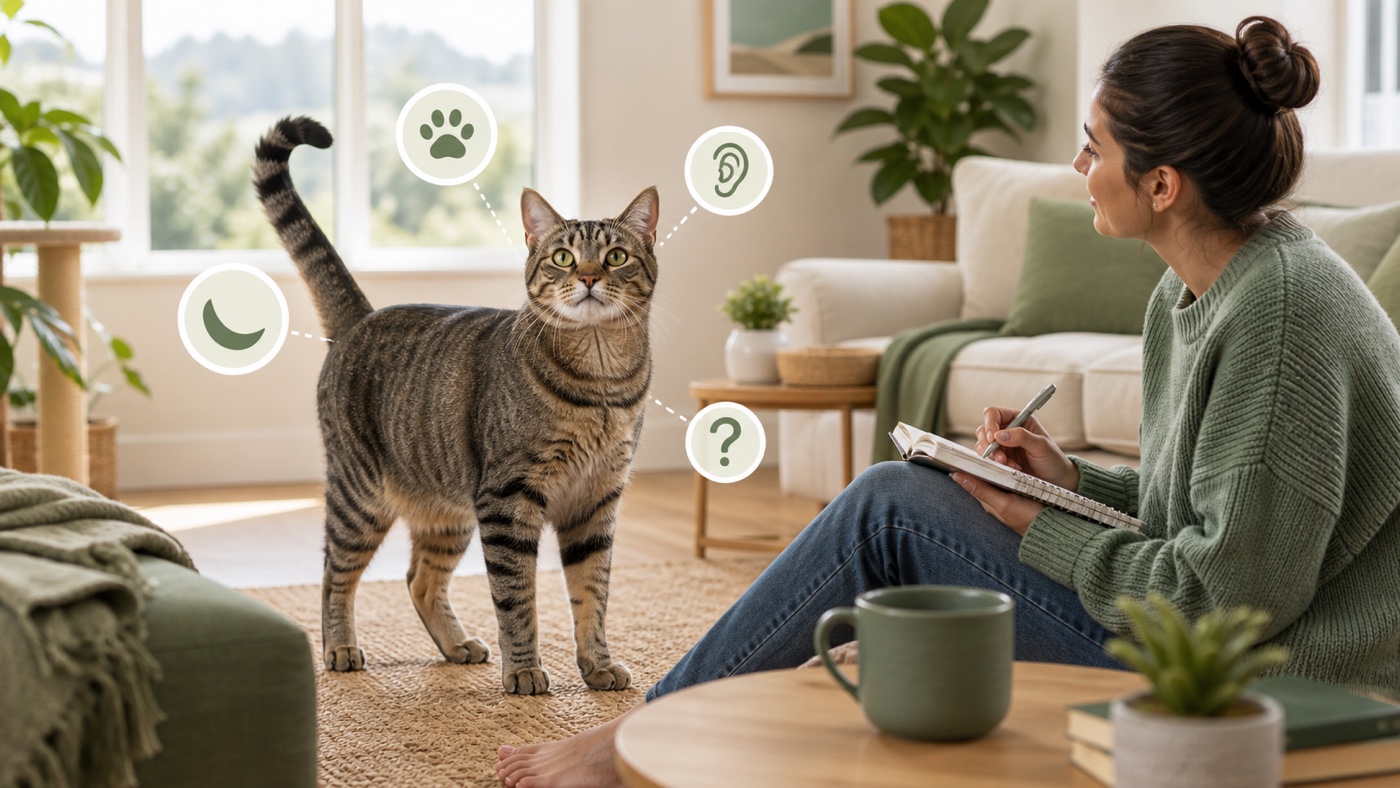
This is a structured questionnaire, not an AI translator. We don't claim to read your cat's mind or translate meows into sentences. What we do is take the observations you describe — tail position, ear set, whiskers, the situation it happens in, your cat's living setup — and match them against well-established patterns in feline behaviour and body language.
The output suggests likely emotional states or unmet needs (such as stress, fear, frustration, boredom, or overstimulation), explains why we're suggesting them based on your inputs, and gives you concrete next steps. It also flags clearly when your cat's signs warrant a vet visit rather than a behavioural fix — which matters more for cats than many owners realise, because cats are very good at masking pain and illness.
What Your Cat's Body Language Might Mean
Tail
A cat's tail is one of the clearest signals it gives. An upright tail with a slight curl at the tip usually means a confident, friendly greeting. A tail held low or tucked under the body often signals fear or insecurity. A puffed, bristled tail means your cat is frightened or highly aroused. And a tail that swishes, thrashes, or thumps is not happy — in cats this usually means irritation or overstimulation, the opposite of a wagging dog. Always read the tail alongside the rest of the body.
Ears
Ears facing forward and slightly to the side usually indicate a relaxed, interested cat. Ears rotated out to the sides — often called "airplane ears" — signal anxiety, irritation, or uncertainty. Ears flattened down against the head are a strong sign of fear or defensiveness, and often appear just before a swat or bite. Ears flicking rapidly suggest your cat is processing something stressful.
Whiskers
Whiskers carry information dogs simply don't have. Whiskers held in a neutral, relaxed fan to the sides indicate a calm cat. Whiskers pushed forward suggest alertness, excitement, or hunting focus. Whiskers pinned flat back against the face are a fear or pain signal. Whisker position is subtle, so watch it together with the ears and eyes.
Eyes & Slow Blink
A soft, relaxed gaze with half-closed eyes usually means a content cat. A slow blink — your cat closing its eyes gently at you — is a genuine sign of trust and comfort. Wide, dilated pupils can mean fear, excitement, or high arousal, while a hard, fixed stare paired with a still body can signal tension or a warning. A cat that avoids eye contact and turns away is often trying to defuse a situation.
Posture & Body Shape
A cat curled into a compact "loaf" with paws tucked is usually relaxed but still mildly alert. A loose, stretched-out body is a sign of real comfort. A crouched, tense body with weight low to the ground signals fear or readiness to flee. An arched back with raised fur is a classic fear-or-threat display. A cat rolling to show its belly may be relaxed and trusting — or, in another context, defensively positioning its claws — so read it alongside the ears and tail.
Vocalisations & Purring
Cats vocalise differently to dogs, and one signal is widely misunderstood: purring does not always mean a happy cat. Cats also purr when stressed, in pain, or self-soothing, so purring should be read in context. Frequent or loud meowing at people is often a request — for food, attention, or access. Yowling, especially at night or in older cats, can signal distress, frustration, or an underlying medical issue. Hissing and growling are clear "give me space" warnings and should never be punished.
Common Reasons Cats Behave Differently
Litter Tray Avoidance
When a cat stops using its litter tray, it is communicating that something is wrong — with the tray, the location, the litter, or the cat's own health. Common environmental causes include too few trays, a tray in a busy spot, a covered tray, or litter the cat dislikes. Important: peeing problems can also signal a urinary medical issue, so this is never purely a "behaviour" question.
Spraying & Urine Marking
Spraying — small amounts of urine on vertical surfaces — is marking behaviour, not a litter tray failure. It is most common in cats that are not desexed, in multi-cat homes, or when a cat feels its territory is under pressure from change or other cats. It is driven by stress and instinct, not spite.
Tension Between Cats
Cats are territorial and do not automatically get along. Tension can show as staring, blocking access to food or trays, chasing, hiding, or outright fighting. Often it is quiet — one cat simply controls the space while another stays out of sight. Resources, space, and careful introductions matter more than "personality".
Fear & Hiding
Hiding is a normal feline coping strategy. Cats hide when frightened by noise, visitors, a new pet, a house move, or any change to their environment. Short-term hiding after a clear trigger is usually normal. Hiding that is new, prolonged, or paired with not eating deserves closer attention.
Petting-Related Overstimulation
Many cats enjoy being petted only up to a point, then suddenly bite or swat. This is overstimulation, not aggression — the cat has reached its threshold. Watch for the early warning signs: a twitching tail, rippling skin along the back, ears rotating, or the cat going still.
Play & Predatory Aggression
Young, indoor, or under-stimulated cats often direct hunting behaviour at moving targets — including ankles and hands. This is normal feline predatory play that has no proper outlet. The fix is more structured play with appropriate toys, not punishment.
Overgrooming
A cat that grooms one area until the fur thins or the skin shows may be responding to stress — but overgrooming is also commonly caused by fleas, allergies, pain, or skin conditions. Because the medical and behavioural causes overlap, a vet check should come first.
Senior Cat Changes
Older cats can develop new behaviours — night-time yowling, restlessness, disorientation, changes in appetite or weight, or seeming "lost". In senior cats these changes are frequently medical (such as overactive thyroid, high blood pressure, kidney issues, arthritis, or cognitive decline) and warrant a vet check rather than a behavioural fix.
When to Skip the Decoder and Call a Vet
The Cat Behaviour Decoder is for understanding behaviour patterns — not for medical emergencies. Cats hide illness well, and some feline emergencies look like "behaviour" at first. Contact a vet immediately if your cat shows:
- Straining in the litter tray, going in and out repeatedly, crying while trying, or passing little or no urine — this can be a life-threatening urinary blockage, especially in male cats
- Not eating anything for 24 hours or more
- Open-mouth breathing, laboured breathing, or pale or blue gums
- Sudden weakness, dragging or paralysis of the back legs, often with crying out
- Collapse, seizures, or loss of consciousness
- Suspected poisoning — lilies (extremely toxic to cats, including pollen and vase water), antifreeze, a dog flea treatment used on a cat, or any human medication
- A serious injury, suspected road accident, or fall from height
- Repeated vomiting, especially with a bloated, hard abdomen
- A sudden, severe behaviour change — aggression appearing from nowhere, extreme lethargy, or disorientation
If you can't reach your usual vet, find your nearest after-hours emergency veterinary clinic via the New Zealand Veterinary Association emergency guidance.
Find emergency vet guidance — NZVAFrequently Asked Questions
Is the Cat Behaviour Decoder a vet diagnosis?
No. It is general guidance based on the behaviour clues you describe. It does not replace veterinary advice. Cats hide illness well, so if your cat's signs are sudden, severe, or worsening, contact a registered NZ vet.
How accurate is it?
The decoder works by matching your inputs against well-established patterns in feline behaviour. It's a starting point for understanding, not a definitive answer. Every cat is an individual, and complex cases often need a vet or a qualified feline behaviourist to assess in person.
Does it use AI to translate my cat's meows?
No. We don't analyse audio, video, or your cat's voice. The tool only uses the answers you give about what you observe. We deliberately avoid claims about translating animal language.
Why is my cat peeing outside the litter tray?
Cats toilet outside the tray for many reasons — too few trays, a tray in a busy or exposed spot, a covered tray, a litter type the cat dislikes, an unclean tray, stress, or tension with another cat. Importantly, it can also signal a urinary medical problem. If your cat is also straining, crying, or passing little urine, treat it as urgent (see Q5). Otherwise, the decoder can help narrow likely causes.
My cat keeps going to the litter tray but little comes out — is that an emergency?
Potentially yes. A cat — especially a male cat — that strains repeatedly, cries in the tray, goes in and out, or passes little or no urine may have a urinary blockage. This is a genuine emergency that can become life-threatening within hours. Do not wait — contact a vet or after-hours clinic immediately.
Why is my cat hiding?
Hiding is a normal way cats cope with fear or change — loud noises, visitors, a new pet, a house move, or a schedule change. Short-term hiding after an obvious trigger is usually normal. Hiding that is new, prolonged, or paired with not eating is worth a vet check. The decoder can help you think it through.
Why is my cat meowing or yowling at night?
Night-time vocalising can be a request for attention or food, a response to being under-stimulated, or — particularly in older cats — a sign of a medical issue such as an overactive thyroid, high blood pressure, or cognitive decline. If your cat is a senior, or the yowling is new, a vet check is the right first step.
Is my cat's purring always a good sign?
No. Cats purr when they are content, but they also purr when stressed, frightened, in pain, or self-soothing. Purring should always be read in context alongside body language, not treated as proof your cat is happy.
Why does my cat bite me when I'm petting them?
This is usually overstimulation, not aggression. Many cats enjoy petting only up to a threshold, then signal they've had enough. Watch for early warnings — a twitching tail, rippling skin, ears rotating back, or the cat going still — and stop before the bite. Let the cat choose when to interact.
Why has my cat suddenly become aggressive?
Sudden aggression in a cat that was not aggressive before is a clue worth taking seriously. It can be fear, pain, overstimulation, redirected frustration, or an underlying medical issue. Because pain is a common hidden cause, sudden aggression usually warrants a vet check before a behavioural plan.
Why is my cat over-grooming or losing patches of fur?
Overgrooming can be stress-related, but it is also commonly caused by fleas, allergies, skin conditions, or pain. Because medical and behavioural causes look similar from the outside, a vet check to rule out medical causes should come first. The decoder treats this as a vet-first situation.
What's the difference between a behaviour issue and a medical issue in cats?
It is often hard to tell from home, and cats mask illness well. A few clues that something may be medical: the change is sudden, there are body changes (appetite, weight, toileting, energy), the cat seems in pain, or the cat is older. When in doubt, vet first, behaviourist second.
My senior cat is acting confused or restless — what's happening?
Older cats can develop cognitive decline, similar to dementia, with disorientation, altered sleep, and night-time yowling. But many medical conditions — overactive thyroid, high blood pressure, kidney disease, arthritis, vision or hearing loss — cause similar signs. A vet check is the right first step for any senior cat behaviour change.
Are lilies dangerous to cats?
Yes — extremely. Many lily species are highly toxic to cats, and even small exposures can cause kidney failure. The pollen, the leaves, the flowers, and even the water in the vase are dangerous. If you think your cat has had any contact with a lily, contact a vet immediately — do not wait for symptoms.
Can I give my cat human medication for pain?
No — never. Many common human medications are dangerous or fatal to cats. Paracetamol, in particular, can kill a cat even at a small dose, because cats cannot process it the way people can. Ibuprofen and aspirin are also dangerous. If your cat seems to be in pain, do not medicate at home — phone your vet or an after-hours clinic.
Does PetMall sell medication for my cat?
No. PetMall is a New Zealand pet supply retailer — we don't operate as a vet clinic, we don't provide veterinary services, and we don't sell prescription or non-prescription medications. Products you may see suggested by the decoder are things like toys, scratching posts, beds, litter, food, and treats. For anything medical — pain relief, anti-anxiety medication, or prescription flea and worm treatment — please consult a registered NZ vet. Never use a dog flea treatment on a cat; some are fatal to cats.
Is the decoder free, and where can I get more help?
Yes, it's free, with no signup required, and we don't store your cat's name or any personal information. We do save anonymous answers to improve the tool. For medical concerns, contact your NZ vet. For behaviour, look for a qualified feline behaviourist. The Knowledge Hub guides linked from each result expand on most common issues.