Free NZ dog behaviour tool
Dog Behaviour Decoder — Understand Your Dog's Behaviour Clues
Wondering why your dog is barking, hiding, shaking, or acting differently? The Dog Behaviour Decoder helps you make sense of the behaviour clues you're seeing at home. Answer a short series of questions about your dog's body language, recent behaviour, and the situations where it happens — and we'll suggest possible reasons, what to watch for, and practical things you can try.
This tool is built for New Zealand dog owners, drawing on widely accepted dog behaviour and body language guidance. It is general guidance only — not a veterinary diagnosis. If your dog's symptoms are sudden, severe, or worsening, please contact a registered NZ veterinarian.
Whether you're a new puppy parent in Auckland figuring out night-time crying, a Wellington owner with a dog that fears fireworks, or someone whose adult dog has suddenly started acting differently — start with the decoder, then explore our PetMall Knowledge Hub guides for deeper help.
Takes about 2 minutes • Anonymous • Free
Before you start
The Dog Behaviour Decoder offers general guidance based on the behaviour clues you describe. It is not a veterinary diagnosis and does not replace professional veterinary, training, or behavioural advice.
By using this tool you understand:
What the Dog Behaviour Decoder Actually Does
This is a structured questionnaire, not an AI translator. We don't claim to read your dog's mind or translate barks into sentences. What we do is take the observations you describe — tail position, ear set, vocalisation, the situation it happens in — and match them against well-established patterns in dog behaviour and body language research.
The output suggests likely emotional states or unmet needs (such as stress, fear, boredom, or excitement), explains why we're suggesting them based on your inputs, and gives you concrete next steps. It also flags when your dog's signs warrant a vet visit rather than a behavioural fix.
What Your Dog's Body Language Might Mean
Tail Position
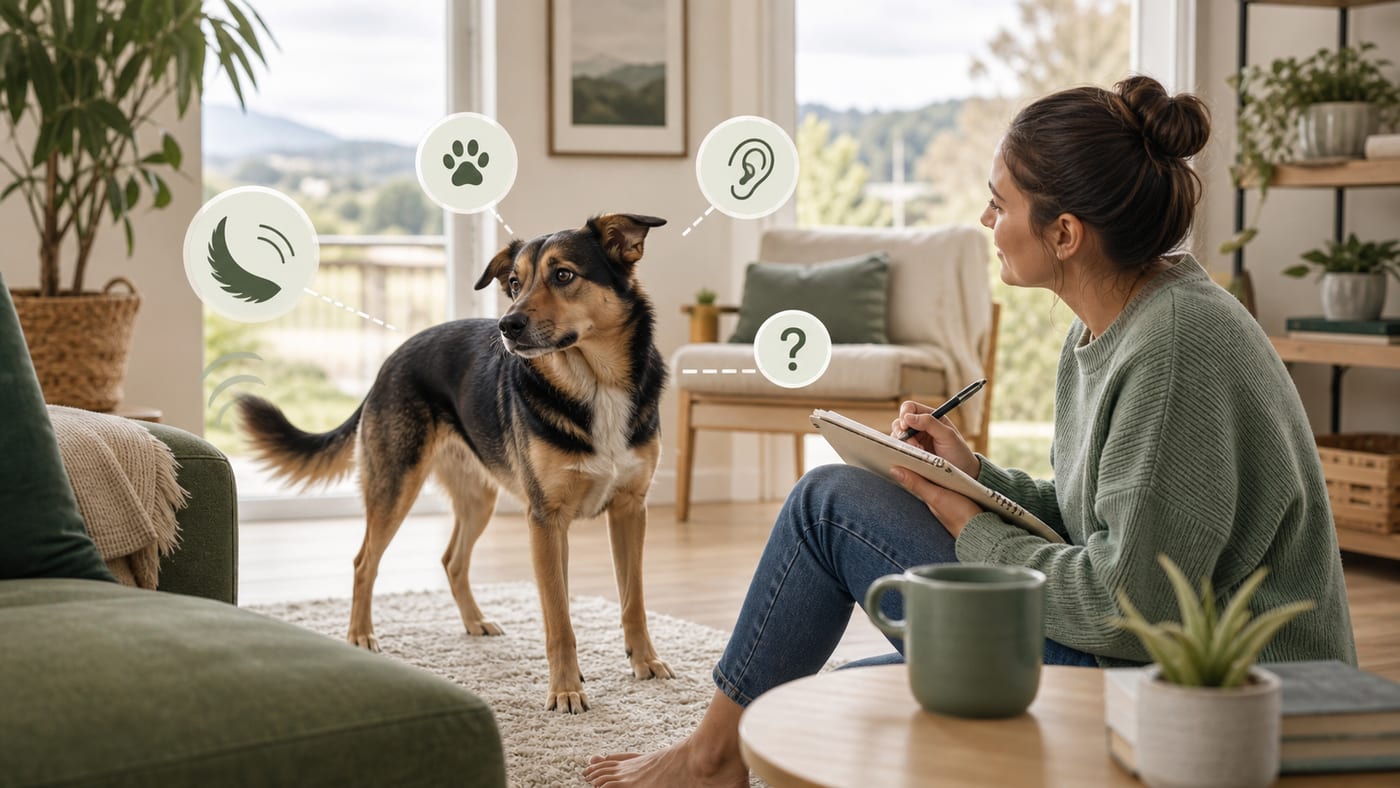
A dog's tail tells you a lot — but it's not as simple as "wagging equals happy." A loose, sweeping wag at mid-height usually signals relaxed friendliness. A high, stiff tail with rapid flicks can mean arousal, alertness, or even tension. A tail tucked between the legs suggests fear or submission, while a low, slow wag can mean uncertainty. Always read tail position alongside the rest of the body — never on its own.
Ears
Ears that sit in their natural relaxed position usually indicate a calm dog. Ears pinned flat back against the skull are a strong signal of fear, appeasement, or stress. Ears that swivel forward and stiffen suggest focused alertness — which can tip into reactivity if the trigger isn't managed. Floppy-eared breeds (like spaniels) show smaller movements, so watch the base of the ear, not the tip.
Posture & Weight Shift
A loose, wiggly body with weight evenly balanced is a sign of comfort. Weight shifted forward with a tall, stiff stance can signal alertness or confrontation. Weight shifted back with a low crouch typically means fear or appeasement. Raised hackles (piloerection) don't always mean aggression — they signal high arousal, which could be fear, excitement, or threat.
Mouth & Facial Signals
A relaxed open mouth (sometimes called a "doggy smile") usually means the dog is comfortable. Repeated lip-licking, yawning when not tired, or "whale eye" (whites of the eyes showing) are classic stress signals in dogs. A tightly closed mouth with tense jaw muscles often appears just before a more obvious reaction — and is your cue to intervene before things escalate.
Vocalisations
Barking, whining, growling, and howling all carry different meanings depending on context. A growl is communication — usually a warning to back off — and should never be punished, because suppressing it leads to dogs who bite without warning. Repetitive whining can signal anxiety, frustration, or a learned attention-seeking pattern. Sudden silence in a normally vocal dog is also worth noting.
Calming Signals
Trained behaviourists watch for "calming signals" — small actions dogs use to defuse tension in themselves or others. These include turning the head away, sniffing the ground for no obvious reason, slow blinking, shaking off as if wet (when dry), and curving their body when approaching another dog. If your dog is showing several of these, it's a sign they're feeling pressured and would appreciate more space.
Common Reasons Dogs Behave Differently
Separation-Related Stress
When dogs become distressed during or shortly after their owner leaves, behaviours like howling, destructive chewing, indoor toileting, or self-harm can appear. Mild forms are common and trainable; severe forms benefit from professional support.
Generalised Anxiety
Some dogs show low-grade tension across many situations — restless pacing, lip-licking, panting without exertion. Causes can include genetics, early-life stress, pain, or a mismatch between lifestyle and breed needs.
Noise & Storm Phobia
Thunder, fireworks, or sudden loud noises can trigger intense fear in dogs. In New Zealand, Guy Fawkes season (early November) and New Year are peak triggers. Signs include hiding, shaking, panting, drooling, and trying to escape.
Boredom & Under-Stimulation
Dogs who aren't getting enough mental or physical exercise often invent their own entertainment — chewing furniture, digging, excessive barking, or pestering owners. This is especially common in working breeds living in small spaces.
Fear of Strangers or Other Dogs
Some dogs were under-socialised as puppies, or had a negative experience that shaped how they respond to unfamiliar people or dogs. Signs include freezing, retreating, lunging, or barking — all driven by fear, not "dominance."
Resource Guarding
When a dog stiffens, growls, or snaps around food, toys, beds, or even people, they're communicating that they feel a valuable resource is at risk. This is normal canine behaviour but should be addressed carefully — never punished — and may need a qualified behaviourist.
Puppy Settling & Teething
Young puppies cry at night, chew everything in sight, and have wild energy bursts. Most of this is normal developmental behaviour that resolves with consistent routine, appropriate chew outlets, and patience.
Senior Dog Changes
Older dogs sometimes develop new behaviours — staring at walls, forgetting routines, becoming restless at night, or seeming "lost." This can indicate canine cognitive dysfunction or underlying medical issues, and warrants a vet check.
When to Skip the Decoder and Call a Vet
The Dog Behaviour Decoder is for understanding behaviour patterns — not for medical emergencies. Contact a vet immediately if your dog shows:
- Difficulty breathing, blue or pale gums
- Collapse, inability to stand, or seizures
- Suspected poisoning (chocolate, grapes, xylitol, rat bait, medications, garden plants)
- Severe bleeding or visible serious injury
- Repeated vomiting or diarrhoea lasting more than 24 hours
- A bloated, hard abdomen — especially in large breeds
- Sudden severe behaviour change (aggression appearing from nowhere, extreme lethargy, disorientation)
- Refusal to eat or drink for more than 24 hours
If you can't reach your usual vet, find your nearest after-hours emergency veterinary clinic via the New Zealand Veterinary Association emergency guidance.
Find emergency vet guidance — NZVAFrequently Asked Questions
Is the Dog Behaviour Decoder a vet diagnosis?
No. It is general guidance based on the behaviour clues you describe. It does not replace veterinary advice. If your dog's signs are sudden, severe, or worsening, contact a registered NZ vet.
How accurate is it?
The decoder works by matching your inputs against well-established patterns in dog behaviour research. It's a starting point for understanding, not a definitive answer. Every dog is an individual, and complex cases often need a vet or behaviourist to assess in person.
Does it use AI to translate my dog's voice?
No. We don't analyse audio, video, or your dog's voice. The tool only uses the answers you give about what you observe. We deliberately avoid claims about translating animal language.
Why is my dog suddenly hiding?
Sudden hiding can signal fear, pain, illness, or response to an environmental change (loud noise, new visitor, schedule shift). If there's no obvious trigger and it persists more than a day or two, a vet check is worthwhile. The decoder can help narrow likely causes.
Why is my dog shaking but isn't cold?
Shaking unrelated to temperature can mean stress, fear, pain, excitement, or sometimes early signs of medical issues (especially in older or small dogs). If shaking is new, frequent, or paired with other symptoms, contact a vet.
Is yawning a sign of stress in dogs?
It can be. Yawning in a relaxed, sleepy context is normal. Repeated yawning during interactions (with strangers, other dogs, at the vet, during training) is a recognised stress signal, often paired with lip-licking or turning away.
My dog growls — should I punish it?
No. A growl is communication — your dog telling you it feels uncomfortable. Punishing growls teaches dogs to skip the warning and bite without it. Instead, work out what's causing the discomfort and manage the situation. Persistent growling around resources, handling, or other situations is a sign to consult a qualified behaviourist.
How long does separation anxiety take to improve?
Mild separation-related behaviours often improve within 4–8 weeks of consistent management. Severe cases can take months and may need help from a vet behaviourist. The decoder can help you tell mild from severe, but it can't replace a professional assessment.
Is my dog scared of fireworks normal?
Yes — noise phobia is extremely common in New Zealand dogs, particularly during Guy Fawkes and New Year. Mild signs (hiding, panting) are common. Severe panic (trying to escape, breaking through fencing, refusing to eat for a day after) is serious and worth discussing with your vet ahead of the next noise event.
What's the difference between a behaviour issue and a medical issue?
This is often hard to tell from home. A few clues that something may be medical: the behaviour change is sudden, your dog seems in pain (yelping, reluctance to move, hunched back), there are body changes (appetite, weight, toileting, energy), or the dog is older. When in doubt, vet first, trainer second.
Can puppies show behaviour problems?
Puppies show developmental behaviours — biting, crying, fear periods, toileting accidents, intense bursts of energy. Most are normal and resolve with consistent guidance. Some puppies develop genuine anxiety or fear issues that benefit from early intervention. Our New Puppy Checklist NZ guide is a good companion to the decoder.
My senior dog is acting confused — what's happening?
Senior dogs (typically 8+ years) can develop canine cognitive dysfunction, similar to dementia in humans. Signs include disorientation, altered sleep patterns, forgetting trained behaviours, and changes in interaction. Many medical conditions (vision/hearing loss, pain, thyroid issues) mimic this. A vet check is the right first step.
Why is my dog barking so much?
Dogs bark for many reasons — alert, fear, frustration, boredom, seeking attention, or genetic predisposition (some breeds are bred to bark). The decoder can help identify which type. Punishment-based "no-bark" devices often increase stress without solving the cause.
Is the decoder free?
Yes. It's a free tool, no signup required, and we don't store your dog's name or any personal information. We do save anonymous answers to improve the tool — see our privacy notes.
Where can I get more help?
For medical concerns, contact your NZ vet. For behaviour and training, look for a qualified force-free trainer or vet behaviourist. The Knowledge Hub guides linked from each decoder result expand on most common issues.
Does PetMall sell medication for my dog?
No. PetMall is a New Zealand pet supply retailer — we don't operate as a vet clinic, we don't provide veterinary services, and we don't sell prescription or non-prescription medications. Products you'll see suggested by the decoder are things like toys, beds, training treats, food, and non-medicated calming aids (herbal supplements, calming beds, lick mats). For anything medical — including pain relief, anti-anxiety medication, supplements that require a vet's recommendation, or flea/worm prescriptions beyond basic OTC — please consult a registered NZ vet.
My dog seems in pain — what should I do?
If your dog seems to be in pain — yelping, reluctance to move, hunched posture, sudden aggression when touched — this is a vet matter, not a tool one. Do not give your dog any human medications; many common ones (paracetamol, ibuprofen, aspirin) are dangerous or fatal to dogs. Phone your vet or after-hours clinic for advice.