Indoor Cat Enrichment NZ: Preventing Boredom, Stress & Behavioural Issues
With cat curfews expanding across NZ, more cats are indoors. Learn cat trees, window perches, foraging toys, and play routines.
Kia ora, fellow Kiwi cat lovers! Bringing a cat into your home is a joy, and for many of us, that means providing a safe, comfortable indoor life. While keeping our feline friends indoors protects them from traffic, fights, and diseases, and safeguards our precious native wildlife, it also places a significant responsibility on us to ensure their mental and physical well-being. An indoor cat in Aotearoa thrives when their environment is rich with opportunities to express natural behaviours – hunting, climbing, exploring, and resting.
Without adequate enrichment, indoor cats can quickly become bored, stressed, and develop a range of behavioural issues that are frustrating for both cat and owner. This comprehensive guide from wiki.petmall.co.nz is designed to help you create a stimulating and happy home for your indoor feline companion, drawing on practical advice tailored for New Zealand pet owners.
NZ Cat Curfews & Indoor Life: A Growing Trend
The conversation around responsible cat ownership in Aotearoa is evolving, with a growing emphasis on managing feline impact on our unique biodiversity. Many local councils, such as Auckland Council and Wellington City Council, are increasingly promoting or even implementing measures like cat management bylaws and advocating for responsible ownership, which often includes keeping cats contained, especially at night. Organisations like the SPCA and the NZ Veterinary Association (NZVA) also champion the benefits of keeping cats indoors or in secure outdoor enclosures for their safety and the protection of native birds, lizards, and insects.
This means that for many Kiwi cat owners, embracing an indoor lifestyle for our pets isn't just a choice, but a response to community expectations and a commitment to our environment. However, this indoor life requires us to be proactive in meeting all of our cat's needs. A well-enriched indoor environment is crucial for preventing boredom, reducing stress, and avoiding common behavioural problems like destructive scratching, aggression, excessive vocalisation, or inappropriate urination – issues that can unfortunately lead to cats being surrendered to shelters.
By understanding and implementing the principles of indoor cat enrichment, you're not just providing a home; you're creating a stimulating sanctuary that allows your cat to thrive physically and psychologically. Let's dive into how you can make your home a feline paradise.
Vertical Space: The Cat's Eye View
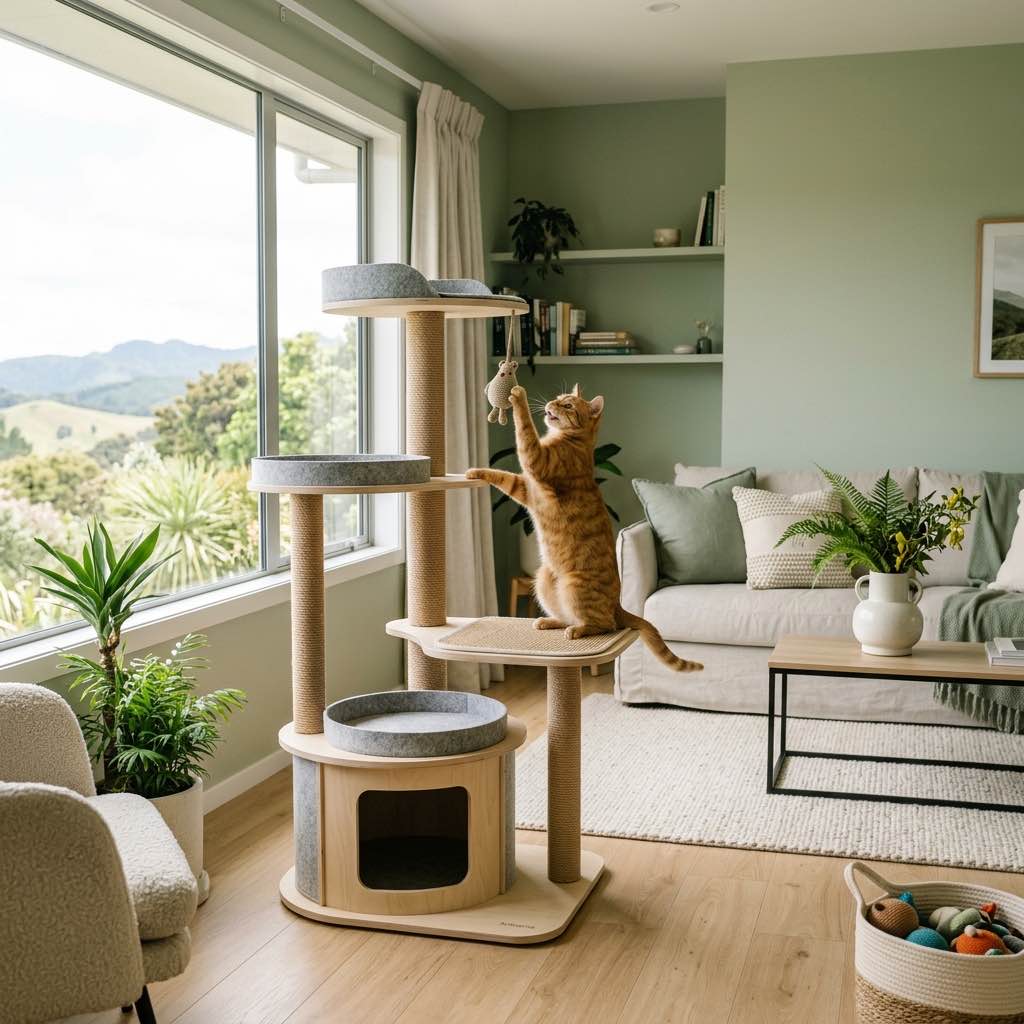
Imagine living in a flat, two-dimensional world. That's often how a home can feel to a cat if it lacks vertical dimensions. Cats are natural climbers and observers; they feel safest and most secure when they have access to elevated perches where they can survey their territory, escape from household hustle and bustle, or simply enjoy a quiet nap. Providing vertical space is one of the most fundamental aspects of indoor cat enrichment.
Why is vertical space so important?
- Security: High places offer a sense of safety from perceived threats (like children, other pets, or even the vacuum cleaner).
- Observation: Cats love to watch the world go by. A high perch gives them a prime viewing spot.
- Exercise: Climbing and jumping are excellent forms of physical activity, helping to maintain a healthy weight and strong muscles.
- Territory Management: In multi-cat households, vertical space helps define individual territories, reducing conflict by allowing cats to avoid each other without feeling trapped.
- Rest & Relaxation: Many cats prefer to sleep in elevated, secluded spots.
How to create vertical opportunities:
- Cat Trees & Condos: These are the superstars of vertical enrichment. Available in various sizes, from compact scratching posts with a single perch to multi-level complexes with tunnels and hammocks. Look for sturdy options with sisal scratching surfaces.
- Cost in NZD (2026): Small posts with a perch: $40 - $100. Medium multi-level trees: $150 - $400. Large, elaborate cat towers: $500 - $1,500+.
- Wall-Mounted Shelves & Perches: If floor space is limited, or you want to create a true cat superhighway, wall-mounted shelves are fantastic. These can be arranged in a staircase pattern, leading to a high perch or a cosy bed. Ensure they are securely mounted into wall studs.
- Cost in NZD (2026): Individual shelves/perches: $30 - $100 each. Full kits: $200 - $800+.
- Window Perches: A simple window perch can provide hours of entertainment, allowing your cat to watch birds, people, and the changing weather outside. These can be suction-cupped to windows or attached to window sills.
- Cost in NZD (2026): Suction-cup perches: $25 - $70. Sturdier, mounted perches: $60 - $150.
- Furniture Integration: Don't underestimate existing furniture! Clear off the top of a bookcase, wardrobe, or dresser to create a designated cat zone. Add a soft blanket or a small cat bed to make it inviting. Always ensure the furniture is stable and won't tip over.
When setting up vertical spaces, consider your cat's age and agility. Kittens and senior cats may need easier access with more gradual ramps or lower perches. For all cats, ensure the surfaces are non-slip and that there's a safe way up and down.
Foraging & Puzzle Feeders: Engaging Their Inner Hunter
In the wild, cats spend a significant portion of their day hunting for food. This natural predatory behaviour involves stalking, pouncing, problem-solving, and eating small, frequent meals. When we simply put a bowl of food down twice a day, we strip away these crucial mental and physical challenges, leading to boredom and potentially overeating.
Foraging and puzzle feeders are brilliant tools to mimic this natural hunting behaviour, transforming mealtime into an enriching activity. They encourage cats to "work" for their food, slowing down eating, stimulating their minds, and providing a sense of accomplishment.
Benefits of Foraging & Puzzle Feeders:
- Mental Stimulation: Engages problem-solving skills, preventing boredom.
- Slower Eating: Helps prevent indigestion, vomiting, and reduces the risk of obesity.
- Physical Activity: Encourages movement and interaction with the feeder.
- Reduced Stress: Provides an outlet for natural instincts, which can reduce anxiety.
- Behavioural Improvement: Can help redirect destructive behaviours by channelling energy into appropriate activities.
Types of Foraging & Puzzle Feeders:
- Slow Feeder Bowls: These bowls have internal ridges, mazes, or pillars that force your cat to eat around obstacles, slowing down their intake. Great for wet or dry food.
- Cost in NZD (2026): $20 - $60.
- Puzzle Feeder Toys: These toys require your cat to manipulate them (bat, roll, push) to release kibble. They come in various difficulty levels. Examples include treat balls, wobble feeders, or interactive boards with hidden compartments.
- Cost in NZD (2026): $15 - $70 for individual toys.
- Snuffle Mats: Made from fabric strips, these mats hide dry kibble or treats within their folds, encouraging your cat to sniff and forage. Excellent for engaging their sense of smell.
- Cost in NZD (2026): $30 - $80.
- DIY Foraging: You don't always need to buy something!
- Muffin Tins: Place a few pieces of kibble in each cup of a muffin tin. For an extra challenge, place a small toy ball on top of some of the kibble, forcing your cat to move it.
- Cardboard Boxes: Cut holes in a cardboard box, put kibble inside, and let your cat figure out how to get it out.
- Scattered Kibble: Simply scatter a portion of their daily kibble ration around the house, hiding it in different spots (on cat trees, under rugs, in safe corners). This encourages extensive searching.
Introducing Puzzle Feeders: Start with easy puzzles and gradually increase the difficulty. If your cat is used to eating from a bowl, they might initially ignore a puzzle feeder. Be patient! Show them how it works, perhaps by placing a few treats in an easy-to-access spot on the feeder. Never let your cat go hungry because they can't figure out a puzzle. If they're struggling, offer a small portion in their regular bowl as a backup.
Remember to clean all feeders regularly to maintain hygiene. Explore the range of Bowls & Enrichment Feeders available at PetMall to find the perfect option for your feline hunter.
Window Entertainment: The World Outside
For an indoor cat, a window is like their personal cinema, offering endless entertainment and a vital connection to the outside world. Providing safe and comfortable access to a window view is an easy yet highly effective form of enrichment.
Maximising Window Views:
- Comfortable Perches: As mentioned in the vertical space section, a window perch is ideal. Ensure it's stable and provides a soft surface for lounging. A cat bed positioned on a window sill can also work wonders.
- Bird Feeders: Place a bird feeder outside a window, far enough away that your cat can't reach it, but close enough for a clear view. Watching tūī, fantails, and sparrows can provide hours of stimulating "cat TV." Just ensure the feeder is clean and well-maintained.
- Squirrel/Lizard Watching: Depending on your location in NZ, your cat might enjoy watching skinks, geckos, or even the occasional squirrel (in areas where they exist).
- "Cat TV" Videos: If you don't have a good outdoor view, or as an occasional supplement, you can play "cat TV" videos on a screen. Many cats are captivated by videos of birds, fish, or small animals.
- Sunbeams: Cats are sun-worshippers! Ensure there's a spot where they can comfortably bask in a sunbeam. This provides warmth and a sense of well-being.
Safety Considerations:
- Screens: Always ensure windows have secure, well-maintained screens if you open them. A cat can easily fall or escape through an open, unscreened window.
- Blinds & Cords: Be mindful of dangling blind cords, which can be a strangulation hazard. Secure them out of reach.
- Temperature: Ensure your cat isn't exposed to extreme temperatures, either too hot from direct sun without shade or too cold from drafts.
A simple window perch, perhaps with a view of a native garden attracting local birds, can significantly enhance your indoor cat's quality of life.
Play Sessions: The Heart of Enrichment
Play is not just fun; it's essential for a cat's physical and mental health. It's how they express their natural hunting instincts, burn energy, reduce stress, and bond with you. Regular, interactive play sessions are non-negotiable for an indoor cat.
The Importance of Interactive Play:
- Mimics Hunting: Interactive play allows your cat to stalk, chase, pounce, and "kill" prey, fulfilling their predatory drive in a safe and appropriate way.
- Physical Exercise: Helps maintain a healthy weight, muscle tone, and cardiovascular health.
- Mental Stimulation: Requires focus, strategy, and problem-solving.
- Reduces Stress & Boredom: Provides an outlet for pent-up energy, reducing destructive behaviours.
- Strengthens Bond: Playing together is a fantastic way to build trust and deepen your relationship with your cat.
Types of Toys & Play Styles:
- Wand Toys (Feather Wands, Teasers): These are arguably the best interactive toys. The long wand allows you to mimic the erratic movements of prey (birds, mice) from a safe distance. Let your cat chase, pounce, and "catch" the toy. Always let them "win" at the end of a session to satisfy their hunting drive.
- Cost in NZD (2026): $10 - $40.
- Chase Toys (Balls, Mice, Springs): Small, lightweight toys that your cat can bat around, chase, and carry. Look for different textures and materials.
- Cost in NZD (2026): $5 - $25 for multi-packs.
- Puzzle Toys (Dispensing Toys): As mentioned in the foraging section, these combine play with food rewards.
- Laser Pointers (Use with Caution): Laser pointers can be highly stimulating, but they must be used correctly. A common mistake is not giving the cat a "kill." Always end a laser pointer session by immediately directing the laser onto a physical toy (like a wand toy or a treat) that your cat can pounce on and "catch." This prevents frustration from never being able to physically capture their "prey."
- Cost in NZD (2026): $10 - $30.
- Catnip Toys: For cats that respond to catnip, these can be great for solo play or to encourage interaction.
- Cost in NZD (2026): $5 - $20.
- Crinkle Balls & Noise-Making Toys: The sound can be very enticing for some cats, mimicking the rustle of prey.
Establishing a Play Routine:
- Frequency: Aim for at least two to three interactive play sessions per day, each lasting 10-15 minutes.
- Timing: Cats are crepuscular, meaning they are most active at dawn and dusk. Schedule play sessions around these times for maximum engagement.
- Rotate Toys: Keep a stash of toys and rotate them every few days or weeks. This keeps things fresh and prevents boredom.
- "The Kill": Always end a play session by allowing your cat to "catch" the toy and give it a good chew/kick. This satisfies their hunting sequence.
- Put Toys Away: Don't leave wand toys or string toys out when you're not supervising, as they can be a choking or entanglement hazard.
Remember, you are your cat's primary playmate! Invest in a variety of Cat Toys from PetMall to keep things exciting.
Multi-Cat Households: Harmony in Numbers
Many Kiwi households have more than one cat, which can bring double the purrs and cuddles. However, multi-cat homes also present unique challenges for enrichment. While cats are often portrayed as solitary, they can form complex social bonds, but they also have individual needs and preferences that must be respected. Overcrowding or competition for resources can quickly lead to stress, conflict, and behavioural issues.
Key Principles for Multi-Cat Enrichment:
- Abundant Resources: The golden rule for multi-cat households is to provide more resources than the number of cats you have (N+1 rule). This minimises competition and allows cats to choose their preferred spot without conflict.
| Resource Type | Ideal Provision (for N cats) | Why it Matters |
|---|---|---|
| Litter Boxes | N+1 (minimum) | Prevents inappropriate elimination, reduces stress over territory and cleanliness. |
| Food Bowls | N+1 (minimum) | Allows individual, unhursted eating, prevents resource guarding. |
| Water Bowls | N+1 (minimum) | Ensures all cats have access, especially if one guards a specific spot. |
| Sleeping Spots/Beds | N+1 (minimum) | Provides choice, privacy, and personal space for rest. |
| Scratching Posts/Pads | N+1 (minimum) | Offers multiple appropriate outlets for scratching, protecting furniture. |
| Vertical Spaces | Multiple options | Allows cats to escape, observe, and define individual territories. |
| Hideaways/Safe Spots | N+1 (minimum) | Crucial for shy or stressed cats to retreat and feel secure. |
- Separate Feeding Stations: If possible, feed cats in separate rooms or at least at a distance from each other to prevent one cat from bullying or stealing food from another. Puzzle feeders can also help manage individual meal times.
- Individual Playtime: While some cats enjoy playing together, ensure each cat gets individual, one-on-one interactive play sessions with you. This strengthens your bond with each cat and ensures their unique play preferences are met.
- Vertical & Horizontal Territory: Maximise both vertical and horizontal space. Provide multiple cat trees, shelves, and window perches. Horizontally, ensure there are clear pathways and multiple routes to access resources, so one cat doesn't block another.
- Scent Management: Cats communicate heavily through scent. Avoid excessive cleaning that removes all their scent marks, but do keep litter boxes and bedding clean. Consider Feliway diffusers (a synthetic feline facial pheromone) if stress or conflict is an issue, after consulting with your vet.
- Monitor Dynamics: Pay close attention to how your cats interact. Look for subtle signs of tension: one cat blocking another, prolonged staring, hissing, growling, or one cat constantly hiding. If you notice persistent conflict or bullying, consult your vet or an animal behaviourist (many NZ vets can recommend one).
Creating a harmonious multi-cat home requires thoughtful planning and ongoing observation. By providing ample resources and respecting individual needs, you can foster a peaceful and enriching environment for all your feline whānau. Ensure you have enough Cat Beds & Houses and Cat Toys to go around.
Signs of Boredom or Stress: What to Look For
Cats are masters at hiding discomfort, a survival instinct from their wild ancestors. However, prolonged boredom or stress will eventually manifest in behavioural or physical changes. Recognising these signs early is crucial for intervening and improving your cat's well-being. If you notice any of these symptoms, especially if they are sudden or severe, always consult your vet first to rule out any underlying medical conditions. Your vet can provide tailored advice and ensure there isn't a physical cause for the behaviour.
Common Signs of Boredom:
- Destructive Behaviour: Scratching furniture excessively (beyond normal marking), chewing on inappropriate items, knocking things over.
- Excessive Vocalisation: Meowing, crying, or howling more than usual, often at night, seeking attention or expressing frustration.
- Overeating/Obesity: Eating out of boredom, leading to weight gain.
- Lethargy/Apathy: Lack of interest in play, interaction, or their surroundings. Spending most of the day sleeping or just lying around.
- "Zoomies" at Inappropriate Times: Sudden bursts of frantic energy, often at night, indicating pent-up energy that wasn't expended during the day.
- Pestering Behaviours: Constantly seeking attention, following you around, or swatting at you for interaction.
Common Signs of Stress:
- Inappropriate Urination/Defecation: Urinating or defecating outside the litter box. This is one of the most common signs of stress and should always prompt a vet visit.
- Excessive Grooming (Over-grooming/Barbering): Licking, chewing, or pulling out fur to the point of bald patches or skin irritation. This is a self-soothing behaviour.
- Aggression: Towards other pets, people, or even inanimate objects. This can be redirected aggression due to frustration or feeling threatened.
- Hiding/Withdrawal: Spending more time hidden, avoiding interaction, or becoming less accessible.
- Changes in Appetite: Eating significantly more or less than usual.
- Changes in Sleep Patterns: Sleeping more or less, or sleeping in unusual locations.
- Increased Vigilance: Appearing jumpy, easily startled, or constantly scanning their surroundings.
- Spraying: Marking territory with urine, often on vertical surfaces.
- Diarrhoea/Vomiting: While often medical, persistent digestive upset can sometimes be stress-related.
- Piloerection: Raised fur (especially along the spine or tail) indicating fear or arousal.
If your cat exhibits any of these signs, especially behavioural changes, it's a clear signal that something isn't right. After consulting with your vet to rule out medical issues, revisit your enrichment strategy. Are they getting enough play? Is their environment stimulating enough? Are there enough resources in a multi-cat home? Is there a new stressor in their environment (e.g., a new pet, a change in routine, construction noise)? Addressing the root cause is key to helping your cat feel safe and happy again.
Catios in NZ: Safe Outdoor Adventures
For many Kiwi cat owners, the desire to give their indoor cats a taste of the outdoors without the risks to the cat or native wildlife is strong. This is where catios come in! A "catio" (cat patio) is an enclosed outdoor space, typically attached to a house, that allows cats to safely experience fresh air, sunshine, and sensory stimulation while remaining contained.
Why Consider a Catio in Aotearoa?
- Safety for Your Cat: Protects your cat from traffic accidents, fights with other animals, exposure to diseases, and getting lost.
- Protection for Wildlife: Prevents your cat from hunting native birds (like tūī, fantails, kererū), lizards, and insects, aligning with NZ's conservation values.
- Enrichment: Provides sensory stimulation (sights, sounds, smells of nature), fresh air, and sunlight that an indoor-only environment can't fully replicate.
- Exercise: Encourages climbing, exploring, and moving in a larger space.
- Reduced Boredom & Stress: A great way to alleviate cabin fever and provide a stimulating change of scenery.
Types of Catios:
- Window Box Catios: Small enclosures that fit directly into a window opening, providing a secure perch for your cat to sit and watch the world.
- Cost in NZD (2026): DIY materials: $100 - $300. Pre-made kits: $300 - $800.
- Modular Kits: Pre-fabricated panels or kits that you can assemble yourself to create a larger enclosure on your deck, patio, or lawn. These often come with shelves and ramps.
- Cost in NZD (2026): Small kits: $500 - $1,500. Larger, multi-panel kits: $1,500 - $4,000+.
- Custom-Built Catios: For a more integrated and personalised solution, you can hire a builder or construct a custom catio. These can range from simple screened-in porches to elaborate multi-level structures with tunnels connecting to different parts of the house.
- Cost in NZD (2026): Materials for DIY: $500 - $2,000+. Professional build: $2,000 - $10,000+, depending on size and complexity.
Key Considerations for Your NZ Catio:
- Location: Choose a spot that gets some sun and some shade throughout the day. Consider proximity to a window or door for easy cat access.
- Materials: Use sturdy, weather-resistant materials like treated timber, galvanised mesh (ensure holes are small enough to prevent escape and keep out predators), and a durable roof.
- Enrichment Inside: Don't forget to enrich the catio itself! Add shelves, perches, scratching posts, potted cat-safe plants (like catnip or wheatgrass), and a comfy bed or hideaway.
- Security: Ensure the catio is fully enclosed and escape-proof, with secure latches on any doors. The mesh should be strong enough to deter predators and prevent your cat from chewing through.
- Council Regulations: For larger, permanent catios that are attached to your house, you might need to check with your local council (e.g., Auckland Council, Christchurch City Council) regarding building permits or specific bylaws. Smaller, freestanding catios generally don't require permits, but it's always wise to check if you're unsure. The NZVA also advocates for safe cat containment, and your vet can offer advice on local resources or best practices.
- Water & Shelter: Always provide fresh water and ensure there's adequate shelter from rain, wind, and strong sun.
A catio is an investment in your cat's happiness and safety, offering the best of both worlds – the security of indoors with the stimulation of the outdoors. It's a fantastic way to enhance the life of your indoor Kiwi cat.
Sources
- SPCA New Zealand, Position Statement and Tips on Keeping Cats Safe at Home, checked 2026-07-21: https://www.spca.nz/advocacy/position-statements/article/keeping-cats-safe-at-home
- Auckland Council, Responsible Ownership and Rules for Keeping Cats in Auckland, checked 2026-07-21: https://www.aucklandcouncil.govt.nz/en/dogs-animals/keeping-other-animals/keeping-cats.html
Shop Related Products at PetMall
Looking for the products mentioned in this guide? PetMall ships across New Zealand with fast delivery.
Free PetMall tools
Related guides
petmall.co.nz
Shop at PetMall
The products below are practical support items for your pet. PetMall ships across New Zealand.
- Cat ToysA small rotation of toys (feather wand, puzzle feeder, and comfort toy) usually works better than buying many at once.
- Cat FoodStart with food that matches your cat's life stage — change brands slowly over 7–10 days to avoid digestive upset.
- Cat LitterClumping or crystal, most cats prefer an unscented litter and a clean tray — one tray per cat plus one spare is the NZ rule of thumb.
- Cat TreatsGreat for bonding and training — keep treats under 10% of daily calories to protect your cat's waistline.
- Cat GroomingRegular brushing cuts hairballs and shedding — essential for long-haired breeds like Ragdolls and British Longhairs.
- Flea & Worm TreatmentFor NZ conditions, choose protection that fits your cat's weight and lifestyle (indoor vs outdoor) and keep it regular.