Introducing Cats NZ: A Calm Cat-to-Cat Plan for Kiwi Homes
Introducing cats NZ guide: safe room setup, scent swapping, door feeding, visual meetings, supervised contact and when to pause.
Introducing cats in NZ works best when you go slowly: separate first, swap scents, feed on opposite sides of a door, add short visual meetings, then supervise brief shared time. Do not put two unfamiliar cats together and hope they sort it out. Cats rely heavily on territory and scent, so rushing the first week can create months of tension.
The quick answer
Give the new cat their own safe room with litter, food, water, bed, scratching post and hiding spot. Keep resident cats away at first. After the new cat settles, swap bedding or cloths so each cat smells the other. Feed on opposite sides of a closed door. When both cats stay calm, use a baby gate, cracked door or carrier barrier for short visual sessions. Only allow face-to-face time when body language stays soft.
SPCA New Zealand's new-cat advice says to start a new cat or kitten in one room for 2-3 days and to introduce resident cats slowly. It also notes that acceptance can take weeks or months.
Set up the new cat room
Before pickup day, choose a safe room. In many Kiwi homes that might be a spare bedroom, office, laundry, warm bathroom, sleepout room, or quiet corner of a townhouse. The room should be secure, easy to clean and not the resident cat's favourite sleeping room.
Add:
- Litter tray.
- Food and water bowls, away from the litter.
- Bed or blanket.
- Hiding spot.
- Scratching post.
- Toys.
- Towel or blanket for scent swapping.
- A way to block the door safely.
Budget in NZD for duplicate basics. For introductions, "one of everything" is usually not enough. You may need an extra tray, bowls, scratching surface, toys and bedding so neither cat has to compete.
First 48 hours: no meetings
When the new cat arrives, go straight to the safe room and open the carrier there. Do not open the carrier in the car or living room. SPCA New Zealand warns that cats can be scared and unpredictable during the journey and should be opened inside the new room.
Let the new cat hide. Sit quietly, talk softly and avoid crowding them. If children are excited, set the rule early: quiet visits, one or two people at a time, and no reaching into hiding spots.
Keep the resident cat's routine steady. Feed them, play with them and give attention as normal so the newcomer does not predict a sudden loss of everything familiar.
Stage 1: scent swapping
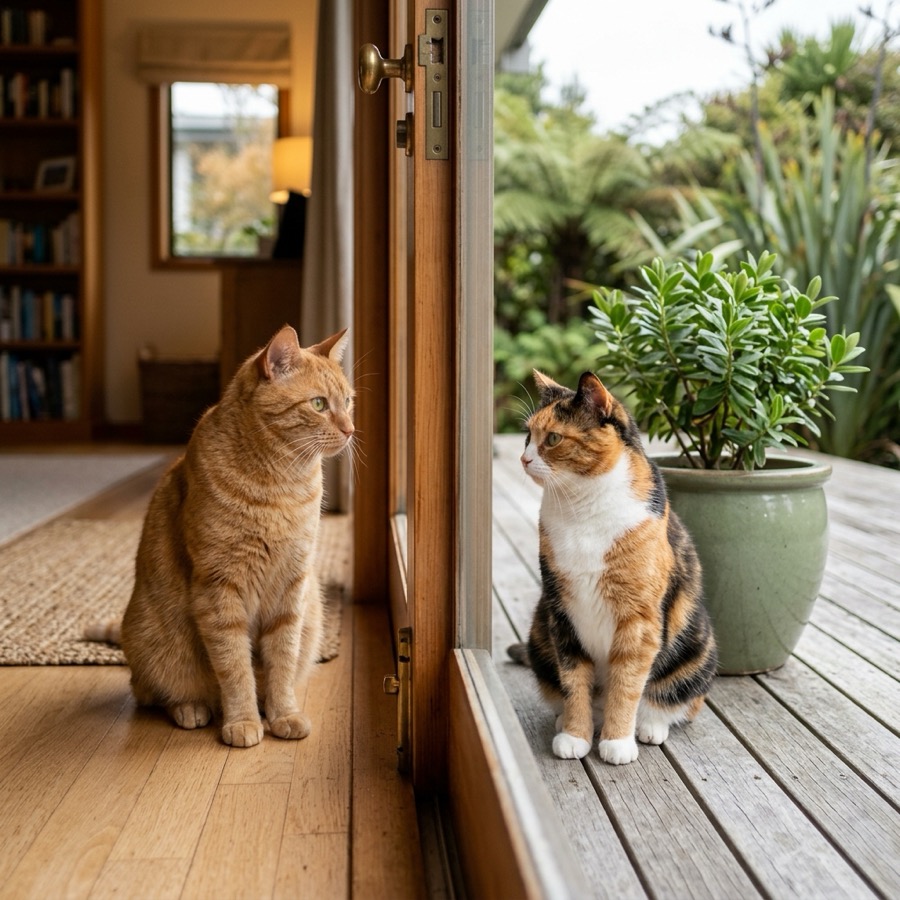
Cats learn through scent before sight. Swap bedding, towels or soft cloths between rooms. Place the scented item near food or play only if the cat remains relaxed. If a cat hisses, retreats or stops eating, move the item farther away and slow down.
Cats Protection and RSPCA both recommend scent-swapping as an early step. The goal is not instant friendship. The goal is "this smell appears and nothing bad happens".
You can also swap rooms briefly: let the new cat explore a hallway or lounge while the resident cat is safely in the new cat's room. This lets each cat investigate scent without a face-to-face meeting.
Stage 2: feed near the door
Feed both cats on opposite sides of the closed door. Start far enough away that both cats eat calmly. Over several meals, move bowls closer to the door.
If either cat refuses food, growls, charges the door, or stares hard, the bowls are too close. Move them back. Calm eating matters more than speed.
In apartments and small NZ rentals, you may not have many spare rooms. Use what you have: a bathroom door, bedroom door, laundry door, baby gate covered with a towel, or a hallway barrier. Safety and calm are more important than having a perfect house layout.
Stage 3: short visual contact
When both cats can eat near the door calmly, add controlled visual contact. Use a baby gate, screen door, cracked door with a stopper, or a carrier barrier. Keep sessions short: 10-30 seconds at first.
Look for soft body language:
- Ears neutral.
- Blinking or looking away.
- Tail relaxed.
- Eating or playing.
- Sniffing then moving on.
- No stalking, charging or freezing.
End while things are still calm. If one cat hisses once and backs away, pause and reset. If there is chasing, swatting through the barrier, hard staring, growling or blocking the other cat, go back to scent and door feeding.
Stage 4: supervised shared time
Start with a few minutes in a room with multiple exits, high places and no dead-end corners. Keep toys and treats handy, but do not force the cats close together.
Good first shared sessions:
- Two humans, one per cat.
- Separate treat stations.
- Wand play at opposite ends of the room.
- A clear path back to the safe room.
- No food bowls close together.
- No cat flap bottlenecks.
Do not leave the cats alone together until they have had many calm sessions. Some cats tolerate each other in a week. Others need months. That is normal.
How to tell it is going well
Progress can look boring:
- Eating normally.
- Grooming after seeing the other cat.
- Resting in the same room at a distance.
- Sniffing and walking away.
- Brief play without pursuit.
- Sharing a sun spot at different times.
Do not require cuddling. Many successful multi-cat homes are peaceful because each cat has space, not because they become best friends.
When to pause
Pause or step back if you see:
- Chasing that one cat cannot escape.
- Repeated blocking of doorways, trays or food.
- Fur flying.
- One cat hiding for long periods.
- Toileting outside the tray.
- Refusing food.
- Growling or hard staring that escalates.
Use the Cat Behaviour Decoder to map the pattern, and ask your vet or a qualified cat behaviour professional if conflict escalates or either cat stops eating.
NZ indoor-cat considerations
SPCA New Zealand supports keeping cats safe and happy at home. If your cats are indoor-only, introductions matter even more because neither cat can create outdoor distance. Add vertical space, separate litter stations, multiple scratching surfaces and quiet resting places.
For rental homes, protect flooring around extra litter trays and ask before installing anything permanent. For townhouses and apartments, avoid forcing cats to share narrow hallways, tiny laundries or one sunny window perch too soon.
A 14-day starter plan
| Days | Step |
|---|---|
| 1-2 | New cat stays in safe room; resident cat routine stays normal |
| 3-4 | Begin scent swapping with bedding or towels |
| 5-6 | Feed on opposite sides of the closed door |
| 7-8 | Let each cat explore the other's scent space separately |
| 9-10 | Add short visual sessions through a barrier |
| 11-12 | Increase visual sessions only if both cats stay relaxed |
| 13-14 | Try supervised shared time with exits and separate rewards |
This is not a deadline. If Day 6 still feels tense, stay there longer.
Key takeaways
- Start with a safe room; do not introduce cats face-to-face on day one.
- Use scent swapping before visual contact.
- Feed on opposite sides of a door, moving bowls closer only when both cats are calm.
- Short, calm visual sessions beat long, tense meetings.
- Give each cat separate litter, food, water, scratching and resting options.
- Pause and step back if chasing, blocking, growling or hiding escalates.
Related reading
- Cat Behaviour Decoder
- New Kitten Checklist NZ
- Kitten Litter Training NZ
- Stop a Cat Scratching Furniture NZ
- Best Cat Litter NZ
- Cat Toys Guide NZ
- Cat Food Guide NZ
- Cat Scratching Posts Guide NZ
---
Reference sources
- SPCA New Zealand: Bringing your new cat home, checked 2026-06-04. https://www.spca.nz/advice-and-welfare/article/bringing-your-new-cat-home?cat=pets&subcat=cats
- SPCA New Zealand: Understanding your cat's behaviour, checked 2026-06-04. https://www.spca.nz/advice-and-welfare/article/understanding-your-cats-behaviour
- RSPCA Australia Knowledgebase: How should I introduce a new cat or kitten to my existing cat?, checked 2026-06-04. https://kb.rspca.org.au/categories/companion-animals/cats/caring-for-my-cat/how-should-i-introduce-a-new-cat-or-kitten-to-my-existing-cat
- Cats Protection: Introducing cats and kittens, checked 2026-06-04. https://www.cats.org.uk/help-and-advice/cat-behaviour/introducing-cats
- Cats Protection: Bringing a cat home, checked 2026-06-04. https://www.cats.org.uk/help-and-advice/home-and-environment/bringing-a-cat-home
- San Francisco SPCA: Introducing cats, checked 2026-06-04. https://www.sfspca.org/resource/introducing-cats/
- RSPCA NSW: Introducing a new cat to your home, checked 2026-06-04. https://www.rspcansw.org.au/news-and-updates/introducing-a-new-cat-to-your-home/
Free PetMall tools
Related guides
petmall.co.nz
Shop at PetMall
The products below are practical support items for your pet. PetMall ships across New Zealand.
- Cat FoodStart with food that matches your cat's life stage — change brands slowly over 7–10 days to avoid digestive upset.
- Cat LitterClumping or crystal, most cats prefer an unscented litter and a clean tray — one tray per cat plus one spare is the NZ rule of thumb.
- Cat TreatsGreat for bonding and training — keep treats under 10% of daily calories to protect your cat's waistline.
- Cat ToysA small rotation of toys (feather wand, puzzle feeder, and comfort toy) usually works better than buying many at once.
- Cat GroomingRegular brushing cuts hairballs and shedding — essential for long-haired breeds like Ragdolls and British Longhairs.
- Flea & Worm TreatmentFor NZ conditions, choose protection that fits your cat's weight and lifestyle (indoor vs outdoor) and keep it regular.