Dog Lead Types NZ: Standard, Long Line, Retractable and Hands-Free Leads
Dog lead types NZ guide: compare standard, long-line, retractable, hands-free and traffic leads for footpaths, beaches and recall practice.
Dog lead types in NZ should be chosen for control first, then comfort. For most Kiwi homes, a fixed standard lead is the everyday default, a long line is for supervised recall practice, a traffic handle is useful near roads, and a retractable lead is only for calm dogs in quiet open spaces. If your dog pulls, lunges or reacts, the safest upgrade is usually a better harness and reward-based training, not a longer lead.
Quick comparison
| Lead type | Look for | Avoid |
|---|---|---|
| Standard fixed lead | 1.2-2 m length, comfortable handle, solid clip | Very thin cord, heavy clips on small dogs |
| Long line | 5-10 m for training, flat webbing, used on a harness | Roads, wildlife areas, busy beaches, tangles around people |
| Retractable | Tape style, locked short in busy places, calm dog only | Pullers, traffic, children, cyclists, crowded council paths |
| Traffic lead / extra handle | Short grab handle near the clip | Using it as the only lead for sniffy exercise |
| Hands-free lead | Waist belt plus manual control point | Running with an untrained puller |
Standard lead: the everyday default
A standard fixed lead is still the most useful lead for footpaths, vet visits, school gates, cafes, markets and council on-lead areas. It gives predictable control and does not teach the dog that pulling earns more distance. Look for a clip that matches your dog's size, a handle that does not burn your hand, and webbing that is easy to rinse after beach sand or muddy winter walks.
Avoid buying a very heavy lead for a toy dog or a skinny cord for a strong dog. The lead should feel boring in a good way: easy to hold, easy to gather, and not dramatic when a scooter or another dog appears.
Long line: for training, not footpaths
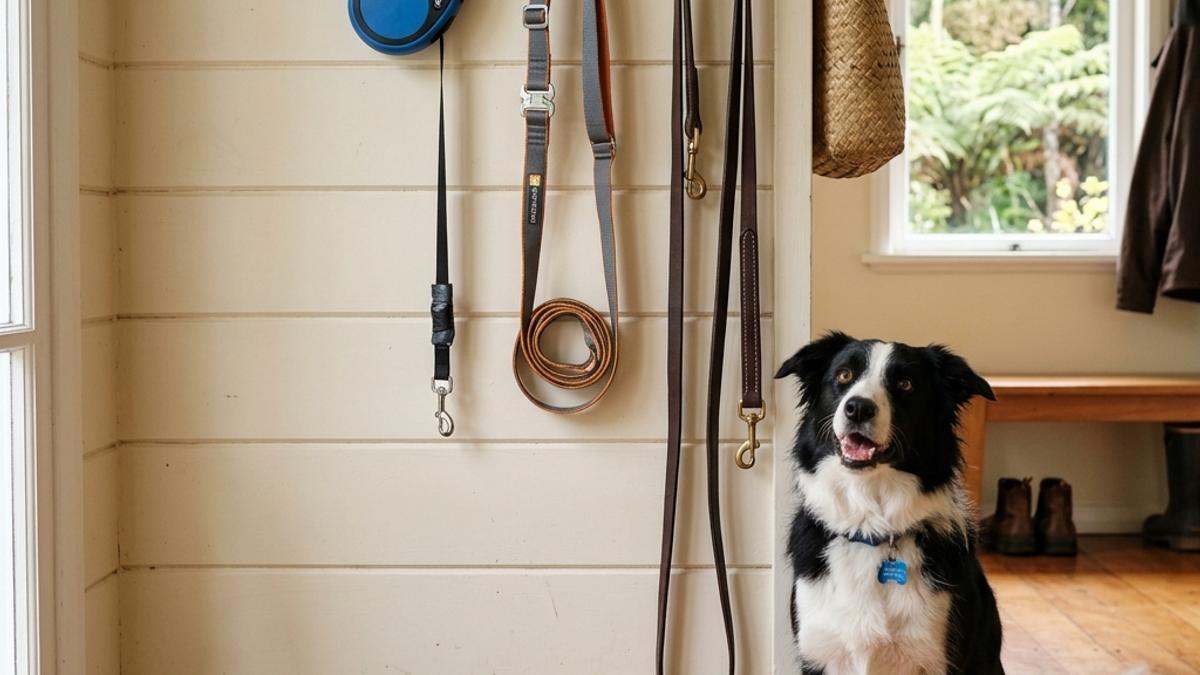
A long line is useful for recall practice before a dog is trusted off lead. Use it in open, low-distraction places and attach it to a harness rather than a collar. In NZ, this matters around wildlife, livestock, mountain bikes and beach access tracks. The dog may technically be attached to you, but a 10 m line still needs active supervision.
Look for flat webbing that is visible on grass, a strong clip and a length you can actually manage. Avoid rope-burn situations: wear gloves if your dog is strong, do not wrap the line around your hand, and gather the line when people, dogs or bikes approach. For the training plan, use Dog Recall Training NZ.
Retractable lead: narrow use, real trade-offs
Retractable leads can suit calm, small or medium dogs in quiet open areas where you can see what is coming. They are a poor choice near roads, narrow Auckland footpaths, busy beach entrances, wildlife, playgrounds and dogs that pull. The thin cord can be hard to see, difficult to reel in quickly, and unpleasant if it wraps around skin.
If you already own one, keep it locked short in any public pinch point and use a harness attachment. Do not use it to manage lunging, reactivity or poor recall. Retractable vs standard vs long-line leads NZ goes deeper on that comparison.
Traffic handles and hands-free leads
A traffic handle is a short second handle near the clip. It is useful when crossing roads, moving through ferry queues, walking past cafe tables or managing a dog at a vet door. Look for one as a feature on a normal lead rather than as the dog's only exercise lead.
Hands-free leads can be handy for jogging or carrying gear, but they are not a shortcut for control. Choose one only if your dog already walks politely. You still need a hand-grab point and a plan for sudden distractions.
What to look for
- A fixed lead for everyday walks, plus a long line only if you are actively training recall.
- A clip sized to your dog, not just the strongest one on the shelf.
- Webbing or tape that dries well after beach, rain and muddy section use.
- Reflective detail for dark winter mornings.
- A comfortable handle you can hold without wrapping the lead around your wrist.
What to avoid
- Retractable leads for pullers, traffic, wildlife areas or busy council spaces.
- Long lines attached to collars.
- Thin cords around children, cyclists or dogs that bolt.
- Lead choices that replace training instead of supporting it.
- Leaving a lead clipped to a dog unsupervised at home, where it can snag.
NZ buying tips
Auckland Council tells owners to keep dogs under control and use a leash when needed. MPI's dog welfare code also frames handling and control as part of responsible dog care. In practice, choose a lead that lets you act quickly where you actually walk: suburban footpaths, beaches with seasonal rules, rural roads, bach stays or tramping car parks. The right lead is the one you can manage calmly.
Related buying guides
- Pet Product Buying Guides NZ
- Dog Leads, Harnesses and Collars Guide NZ
- Retractable vs Standard vs Long-Line Leads NZ
- How to Stop Your Dog Pulling on the Lead NZ
Shop category
Quick takeaways
- A fixed standard lead is the safe default for most NZ walks.
- Long lines are for supervised recall practice in open spaces.
- Retractable leads suit only calm dogs in quiet areas, and should be locked short near risk.
- Traffic handles help at roads, cafes, ferries and vet doors.
- A lead supports training; it does not fix pulling by itself.
References
- SPCA NZ, Dog behaviour and training, checked 2026-06-13: https://www.spca.nz/advice-and-welfare/article/dog-behaviour-and-training
- Auckland Council, Control your dog, checked 2026-06-13: https://www.aucklandcouncil.govt.nz/dogs-animals/problems-dogs/Pages/control-your-dog.aspx
- MPI, Code of Welfare: Dogs, checked 2026-06-13: https://www.mpi.govt.nz/animals/animal-welfare/codes/all-animal-welfare-codes/code-of-welfare-dogs
Free PetMall tools
Related guides
petmall.co.nz
Shop at PetMall
The products below are practical support items for your pet. PetMall ships across New Zealand.
- Leads & HarnessesComfort matters: padded contact points and adjustable fit help reduce rubbing on longer walks or tramping weekends.
- Dog FoodStart with food that matches your dog's life stage and activity level — and change brands slowly over 7–10 days.
- Dog TreatsTraining rewards and everyday treats — small, soft pieces work best for consistent reinforcement.
- Dog ToysA small rotation of chew, fetch, and puzzle toys usually works better than buying a large variety at once.
- Dog GroomingA gentle brush and the right shampoo make maintenance easier — especially for dogs that get muddy on walks.
- Flea & Worm TreatmentFor NZ conditions, look for protection that fits your routine (monthly vs longer-lasting) and your dog's weight range.