Cat Scratching Post & Tree Types NZ: Which One Does Your Cat Actually Use?
Sisal post, cardboard scratcher, cat tree, wall-mounted panel — which type will your cat actually use? Compare options for NZ apartments and houses with limited space.
The most common reason a cat ignores an expensive scratching post is that it wobbles, faces the wrong direction, or is in the wrong location. Cats scratch to maintain their claws, stretch their muscles and mark territory — and they will find *something* to scratch on. Your job is to make the right option more appealing than your sofa.
Here's what the different types of cat scratching furniture do, who they suit, and what to look for when buying in New Zealand.
Why cats scratch — and why this affects what you buy
Scratching serves three purposes for a cat:
- Claw maintenance — scratching strips the outer layer of old claw sheaths, exposing fresh, sharp claw underneath
- Muscle stretch — scratching posts are often used during a full-body stretch; this is why cats scratch near where they sleep
- Territory marking — cats have scent glands in their paws; scratching leaves both visual and scent marks
This means the "best" scratching option is the one positioned where your cat already wants to scratch (usually near sleeping areas or along their movement paths), is tall or long enough for a full-body stretch, and is stable enough not to wobble when used at full force.
The main types of cat scratching furniture
1. Vertical sisal post — the classic starter option
A standalone post covered in natural sisal rope or sisal fabric, typically on a weighted base. Sisal has a texture cats naturally prefer for claw conditioning — it shreds satisfyingly in a way carpet and smooth surfaces don't.
Best for:
- Cats that scratch vertical surfaces (doorframes, couch arms, curtains)
- Apartments and smaller NZ homes where floor space is limited
- First cat setups — a solid sisal post is the most reliable starting point
What to look for:
- Height: at least 75–90 cm tall so your cat can stretch fully upright. Shorter posts are the most common reason cats ignore them — the post doesn't allow a proper stretch.
- Stability: it must not wobble. If you can push it over with light force, your cat will push it over too — and then avoid it. Wide, weighted bases are more stable.
- Sisal fabric vs rope: fabric wears more evenly and lasts longer; rope can unravel but some cats prefer the texture.
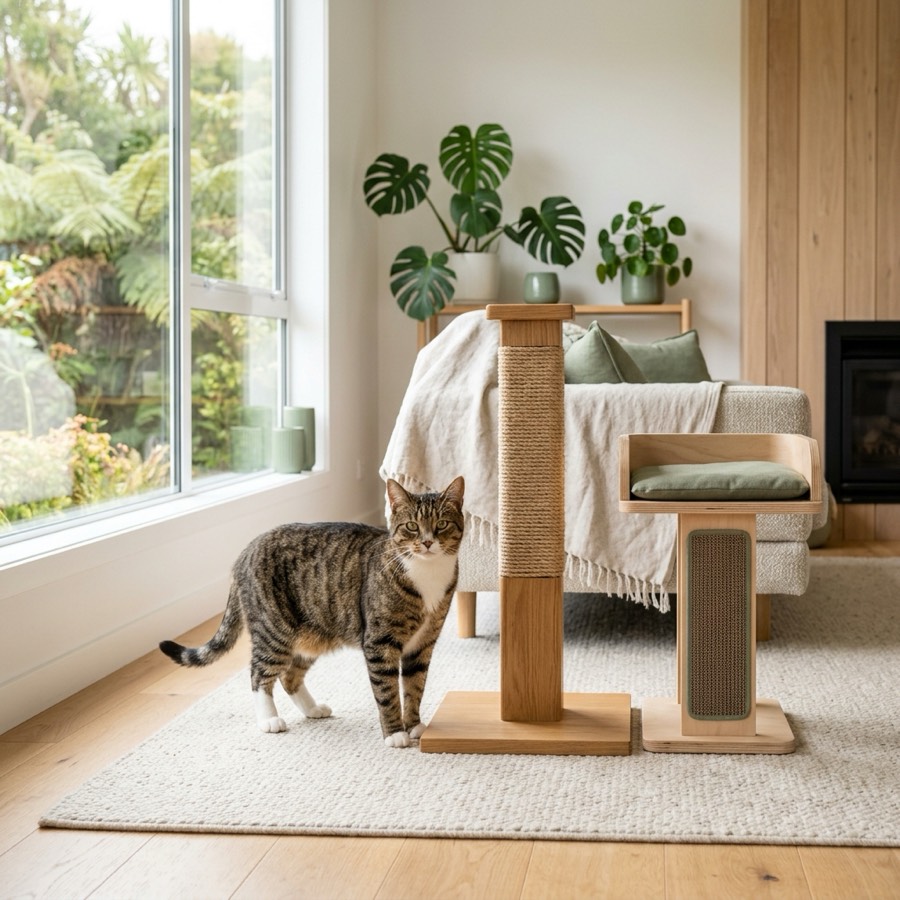
2. Horizontal cardboard scratcher — for ground-scratchers
Some cats prefer to scratch on horizontal surfaces — flat or slightly angled. A corrugated cardboard scratcher laid flat or at a low angle suits these cats. Cardboard shreds easily and is very satisfying for cats that dig-scratch rather than reach-scratch.
Best for:
- Cats that scratch the floor, mats, carpet or the base of furniture rather than vertical surfaces
- Multi-cat households — cheap enough to have several around the house
- NZ cat owners who want a low-cost option to test whether their cat is a vertical or horizontal scratcher
Practical notes: cardboard scratchers produce small cardboard flakes (not a problem but worth knowing). Replace when heavily worn. Some brands are compostable — a good option for eco-conscious NZ households. Sprinkle with dried catnip to increase initial appeal.
3. Cat tree (activity centre) — for active or multi-cat households
A cat tree combines scratching posts, platforms, hammocks, and sometimes hideaway boxes in one structure. It serves scratching, climbing, perching (cats feel safer elevated) and napping.
Best for:
- Active or young cats that need vertical territory and climbing opportunities
- Multi-cat households where individual perching spots reduce competition
- Indoor-only NZ cats (particularly relevant for apartment cats in Auckland, Wellington, Christchurch) that need vertical enrichment to compensate for limited outdoor access
What to look for:
- Stability again is the #1 issue: large cat trees must not tip when a cat jumps onto the top level. Check weight ratings and whether the base is properly weighted or can be bolted to a wall.
- NZ apartment note: measure your ceiling height before buying taller cat trees — many NZ apartments have 2.4 m ceilings. A 180 cm tree fits; a 220 cm tree may not.
- Materials: sisal-wrapped posts on the tree keep the scratching appeal high. Carpet-only trees lose appeal faster as the carpet traps scent and gets matted.
4. Wall-mounted cat shelves and panels — NZ apartment-friendly
Wall-mounted scratching panels, shelves and ledges attach to the wall at any height, taking up zero floor space. They can be combined with floating shelves to create a full "cat highway" along walls.
Best for:
- Small NZ apartments where floor space is at a premium
- Cats that scratch walls, doorframes or vertical surfaces
- Owners who want to provide climbing and perching without a large floor-standing structure
What to look for: check that the wall anchor suits your wall type. NZ apartments often have plasterboard walls — you need to hit a stud or use appropriate plasterboard anchors rated for your cat's weight plus dynamic load (jumping). A 5 kg cat landing on a shelf generates far more than 5 kg of force.
5. Doorframe and corner scratchers — targeted problem-solving
Doorframe scratchers clip around door corners, and corner panels attach to room corners. Both target the specific surfaces cats commonly scratch in NZ homes.
Best for:
- Redirecting a cat that has fixated on a specific doorframe or corner
- Supplementary options in a multi-room home
Limitation: these rarely replace a full scratching post — they address the symptom but don't provide the stretch and claw-maintenance function of a tall sisal post.
How to get your cat to use the scratcher (not the sofa)
- Place the scratcher where your cat already wants to scratch — near sleeping areas, along movement paths, or directly next to the furniture they're already using. Don't hide it in a spare room.
- Make it more appealing: rub dried catnip on the post, or use a pheromone spray (Feliway). Praise and treat any interaction with the scratcher.
- Make the problem surface less appealing: double-sided tape or a plastic carpet runner (nubbed side up) on the sofa arm for a few weeks. Once your cat is reliably using the scratcher, remove the deterrent.
- Never punish scratching: it's a biological need. Redirecting to an appropriate surface is more effective and doesn't damage your relationship with your cat.
For full guidance on redirecting scratching behaviour, see our how to stop a cat scratching furniture NZ guide.
NZ-specific notes
- NZ humidity, especially in northern regions, can cause sisal to develop a musty smell over time. Replace or sun-dry well-used posts periodically.
- NZ cats with outdoor access may not need indoor scratching furniture as much — outdoor cats often use trees, fence posts and decks. Indoor-only cats (recommended for NZ native wildlife protection) need adequate indoor scratching options.
- Local NZ pet stores stock the most common options; larger cat trees are usually cheaper ordered online with nationwide delivery.
Quick comparison table
| Type | Space needed | Best for | Watch for |
|---|---|---|---|
| Vertical sisal post | Small (base ~35×35 cm) | Vertical scratchers, small spaces | Must be ≥75 cm tall; must be stable |
| Cardboard scratcher | Very small (flat) | Ground-scratchers, multi-cat homes | Produces flakes; replace when worn |
| Cat tree | Medium-large | Active cats, multi-cat, indoor-only | Stability; check height vs ceiling |
| Wall-mounted panel/shelf | None (wall space only) | Apartments, space-limited homes | Correct wall anchoring required |
| Doorframe/corner scratcher | None | Targeting a specific spot | Supplementary only, not a replacement |
Quick takeaways
- Height and stability matter more than price — a tall, stable sisal post will be used; a short wobbly one won't
- Match the scratcher orientation to how your cat already scratches (vertical vs horizontal)
- Position near sleeping areas and existing problem spots, not in a corner of a spare room
- Multi-cat homes benefit from multiple scratching options in different areas
- Indoor-only NZ cats especially need adequate scratching and climbing enrichment
- Redirect, don't punish — make the right surface more appealing than the wrong one
Related reading
- How to Stop a Cat Scratching Furniture NZ
- Cat Toys Guide NZ
- Best Cat Breeds for First-Time Owners NZ
- Cat hub — breeds and guides
Shop cat scratching furniture at PetMall
Looking for cat trees and scratching posts in New Zealand? PetMall stocks a range with nationwide delivery.
→ Browse Cat Scratching Posts & Trees
---
References
- Department of Conservation, Feral cats — impact on native wildlife (a feral cat caught in Canterbury in 2020 had 17 skinks in its stomach; feral cats caused 20% of monitored kea deaths at Arthur's Pass 2019-2021), checked 2026-07-28: https://www.doc.govt.nz/nature/pests-and-threats/animal-pests-and-threats/feral-cats/
- American Association of Feline Practitioners, Claw Friendly Educational Toolkit — Scratching Resources — scratching is normal feline behaviour; provide both vertical and horizontal scratching surfaces, checked 2026-07-28: https://catvets.com/wp-content/uploads/2024/01/ClawFriendlyEducationalToolkit_ScratchingResources.pdf
---
*This guide provides general information for New Zealand cat owners. For advice about your cat's specific behaviour or health, consult a registered New Zealand vet.*
Related guides
petmall.co.nz
Shop at PetMall
The products below are practical support items for your pet. PetMall ships across New Zealand.
- Cat ToysA small rotation of toys (feather wand, puzzle feeder, and comfort toy) usually works better than buying many at once.
- Cat FoodStart with food that matches your cat's life stage — change brands slowly over 7–10 days to avoid digestive upset.
- Cat LitterClumping or crystal, most cats prefer an unscented litter and a clean tray — one tray per cat plus one spare is the NZ rule of thumb.
- Cat TreatsGreat for bonding and training — keep treats under 10% of daily calories to protect your cat's waistline.
- Cat GroomingRegular brushing cuts hairballs and shedding — essential for long-haired breeds like Ragdolls and British Longhairs.
- Flea & Worm TreatmentFor NZ conditions, choose protection that fits your cat's weight and lifestyle (indoor vs outdoor) and keep it regular.