Dog Recall Training NZ: Teach Your Dog to Come Back Safely
Dog recall training NZ guide: positive come-when-called steps, long-line practice, council off-leash rules, DOC beach safety and troubleshooting.
Dog recall training in NZ starts with one rule: do not let your dog off lead in public until coming back is more rewarding than running off. Build the cue at home, practise on a long line, reward generously, and follow council and DOC rules. A reliable recall is trained in layers; it is not something a dog magically has because they know their name.
Why recall matters in New Zealand
Recall is a safety skill. It helps around council dog parks, shared paths, beaches, lifestyle blocks, road edges, stock, shorebirds, sea lions, kids, joggers and unfamiliar dogs. It also protects your dog from being rehearsed in the wrong lesson: "ignore the human, sprint to the interesting thing".
Many NZ owners only discover the gap when the dog is already loose. The better approach is boring but effective: practise before you need it.
SPCA New Zealand supports low-stress, force-free training based on positive reinforcement. That is the right frame for recall. You want your dog to hear the cue and think, "Brilliant, good things happen with my person", not "I am about to be grabbed, told off, or taken home every time."
Pick one cue and protect it
Choose one recall cue. It can be "come", "here", "kiwi", a whistle, or any word your household can say clearly. Do not use a word that already means five different things.
For the first two weeks, protect that cue:
- Do not call if you know your dog will ignore you.
- Do not call and then punish, scold, clip the lead on angrily, or end every fun activity.
- Do not repeat the cue over and over.
- Do reward every single correct response.
If your current cue has been poisoned by repetition, pick a fresh cue and rebuild it.
Start indoors
Begin in the easiest possible place: the hallway, lounge, garage, fenced deck or quiet backyard.
Say the cue once in a cheerful voice. When your dog turns towards you, mark with "yes" and reward close to your legs. Then release them back to what they were doing. That release matters because recall should not always mean the fun ends.
Use tiny, high-value rewards. For some dogs that is roast chicken, cheese, liver treats, a tug toy, or a quick game. For others it is access to a sniff. The reward must beat the distraction level.
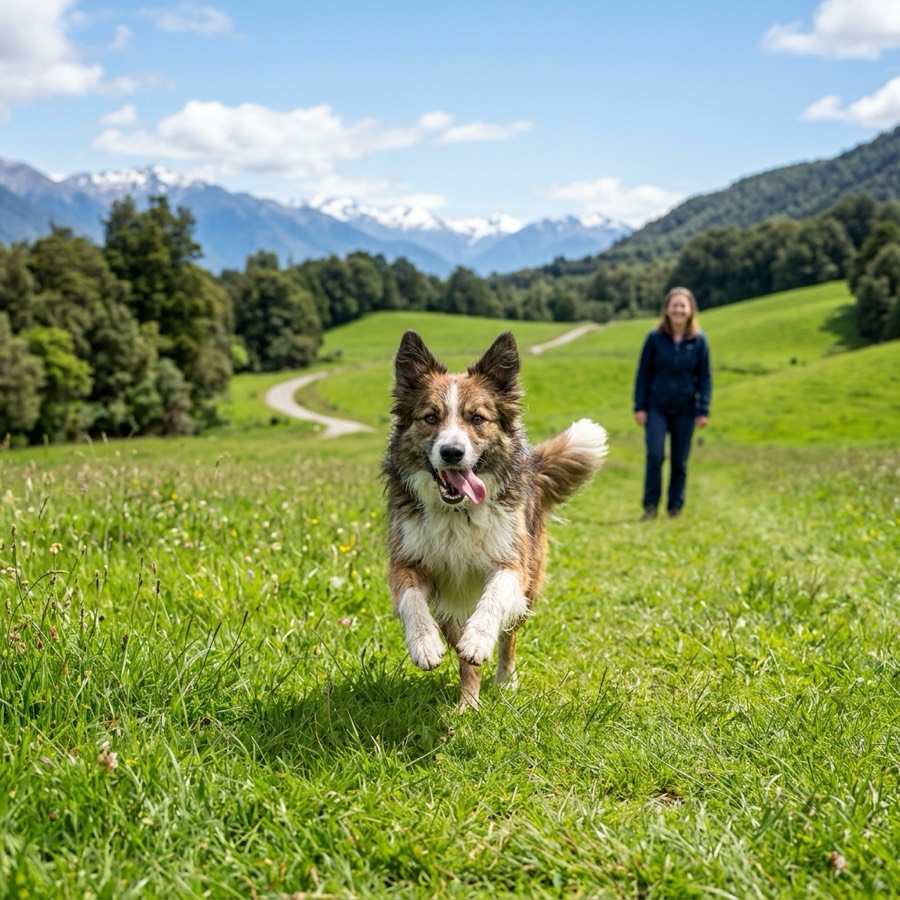
Practise five recalls, then stop. Short, clean sessions build faster than long sessions where the dog gets bored.
Add distance with a long line
Once your dog comes reliably indoors and in the yard, move to a quiet outdoor space on a long line. A 5-15 metre long line gives the dog room to move while you still have safety backup. Kuri City NZ listed longline training leads at NZD $24.99-$34.99 including GST, checked on 4 June 2026; similar long lines vary by material and length. Choose one that suits your dog's size and your handling skill.
Attach the line to a harness rather than a neck collar for recall practice. Let it trail or hold it loosely in a safe, open area. Avoid wrapping it around your hand, and keep it away from kids' legs.
Call once when your dog is likely to succeed. Reward when they arrive. Then release them to sniff again. If they ignore you, gently shorten the line, make a happy movement away from them, and reduce the difficulty next time.
Build the habit: come in, get paid, go out again
The best recall trainers reward the return and then release the dog back to life. Try this pattern:
- Dog sniffs.
- You say the cue once.
- Dog turns and runs in.
- You reward at your feet.
- You say "go sniff" and let them return to the environment.
That teaches your dog that coming back does not always end the adventure. On real walks, occasionally clip the lead on, reward, walk a few steps, then release again where rules allow. This stops the lead clip becoming a predictor of disappointment.
Use council rules as your boundary
Recall training does not override local rules. The Dog Control Act 1996 gives New Zealand councils the framework for dog control in public places, and each council sets local access rules. Auckland Council says dogs must generally be on lead in council-controlled public places where dogs are allowed unless signs state otherwise, including roads, footpaths, car parks and boating areas.
Before using an off-leash area, check your council map, local signs and seasonal restrictions. Off-leash means your dog may be allowed off the lead; it does not mean your dog may rush other dogs, wildlife or people.
If you are not sure your dog will come back, use a long line. A controlled dog on a long line is better than an uncontrolled dog off lead.
Beaches, wildlife and DOC land
New Zealand beaches are not empty training fields. DOC warns that wildlife can be present on any beach, including places where dogs are otherwise allowed. If wildlife is present, put your dog on lead and keep your distance.
Recall around birds, seals, sea lions or penguin nesting areas is advanced training, not beginner practice. Use the lead before the dog has a chance to chase. If your dog has a strong chase instinct, keep them on lead or long line near coastal wildlife, even if they are excellent in the backyard.
DOC tracks and reserves can also have dog access rules, permit requirements, prohibited areas or lead-only areas. Check before you go, especially on holiday routes, rural reserves and conservation land.
Troubleshooting
My dog comes slowly
Pay better and be more exciting. Move away from your dog, crouch sideways, clap once, or use a toy. Reward speed, not just arrival.
My dog comes, grabs the treat and leaves
Reward at your body and hold the next treat near your leg. Feed two or three treats in a row so staying close also pays.
My dog ignores me around other dogs
The distraction is too hard. Practise farther away, on a long line, and reward for looking back at you before they lock onto the other dog.
My dog only comes when they see food
Hide the food, but still pay well. Keep treats in a pouch or pocket, use a marker word, and vary the reward: food, tug, chase-you game, sniff release.
My dog runs away when I reach for the collar
Practise collar touches separately. Touch the harness or collar, feed, release. Do that hundreds of times away from the park gate so handling does not predict the end.
A simple 14-day starter plan
| Days | Goal | Where |
|---|---|---|
| 1-2 | Cue means turn towards you | Lounge, hallway, deck |
| 3-4 | Come from another room | House and fenced yard |
| 5-6 | Add gentle movement away from dog | Yard or quiet driveway |
| 7-8 | Long-line recalls with low distractions | Quiet park edge |
| 9-10 | Recall, reward, release to sniff | Quiet open area |
| 11-12 | Practise near mild distractions | Far from dogs, bikes or kids |
| 13-14 | Add lead clip, reward, release again | Legal off-leash or long-line area |
Keep the success rate high. If your dog fails more than twice in a session, make it easier.
What not to do
Do not chase your dog unless you are in a genuine safety situation. Chasing turns the recall into a game where the dog controls the distance.
Do not tell your dog off when they finally return. Even if they took ten minutes, punish the return and you teach them that coming back is risky.
Do not use off-leash spaces as your first training location. Dog parks, busy beaches and shared pathways are graduate-level environments.
Do not rely on breed myths. Some breeds are naturally more independent or chase-driven, but every dog benefits from a trained recall and sensible management.
When to get help
Get help from a reward-based trainer if your dog regularly bolts, chases stock or wildlife, ignores the cue around dogs, or is too strong for the person handling the long line. Use professional help early if your dog's behaviour feels unsafe in public spaces.
For puppies, pair recall practice with the New Puppy Checklist NZ. For adult dogs, combine recall with loose-lead work, enrichment and local rule checks so the whole walk is calmer.
Key takeaways
- Recall is a trained safety skill, not a hope.
- Pick one cue, say it once, reward generously and release often.
- Practise indoors first, then use a long line outdoors.
- Never punish a dog for eventually coming back.
- Council off-leash rules still require control.
- Around DOC beaches, coastal wildlife or stock, use the lead before the chase starts.
Related reading
- Dog Behaviour Decoder
- New Puppy Checklist NZ
- Stop Dog Pulling on Lead NZ
- Dog Training Tools Guide NZ
- Dog Leads, Harnesses & Collars Guide NZ
- Dog Enrichment NZ
- Dog Registration NZ: Council Renewal Checklist
---
Reference sources
- SPCA New Zealand: Training Methods and Devices, checked 2026-06-04. https://www.spca.nz/advocacy/position-statements/article/training-methods-and-devices
- New Zealand Legislation: Dog Control Act 1996, checked 2026-06-04. https://www.legislation.govt.nz/act/public/1996/0013/latest/whole.html
- Auckland Council: Rules for dogs in public places, checked 2026-06-04. https://new.aucklandcouncil.govt.nz/en/dogs-animals/guide-for-dog-owners/rules-dogs-public-places.html
- Department of Conservation: Dogs on beaches, checked 2026-06-04. https://www.doc.govt.nz/dogs-on-beaches
- Animates NZ: Puppy training basics, checked 2026-06-04. https://www.animates.co.nz/articles/puppy-training-basics
- Scottish SPCA: Dog recall training guide, checked 2026-06-04. https://www.scottishspca.org/advice/dogs/dog-recall-training/
- Kuri City NZ: Training Lead Longline price example, checked 2026-06-04. https://kuri.co.nz/product/training-lead-longline/
Free PetMall tools
Related guides
petmall.co.nz
Shop at PetMall
The products below are practical support items for your pet. PetMall ships across New Zealand.
- Dog TreatsTraining rewards and everyday treats — small, soft pieces work best for consistent reinforcement.
- Dog FoodStart with food that matches your dog's life stage and activity level — and change brands slowly over 7–10 days.
- Dog ToysA small rotation of chew, fetch, and puzzle toys usually works better than buying a large variety at once.
- Dog GroomingA gentle brush and the right shampoo make maintenance easier — especially for dogs that get muddy on walks.
- Leads & HarnessesComfort matters: padded contact points and adjustable fit help reduce rubbing on longer walks or tramping weekends.
- Flea & Worm TreatmentFor NZ conditions, look for protection that fits your routine (monthly vs longer-lasting) and your dog's weight range.