Stop Dog Pulling on Lead NZ: Loose-Lead Training That Works
Stop dog pulling on lead NZ guide: positive loose-lead steps, gear setup, council leash rules, beach safety and a simple 7-day plan.
To stop dog pulling on lead in NZ, teach your dog that a loose lead makes forward movement happen and a tight lead makes the walk pause. Use reward-based training, short sessions, a comfortable harness or collar, and locations where your dog can still think. Pulling is not fixed by yanking back; it improves when the dog learns that checking in with you pays.
Why dogs pull
Most dogs pull because the world is exciting and pulling has worked before. The lead tightens, the human keeps moving, and the dog reaches the smell, dog, beach track, school gate, dairy corner or lamp post anyway. From the dog's point of view, the tight lead is part of the transport system.
That matters because the fix is not a stronger arm. The fix is changing the rule:
- Loose lead: the walk continues.
- Tight lead: forward motion stops.
- Check in beside you: reward and move again.
SPCA New Zealand supports low-stress, force-free training focused on positive reinforcement. That is the right frame for loose-lead walking. You are teaching a skill, not winning a tug-of-war.
Set up before you train
Choose gear that lets you reward good choices without hurting your dog or your shoulder. A standard 1.2-1.8 metre lead is easier for footpaths than a retractable lead. A well-fitted Y-front harness, back-clip harness, front-clip harness, or flat collar can all be suitable depending on the dog. Avoid anything that works mainly by causing discomfort.
Fit matters. Animates' walkies advice uses the practical two-finger harness check: you should be able to slip two fingers comfortably between harness and dog. Bunnings NZ listed dog collars and harnesses from about NZD $3.98 for simple collars and NZD $10.98-$41.90 for harness examples, checked on 4 June 2026. You do not need fancy gear, but you do need safe, well-fitting gear that will not rub under the front legs.
For strong pullers, a front-clip harness can help turn the dog's chest slightly when they hit the end of the lead, but it is a management tool, not the lesson. Pair it with rewards for walking beside you.
The loose-lead rule
Start somewhere boring: driveway, hallway, garage, quiet berm, empty netball court edge, or a quiet stretch of footpath. Put five to ten tiny treats in the hand nearest your dog.
Walk one step. If the lead stays loose, mark it with "yes" and reward at your trouser seam. Walk another step. Reward again. For the first session, your goal is not a full neighbourhood loop; it is ten good steps where the dog notices that being near you pays.
If the lead tightens, stop. Keep your hands still. Do not jerk, reel the dog in, or repeat "heel" ten times. Wait for your dog to soften the lead, turn their head, or step back towards you. Mark that moment, reward close to your leg, then move again.
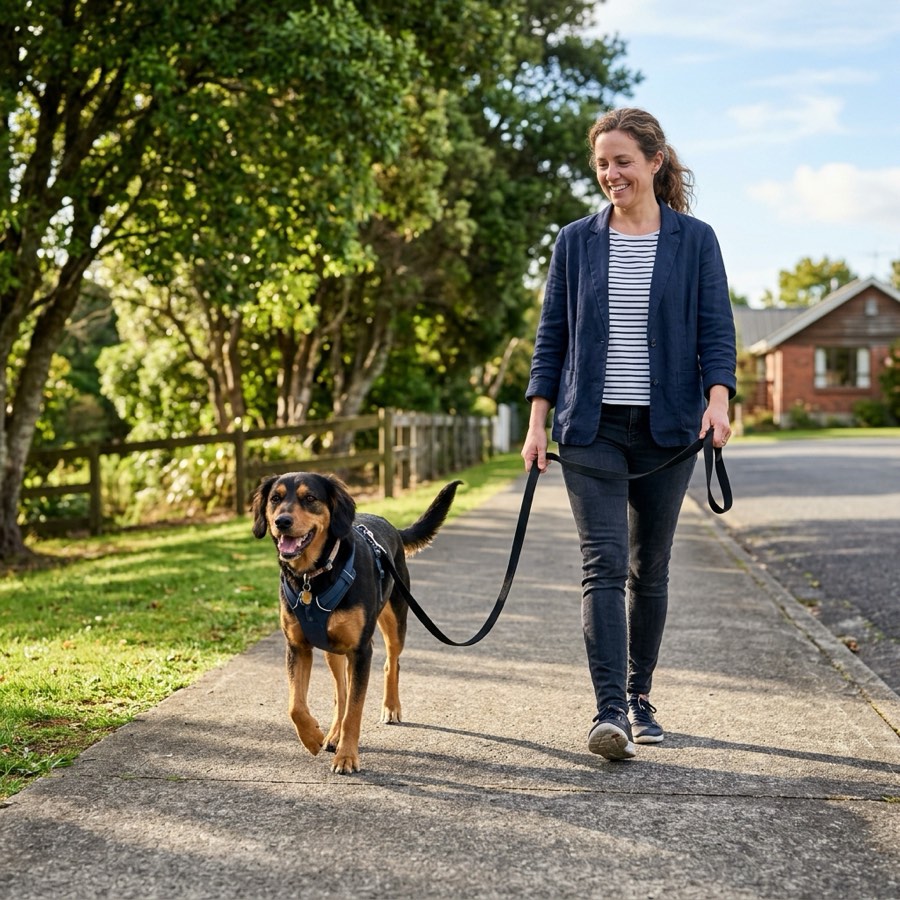
This feels slow for a few days. That is normal. You are replacing hundreds of rewarded pulling repetitions with a new pattern.
Use turns instead of arm strength
When your dog surges ahead, use calm direction changes. Say "this way", turn 180 degrees, and reward when your dog catches up beside you. The point is not to trick them; it is to make your movement more relevant than whatever is at the end of the lead.
Use this especially before predictable triggers:
| Trigger | What to do before the lead goes tight |
|---|---|
| Another dog ahead | Turn early, feed several treats, or cross the road if safe |
| Interesting smell | Ask for two loose steps, then release to sniff |
| Skateboard, scooter or bike | Increase distance and reward looking back at you |
| Beach wildlife or birds | Put space between dog and wildlife; keep the lead short but soft |
| Busy school pickup | Practise outside the rush, then build up gradually |
If your dog is already lunging at the end of the lead, the lesson is too hard in that spot. Distance is training, not failure.
Reward sniffing the smart way
Dogs pull because sniffing is valuable. Use that. When your dog walks a few loose steps towards a smell, say "go sniff" and let them investigate. After three to five seconds, invite them back and reward beside you.
This is powerful because you are not fighting the environment; you are using the environment as payment. A loose lead earns access. A tight lead pauses access.
For young dogs, build sniff breaks into the walk on purpose. A five-minute training walk with three good sniff breaks often teaches more than a 30-minute drag around the block.
NZ leash rules make this skill practical
Loose-lead walking is not just a nice-to-have in New Zealand. Many everyday places require a controlled dog on lead.
Auckland Council says dogs must generally be on lead in council-controlled public places where dogs are allowed unless local signs state otherwise, including roads, footpaths, car parks and boating areas. Dunedin City Council's 2025 rules note leash requirements for roads, footpaths, tracks and coastal dunes, with dogs still needing to be under control.
DOC's beach guidance adds another Kiwi reality: coastal wildlife can be present on any beach. If wildlife is ahead, put your dog on lead and pass well away from it. A dog that can walk on a soft lead is easier to manage around penguins, shorebirds, sea lions, runners, bikes and kids.
Check your local council map before assuming an area is off-leash. Off-leash still means under control; it does not mean your dog can rush other dogs or people.
A 7-day starter plan
Use tiny sessions. Stop while both of you are still doing well.
Day 1: Reward position
Stand still with your dog on lead. Every time they are beside your leg or glance up at you, mark and reward. Do this for three minutes.
Day 2: One-step walking
Take one step, reward at your leg, then take another. If your dog forges ahead, stop and wait for the lead to soften.
Day 3: Direction changes
Walk five steps, say "this way", turn, and reward when your dog follows. Keep it cheerful, not sharp.
Day 4: Add sniff rewards
Ask for three loose steps towards a tree, then release with "go sniff". After a few seconds, move on.
Day 5: Practise around mild distractions
Use a quiet park edge, not the busiest dog area. Reward before your dog pulls, not after they explode into the lead.
Day 6: Footpath manners
Practise stopping at driveways, letting people pass, and moving to the side on shared paths. Keep sessions short in wet or windy weather; tired handlers get inconsistent.
Day 7: Review the pattern
Count wins: fewer tight-lead moments, faster check-ins, and more steps beside you. If the lead is tight for most of the walk, go back to easier locations for another week.
Common mistakes
The first mistake is walking too far too soon. If the whole route is too exciting, every metre becomes pulling practice. Drive or walk to a calmer spot, train for five minutes, then go home.
The second mistake is rewarding in the wrong place. If you feed in front of your body, your dog learns to cut across you. Reward beside your leg so the dog wants to be where the loose-lead position lives.
The third mistake is relying on equipment alone. A harness can make walks safer and kinder, but it cannot teach the rule by itself. Your timing teaches the rule.
The fourth mistake is mixed messages. If pulling works when you are in a hurry but not on Sunday training walks, your dog will keep trying. On days you cannot train, choose a quieter route or use a longer sniff walk where you can keep the lead loose.
When to get help
Get qualified help if your dog repeatedly lunges, growls, redirects onto the lead, knocks people over, or is too strong for the person walking them. Choose a reward-based trainer who is comfortable working around real-world NZ distractions such as footpaths, shared paths, parks and beaches.
If your dog is a new rescue, a large adolescent, or a puppy still learning the outside world, use the Dog Behaviour Decoder and a calm, consistent plan before expecting polished street manners.
Key takeaways
- Loose-lead walking is trained by rewarding slack in the lead, not by yanking back.
- Stop when the lead tightens; move and reward when the dog checks in or softens the lead.
- Use sniffing as a reward: loose steps earn access to smells.
- Choose safe, well-fitting gear, then teach the skill separately.
- Practise first in boring places before busy beaches, shared paths or dog parks.
- Check council and DOC rules; off-leash areas still require control.
Related reading
- Dog Behaviour Decoder
- New Puppy Checklist NZ
- Dog Leads, Harnesses & Collars Guide NZ
- Dog Training NZ Guide
- Dog Enrichment NZ
- Dog Registration NZ: Council Renewal Checklist
---
Reference sources
- SPCA New Zealand: How to stop your puppy pulling on the lead, checked 2026-06-04. https://www.spca.nz/advice-and-welfare/article/how-to-stop-your-puppy-pulling-on-the-lead
- SPCA New Zealand: Training Methods and Devices, checked 2026-06-04. https://www.spca.nz/advocacy/position-statements/article/training-methods-and-devices
- Auckland Council: Rules for dogs in public places, checked 2026-06-04. https://new.aucklandcouncil.govt.nz/en/dogs-animals/guide-for-dog-owners/rules-dogs-public-places.html
- Dunedin City Council: Dog Control Bylaw and Dog Control Policy, checked 2026-06-04. https://www.dunedin.govt.nz/services/dogs/dog-control-bylaw-and-policy
- Department of Conservation: Dogs on beaches, checked 2026-06-04. https://www.doc.govt.nz/dogs-on-beaches
- Animates NZ: Everything you need for happy walkies, checked 2026-06-04. https://www.animates.co.nz/articles/everything-you-need-for-happy-walkies
- Bunnings New Zealand: Dog collars and harnesses, price examples checked 2026-06-04. https://www.bunnings.co.nz/products/pet-supplies/dogs/dog-collar-harnesses/
Free PetMall tools
Related guides
petmall.co.nz
Shop at PetMall
The products below are practical support items for your pet. PetMall ships across New Zealand.
- Leads & HarnessesComfort matters: padded contact points and adjustable fit help reduce rubbing on longer walks or tramping weekends.
- Dog FoodStart with food that matches your dog's life stage and activity level — and change brands slowly over 7–10 days.
- Dog TreatsTraining rewards and everyday treats — small, soft pieces work best for consistent reinforcement.
- Dog ToysA small rotation of chew, fetch, and puzzle toys usually works better than buying a large variety at once.
- Dog GroomingA gentle brush and the right shampoo make maintenance easier — especially for dogs that get muddy on walks.
- Flea & Worm TreatmentFor NZ conditions, look for protection that fits your routine (monthly vs longer-lasting) and your dog's weight range.