Retractable vs Standard vs Long-Line Leads NZ: Which Lead Should You Buy?
Retractable, standard or long-line lead in NZ? Compare control, safety, training use and where each suits Kiwi walks, beaches and recall practice.
Most Kiwi dog owners only need to get one thing right when choosing a lead: match the lead to where you walk and what you're training. As a quick answer — a standard 1.2–1.8 m lead is the safe default for footpaths, roads and most council areas; a long line (5–15 m) is a training tool for recall practice in open space; and a retractable lead suits calm dogs in quiet, open areas but is a poor choice near traffic, other dogs or for dogs that pull.
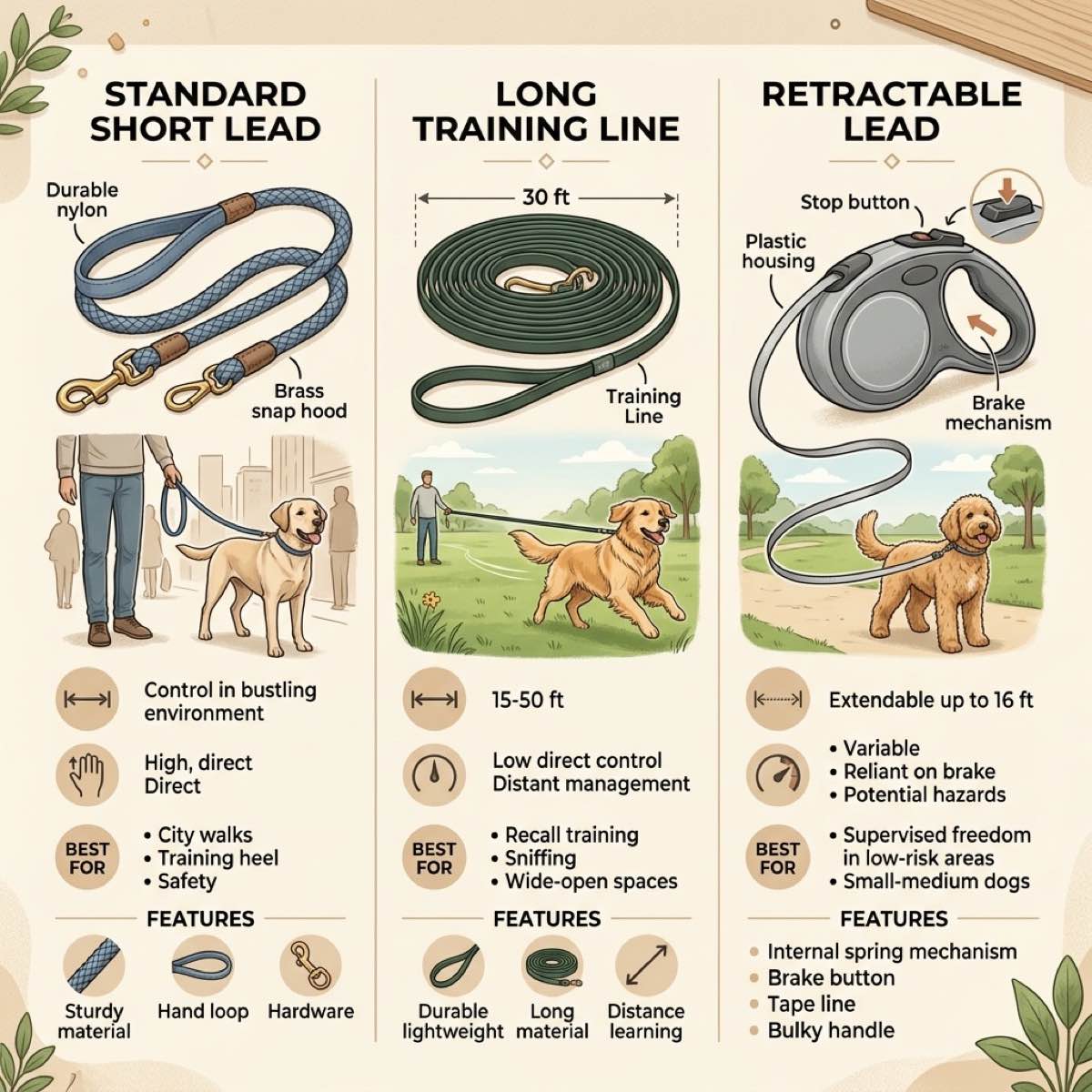
This guide compares the three so you don't buy the wrong one. For the bigger picture on collars and harnesses too, see our dog leads, harnesses and collars guide.
Quick comparison
| Lead type | Best for | Watch out for |
|---|---|---|
| Standard lead (1.2–1.8 m) | Everyday footpath, road, cafe and most council on-lead areas | Too long near busy roads if you don't gather the slack |
| Long line (5–15 m) | Supervised recall training in open, low-traffic space | Tangling, rope burn, never near roads/wildlife/other dogs |
| Retractable lead | Calm, non-pulling dogs in quiet open areas | Poor control, cord injuries, sudden lock failures, dogs that pull |
Standard lead — the everyday default
A fixed-length lead, usually 1.2–1.8 m, is what most NZ owners should reach for first. It gives predictable, immediate control near roads, school gates, shared paths and cafes, and it's what most council on-lead areas effectively assume. A clip, a fixed length, and a comfortable handle — there isn't much to go wrong.
Pair it with a well-fitted flat collar (for ID and registration tags) or a harness for dogs that pull or have delicate necks. If your dog pulls, the lead isn't the fix — training is; see how to stop your dog pulling on the lead.
Long line — a training tool, not a walking lead
A long line is a 5–15 m lead used to practise recall and give a dog freedom while you still have a safety backup. It's genuinely useful for teaching a reliable "come" before you trust your dog off-lead, which matters a lot in New Zealand where sheep worry is a serious offence and many beaches and reserves have on-lead seasons.
Treat it as a supervised training tool only:
- Use it in open, low-traffic space — never near roads, cyclists, livestock, wildlife or other dogs.
- Attach it to a harness, not a collar, so a sudden run doesn't jolt the neck.
- Wear gloves and keep it from tangling around legs (yours, the dog's, or other people's).
- It is not a licence to let a dog approach others — gather it in when anyone is near.
For the training itself, see our dog recall training NZ guide.
Retractable lead — narrow uses, real downsides
Retractable leads (a thin cord or tape that extends and locks from a plastic handle) suit fewer situations than owners expect. For a calm, non-pulling dog in a quiet open area, they can allow a bit of sniffing freedom. But they have real drawbacks that make them a poor everyday choice in most NZ settings:
- Weak control: several metres of cord is hard to reel in quickly when a cyclist, child or another dog appears.
- Injury risk (this one is measured, not folklore): a 2024 review of 443 hand and wrist dog-lead injuries seen in outpatient clinics found the ring finger and the wrist were the most commonly injured sites, the most common injuries were interphalangeal joint sprains and finger fractures, and 21.6% of those patients ended up needing surgery. The mechanism is a sudden spike in tension at the end of the lead's travel — exactly what a retractable does by design — and thin cord concentrates that force on whatever finger it is wrapped around. Dogs get the other half of it: a neck jolt when they hit the end of the line at speed.
- Mixed messages for pullers: the lead rewards pulling with more length, which works against loose-lead training.
- Mechanical failure: locks can slip and handles get dropped, releasing the dog.
On narrow Auckland footpaths, beach access tracks, weekend markets or anywhere near traffic, a fixed lead is safer and easier for everyone. If you do use a retractable, keep it locked short in any busy area and attach it to a harness.
How to choose for your situation
- Most walks (roads, paths, town): standard lead + collar or harness. Done.
- Teaching recall in a park or paddock: long line on a harness, supervised.
- A calm dog, quiet open space, you just want some sniff freedom: a retractable can work, locked short near anything busy.
- A dog that pulls or lunges: standard lead + front-clip harness + reward-based training — not a longer or retractable lead.
Whatever you choose, fit and training matter more than the hardware. The right lead keeps you and your dog safe and legal on Kiwi streets, beaches and tracks; it doesn't replace teaching your dog how to walk.
Quick takeaways
- Standard 1.2–1.8 m lead is the safe everyday default for NZ walks.
- Long lines are recall-training tools for open space — never near roads or wildlife.
- Retractable leads suit only calm dogs in quiet areas; avoid them near traffic, other dogs, or for pullers — hand and wrist lead injuries are common enough that 1 in 5 clinic cases need surgery.
- Attach training/long leads to a harness, not a collar.
- The lead doesn't fix pulling — training does.
Shop related categories at PetMall
Looking for leads, harnesses and collars in New Zealand? Browse the PetMall category for current options and nationwide delivery.
-> Browse Dog Collars, Leads & Harnesses
Related reading
- Dog Leads, Harnesses & Collars Guide NZ
- How to Stop Your Dog Pulling on the Lead NZ
- Dog Recall Training NZ
- Dog breeds in NZ
References
- New Zealand Legislation, Dog Control Act 1996 (owner responsibility and control of dogs), checked 2026-06-04: https://www.legislation.govt.nz/act/public/1996/13/en/latest/
- Plusch, Givner, Wiafe, Lutsky & Beredjiklian — Hand and Wrist Dog-Leash Injuries in the Outpatient Setting: A Review of 443 Cases, *HAND* (peer-reviewed), checked 2026-08-26: https://pubmed.ncbi.nlm.nih.gov/39600039/
Important notice
*This guide provides general information for NZ pet owners. For advice specific to your dog's behaviour or health, talk to a registered New Zealand vet or a qualified force-free trainer.*
Related guides
petmall.co.nz
Shop at PetMall
The products below are practical support items for your pet. PetMall ships across New Zealand.
- Dog FoodStart with food that matches your dog's life stage and activity level — and change brands slowly over 7–10 days.
- Dog TreatsTraining rewards and everyday treats — small, soft pieces work best for consistent reinforcement.
- Dog ToysA small rotation of chew, fetch, and puzzle toys usually works better than buying a large variety at once.
- Dog GroomingA gentle brush and the right shampoo make maintenance easier — especially for dogs that get muddy on walks.
- Leads & HarnessesComfort matters: padded contact points and adjustable fit help reduce rubbing on longer walks or tramping weekends.
- Flea & Worm TreatmentFor NZ conditions, look for protection that fits your routine (monthly vs longer-lasting) and your dog's weight range.