Cat Tree Types NZ: Standard, Modular, Wall-Mounted and Freestanding Towers Compared
Which type of cat tree suits your NZ home? Compare standard towers, modular shelving systems, wall-mounted perches, and floor-to-ceiling poles — what each provides and what to consider for NZ apartments.
A cat tree is one of the most useful purchases for an indoor cat in New Zealand. Cats need vertical space — a cat on an elevated perch feels safer, has a vantage point over the room, and exercises natural climbing instinct. A good cat tree also redirects scratching from furniture to an acceptable surface. Here's what the main types offer.
Why cats need vertical space
In a multi-cat household or a cat with anxiety, vertical territory is distinct from floor territory. A cat that can climb above the situation (literally) manages stress far better than one confined to floor level.
In NZ apartments — particularly in Auckland and Wellington where indoor-only cats are common due to council cat management rules — a cat tree effectively expands the cat's perceived territory without using floor space.
The main types
1. Standard tower / multi-level cat tree
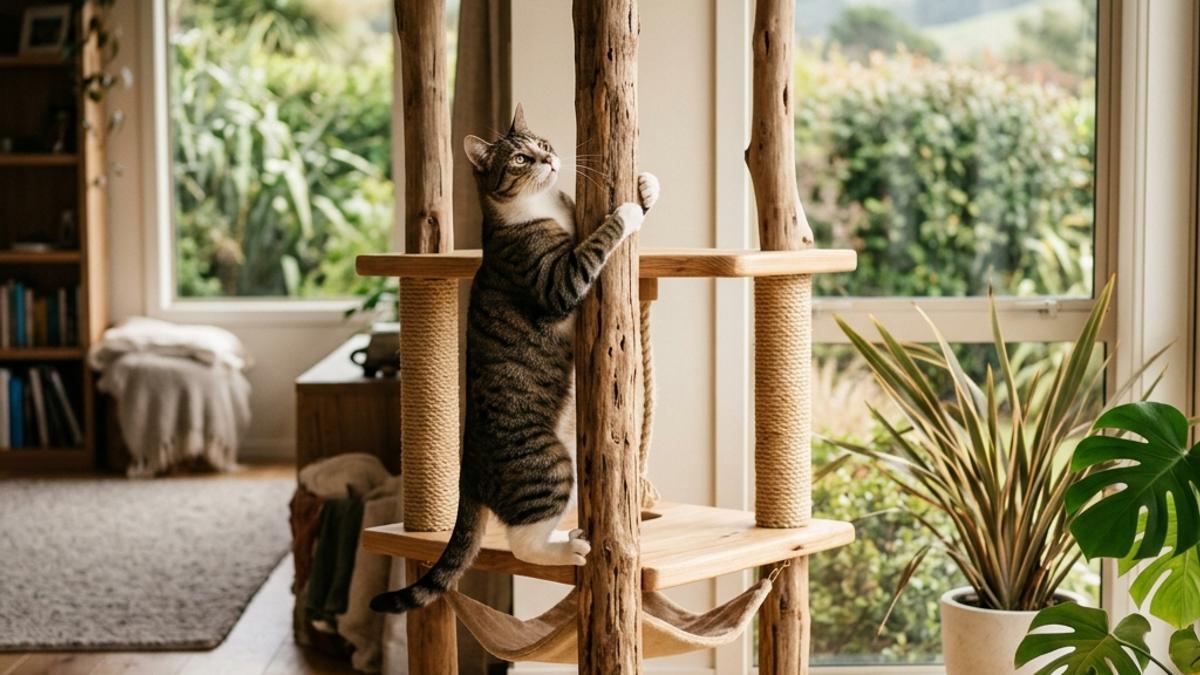
A freestanding unit with a stable base, multiple platforms at different heights, integrated scratching posts (usually sisal-wrapped), and often hammocks or enclosed hideaways. The most common type sold at NZ pet shops.
Pros:
- Self-contained — no wall mounting required; suitable for NZ rentals
- Usually includes scratching, climbing, perching, and hiding in one unit
- Wide range of sizes and price points — from $50 for a small single-post unit to $400+ for large multi-level towers
Cons:
- Base footprint can be substantial — a large cat tree in a small NZ flat may dominate a room corner
- Standard towers can wobble if poorly constructed — check the base width and platform weight ratings before purchasing, especially for large breeds (Maine Coon, Ragdoll)
- Carpet-covered surfaces collect hair and dander; synthetic platforms are easier to clean
NZ flat/apartment note: Check the base dimensions before buying. A tower with a 40 × 40 cm base is significantly more stable and takes less space than one with a narrow base, but both are viable in standard NZ apartment rooms.
Best for: Most NZ households, especially renters who can't drill walls.
---
2. Modular/expandable cat furniture systems
A modular system of individual pieces — platforms, steps, bridges, scratching posts, and hiding boxes — that attach to each other or to a shared mounting surface, allowing custom configuration.
Pros:
- Highly configurable — can be arranged to suit your NZ home layout and expand over time
- Often better quality construction than standard towers — the best-known systems (such as those from Catswall Design, MaupetTree, and similar brands) are durable and stable
- Individual elements can be replaced when worn rather than the whole unit
Cons:
- Generally more expensive per total surface area than standard towers
- May require planning to configure well — random arrangements don't always work functionally
- Some modular systems do require wall mounting for stability
Best for: Long-term cat owners with a specific space in mind who want to build a lasting setup.
---
3. Wall-mounted shelving / cat shelves
Individual brackets, shelves, and perches mounted directly to the wall, creating a route for the cat to travel across the room at height.
Pros:
- Zero floor space — the entire structure is on the wall
- Visually clean if designed well — some systems (Catastrophic Creations, floating shelf systems) look like design features rather than pet furniture
- Excellent for multi-cat households where elevated territory reduces conflicts
- Cats that prefer to survey from height (which is most cats) often use these in preference to standard trees
Cons:
- Requires wall mounting — not suitable for most NZ rentals without landlord permission. The holes required for secure mounting are significant.
- Load rating matters: a 7 kg Maine Coon launching themselves at a bracket needs that bracket rated for dynamic load, not just static weight
- Carpeted shelf surfaces wear and accumulate hair; replaceable surface covers are worth choosing
NZ rental note: Some NZ landlords will approve removable mounting systems (toggle bolts with patch-repairable holes) — check your tenancy agreement. Free-standing alternatives (standard towers) are the rental-safe option.
Best for: Cat owners in owned properties with multiple cats and specific space constraints.
---
4. Floor-to-ceiling tension poles / cat poles
Poles that extend from floor to ceiling using spring tension — no drilling required. Platforms, perches, and hammocks attach along the pole length.
Pros:
- No drilling — the most rental-friendly elevated option that doesn't require floor footprint
- Genuinely stable when properly tensioned — the pole wedges between floor and ceiling
- The vertical orientation suits narrow spaces (alcoves, beside windows)
- Some NZ cats use these in preference to standard trees due to the satisfying climb
Cons:
- NZ ceiling heights vary — most poles accommodate 240–300 cm ceiling heights; very high NZ ceilings (villa/character homes) may need custom-length poles
- Fewer platform options than a wide tree; a wide-mouthed cat may find the compact platforms less comfortable for lounging
- Installation: ensure the ceiling surface is solid — hollow plasterboard ceilings without backing can be damaged by tension poles in heavy-use positions
Best for: NZ renters in apartments or flats who want vertical space without floor space or wall drilling.
---
5. Cat towers with outdoor/large breed ratings
Standard towers but sized for large breeds — heavier duty sisal, wider platforms (40 cm+), stable wide bases.
What to look for:
- Platform dimensions: minimum 35 × 35 cm for a comfortable perch; 40 × 40 cm for a large cat to turn around
- Base stability: base should be wider than the widest platform for top-heavy structures
- Weight rating: check manufacturer ratings; a 9 kg Maine Coon plus dynamic landing load can destabilise a poorly rated unit
Best for: Maine Coon, Ragdoll, British Shorthair, Norwegian Forest Cat, and any cat over 6 kg.
---
What to look for when buying in NZ
- Sisal-wrapped posts: Natural sisal (not synthetic) is more satisfying for cats and lasts longer
- Replaceable covers: Some trees have removable/replaceable carpet or fleece platforms — useful for hygiene
- Stable base: Wobble test — push the top lightly; if it sways significantly, it's not safe
- Platform size: Should be large enough for your cat to turn a full circle without hanging off the edge
- Height vs NZ ceiling: Confirm the tallest unit fits comfortably in your room with clearance to spare
Related guides
- Indoor cat enrichment NZ
- Cat scratching post types NZ
- Best cats for busy professionals NZ
- Cat curfew NZ
- New kitten checklist NZ
---
References
- MPI Code of Welfare: Companion Cats: https://www.mpi.govt.nz/animals/animal-welfare/codes/all-animal-welfare-codes/code-of-welfare-companion-cats/
- AAFP/ISFM Feline Environmental Needs Guidelines (elevated space lets a cat monitor its environment and reduces inter-cat competition), checked 2026-08-04: https://www.canadianveterinarians.net/media/04gh2nhv/2013-aafp_isfm-environmental-needs-guidelines.pdf
---
*This guide provides general product guidance for NZ cat owners. Wall-mounting requirements vary by NZ property type — check with your landlord before drilling. Not a substitute for veterinary or behaviour advice.*
Related guides
petmall.co.nz
Shop at PetMall
The products below are practical support items for your pet. PetMall ships across New Zealand.
- Cat FoodStart with food that matches your cat's life stage — change brands slowly over 7–10 days to avoid digestive upset.
- Cat LitterClumping or crystal, most cats prefer an unscented litter and a clean tray — one tray per cat plus one spare is the NZ rule of thumb.
- Cat TreatsGreat for bonding and training — keep treats under 10% of daily calories to protect your cat's waistline.
- Cat ToysA small rotation of toys (feather wand, puzzle feeder, and comfort toy) usually works better than buying many at once.
- Cat GroomingRegular brushing cuts hairballs and shedding — essential for long-haired breeds like Ragdolls and British Longhairs.
- Flea & Worm TreatmentFor NZ conditions, choose protection that fits your cat's weight and lifestyle (indoor vs outdoor) and keep it regular.