Reptile Terrarium Setup NZ: Heat, UVB, Substrate & Starter Gear
Reptile terrarium setup NZ guide: choose enclosure size, heating, UVB, substrate, hides and safe gear for legal pet reptiles.
A safe reptile terrarium setup NZ owners can build starts with the species, not the tank. Check the reptile is legal to keep, then choose an enclosure, heat source, thermostat, UVB, substrate, hides and monitoring tools that match that species' needs.
Reptiles are not one-care-sheet pets. A leopard gecko, blue-tongue skink, bearded dragon and native gecko can need very different housing. This guide helps you buy the right categories of gear; it does not replace species-specific advice from an experienced reptile vet or keeper.
Quick Setup Table
| Setup item | Why it matters | Watch-outs |
|---|---|---|
| Legal species check | NZ has strict biosecurity and wildlife rules | Do this before buying gear |
| Secure enclosure | Prevents escape, injury and household risk | Match adult size, not baby size |
| Heat source | Reptiles rely on external heat | Use thermostats and guards where needed |
| Thermometer/hygrometer | Lets you check real conditions | Guessing room feel is not enough |
| UVB lighting | Needed by many diurnal reptiles | Species, distance and mesh matter |
| Substrate | Affects traction, hygiene and humidity | Avoid unsafe loose or dusty materials |
| Hides and cover | Reduces stress and supports behaviour | Provide warm and cool options |
| Cleaning kit | Keeps food, waste and shed skin managed | Use reptile-safe cleaning routines |
First: Is This Reptile Legal in NZ?
New Zealand is strict about reptiles because of biosecurity and native wildlife protection. MPI says snakes and other reptiles cannot generally be imported into New Zealand except some reptiles for zoos. MPI's pet biosecurity guidance also warns that exotic pets can carry disease or become pests, and owners should never release pets into the wild.
Before setting up a terrarium, confirm:
- The species is legal to keep in New Zealand.
- It was bred or obtained legally.
- You understand any permit or transfer rules.
- You have access to appropriate food, vet care and equipment.
- You can keep it securely for its whole life.
Use PetMall's legal reptile guide as a starting point, then check official sources if you are dealing with native species, permits or unusual animals.
Enclosure Size and Shape
Buy for the adult animal. A small juvenile enclosure may be useful temporarily, but a long-term terrarium needs enough floor space, climbing room or height for the species.
The RSPCA reptile housing guidance says enclosure placement and size should consider temperature, sunlight, disturbances and the space the reptile needs. That sounds simple, but it is where many beginner mistakes begin. A beautiful glass box in the wrong sunny window can overheat. A tall display tank may be poor for a ground-dwelling lizard that needs horizontal space.
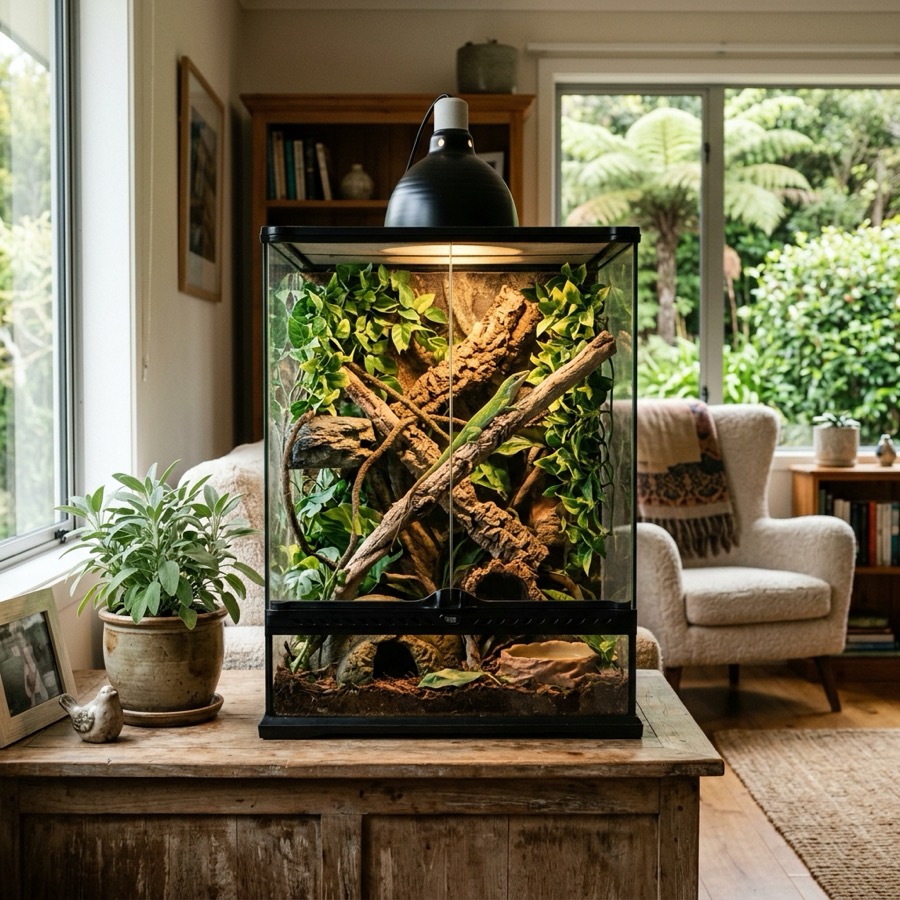
For NZ rentals and apartments, also think about stand strength, power points, ventilation and whether the enclosure can move safely if you shift house.
Heat: Buy the Control Gear Too
Reptiles need a controlled heat setup, not random warmth. Merck Veterinary Manual notes that reptile heat sources should be appropriately sized, thermostat-controlled, screened from the animals, and positioned toward one end of the enclosure to provide a thermal gradient.
For a shopping list, that usually means:
- A species-appropriate heat source.
- A thermostat or controller matched to the heat source.
- A reliable thermometer or temperature gun.
- A guard or safe placement so the reptile cannot burn itself.
- A warm side and a cooler side, not one uniform hot box.
This guide does not give exact temperatures because those depend on species, age, enclosure type and equipment. Use a species guide, reptile vet or experienced keeper for the actual range.
NZ angle: a Wellington flat, a sunny Tauranga lounge and a cold Southland spare room will not behave the same. Check the enclosure, not the weather app.
UVB and Lighting
Many reptiles need appropriate UVB and visible light, but the right product is species-specific. Merck notes UVB is especially important for many diurnal lizards and chelonians. RSPCA Australia's housing advice also warns that putting a reptile enclosure by a window is not a safe UVB solution, because glass filters UVB and direct sun can overheat the enclosure.
When choosing lighting, ask:
- Does this species need UVB?
- What type and strength is suitable?
- How far should it be from the basking area?
- Does mesh, glass or plastic block useful output?
- How often does the bulb need replacing?
- Does the animal also need shaded areas?
Use timers for day/night consistency. Do not run bright lights 24/7.
Substrate and Furnishings
Substrate should suit the species and support safe movement, hygiene and humidity. RSPCA Victoria's reptile care guidance notes that suitable flooring can vary by species, including options such as sand, smooth gravel, leaf litter or absorbent paper.
Beginner-friendly choices often prioritise easy cleaning while you learn. More naturalistic setups can be excellent, but only if you understand moisture, mould, impaction risk, live plants, drainage and cleaning.
Furnishings should include:
- At least one hide on the warm side and one on the cool side.
- Climbing branches or rocks if the species uses them.
- A water dish sized for the animal and enclosure.
- Rough surfaces for shedding, if appropriate.
- Visual cover so the reptile does not feel constantly exposed.
Avoid sharp decor, unstable rocks, untreated outdoor wood, sticky tape inside the enclosure and anything that can collapse onto the animal.
Humidity and Water
Humidity needs vary wildly. A desert species and a tropical species should not have the same setup. Buy a hygrometer, then learn the range for the actual animal.
SPCA New Zealand's bearded dragon advice says water dishes should be washed with reptile-safe soap and water when refilled. That is a small but useful reminder: reptiles still need clean basics. Water bowls, humid hides and damp substrates can become dirty if they are treated as set-and-forget decor.
For Auckland humidity, watch mould and poor ventilation. For dry, heated winter rooms in Canterbury or Otago, watch whether humidity drops too far for species that need more moisture. Again, measure inside the enclosure.
Safe Placement
Do not place a terrarium where it will get direct sun through glass. RSPCA Australia warns this can overheat reptiles, while the window glass does not provide useful UVB.
Good placement:
- Away from direct sun and draughty windows.
- Off the floor if the room is cold or busy.
- Away from cats, dogs and young children.
- Close enough to power for safe cable routing.
- Somewhere you can inspect, feed and clean without awkward lifting.
- Away from aerosol sprays, smoke and cooking fumes.
Use a drip loop and safe cable management around water bowls, misting systems and power boards.
NZD Cost Planning
Reptile setup is often more expensive than the animal. Budget before buying.
| Item | Rough NZD planning range | Notes |
|---|---|---|
| Starter enclosure | NZD $150-$500+ | Size and material drive cost |
| Heat source + thermostat | NZD $80-$220+ | Control gear is not optional |
| UVB and light fittings | NZD $80-$250+ | Species-specific and replacement bulbs needed |
| Thermometer/hygrometer | NZD $20-$100 | Use more than one measuring point |
| Substrate and hides | NZD $40-$180 | Replace or clean as needed |
| Cleaning and feeding gear | NZD $20-$80 | Tongs, dishes, disinfectant, spare tubs |
If budget is tight, wait. A cheap enclosure without safe heat control can become the most expensive mistake.
Key takeaways
- Reptile terrarium setup NZ choices start with a legal species check.
- Buy for the adult animal and the species' real movement style.
- Heat needs control gear: thermostat, monitoring and safe placement.
- UVB is species-specific; windows are not a safe UVB substitute.
- Substrate, hides and humidity should match the animal, not the shop display.
- Never release pet reptiles or unwanted animals into the wild.
Related reading
- Best Reptiles for NZ Beginners
- Leopard Gecko Care NZ
- Reptiles as Pets in NZ: Legal Guide
- Chameleons in NZ: Legal Rules & Setup Checks
- Reptiles Hub
---
Reference sources
- MPI, Bringing pets to NZ other than cats and dogs, checked 2026-06-04: https://www.mpi.govt.nz/bring-send-to-nz/pets-travelling-to-nz/bringing-pets-to-nz-other-than-cats-and-dogs/
- MPI, Stopping pets becoming pests, checked 2026-06-04: https://www.mpi.govt.nz/biosecurity/biosecurity-and-your-pets/
- RSPCA Australia Knowledgebase, Where should I keep my reptile?, checked 2026-06-04: https://kb.rspca.org.au/knowledge-base/where-should-i-keep-my-reptile/
- RSPCA Victoria, Reptiles & Frogs, checked 2026-06-04: https://rspcavic.org/learn/reptiles-and-frogs/
- Merck Veterinary Manual, Management and Husbandry of Reptiles, checked 2026-06-04: https://www.merckvetmanual.com/exotic-and-laboratory-animals/reptiles/management-and-husbandry-of-reptiles
- SPCA New Zealand, Caring for bearded dragons, checked 2026-06-04: https://www.spca.nz/advice-and-welfare/article/caring-for-bearded-dragons
Related guides
petmall.co.nz
Shop at PetMall
The products below are practical support items for your pet. PetMall ships across New Zealand.
- Food & FeedingMatch diet to species — feeders, supplements, and the right calcium/D3 dusting keep NZ reptiles healthy.
- Heating & LightingUVB and a proper heat gradient are the foundation of reptile health — get this right before anything else.
- Reptile SuppliesSubstrate, hides, and enclosure gear — stable conditions are the foundation of reptile health in NZ.