Great Pyrenees vs Bernese Mountain Dog NZ: Two Gentle Giants Compared
Great Pyrenees or Bernese Mountain Dog for your NZ family? Both are large, gentle, family-friendly breeds — but they differ in trainability, lifespan, NZ climate suitability and grooming needs.
Both the Great Pyrenees and the Bernese Mountain Dog are large, gentle, family-oriented breeds that appear on many NZ dream dog lists. They share a majestic appearance and a reputation for being calm and kind with children — but they differ in important ways, including temperament, trainability, lifespan, and how they handle NZ's climate.
Side-by-side overview
| Great Pyrenees | Bernese Mountain Dog | |
|---|---|---|
| Weight | 39–54 kg | 36–52 kg (male); 32–43 kg (female) |
| Lifespan | 10–12 years | 7–10 years |
| NZ Price (breeder) | $1,800–$3,500 | $3,000–$5,000 |
| NZ Price (adoption) | $200–$450 via SPCA | $150–$350 via SPCA |
| Energy level | ★★★☆☆ | ★★★☆☆ |
| Trainability | ★★★☆☆ | ★★★★☆ |
| Grooming needs | ★★★★☆ | ★★★☆☆ |
| Apartment suitability | ★☆☆☆☆ | ★★☆☆☆ |
| Good with kids | ★★★★★ | ★★★★★ |
| Good with other pets | ★★★★☆ | ★★★★☆ |
*Scores from PetMall breed profiles (1–5). Both breeds need substantial space and are not suited to apartments.*
Temperament
The Great Pyrenees was bred for millennia as a livestock guardian dog — specifically, to stay with and protect flocks of sheep in the Pyrenees mountains between France and Spain, often working entirely without human supervision for days or weeks at a time. This heritage produces a dog that is independently minded, protective, calm under pressure, and capable of making its own decisions. Pyrenees are gentle with family members but can be territorial and aloof with strangers. They tend to bond deeply with their household but are not dogs that seek constant human approval — they were bred to function independently.
The Bernese Mountain Dog has a different working heritage — it was used as a draft dog (pulling carts) and farm dog in the Bernese Oberland region of Switzerland, where it needed to work *with* people and respond to commands. This makes the Bernese notably more trainable, biddable, and responsive to direction than the Pyrenees. Berners are famously warm, sociable, and eager to please — they're more openly affectionate with family and generally friendlier with strangers. Their friendliness score (★★★★★) reflects this broader social warmth.
Lifespan: the most important practical difference
The Bernese Mountain Dog's relatively short lifespan — 7–10 years on average — is a known characteristic of the breed. For context, that's among the shorter lifespans of large dog breeds. Large breeds typically live shorter lives than small breeds, and Berners fall at the short end of the large-breed range.
This is not a minor consideration for NZ families. A dog purchased for a young family may be at the end of its life before children are old enough to remember it clearly. This reality is worth factoring in honestly — it's not a reason to avoid the breed, but it's a reason to go in with clear expectations.
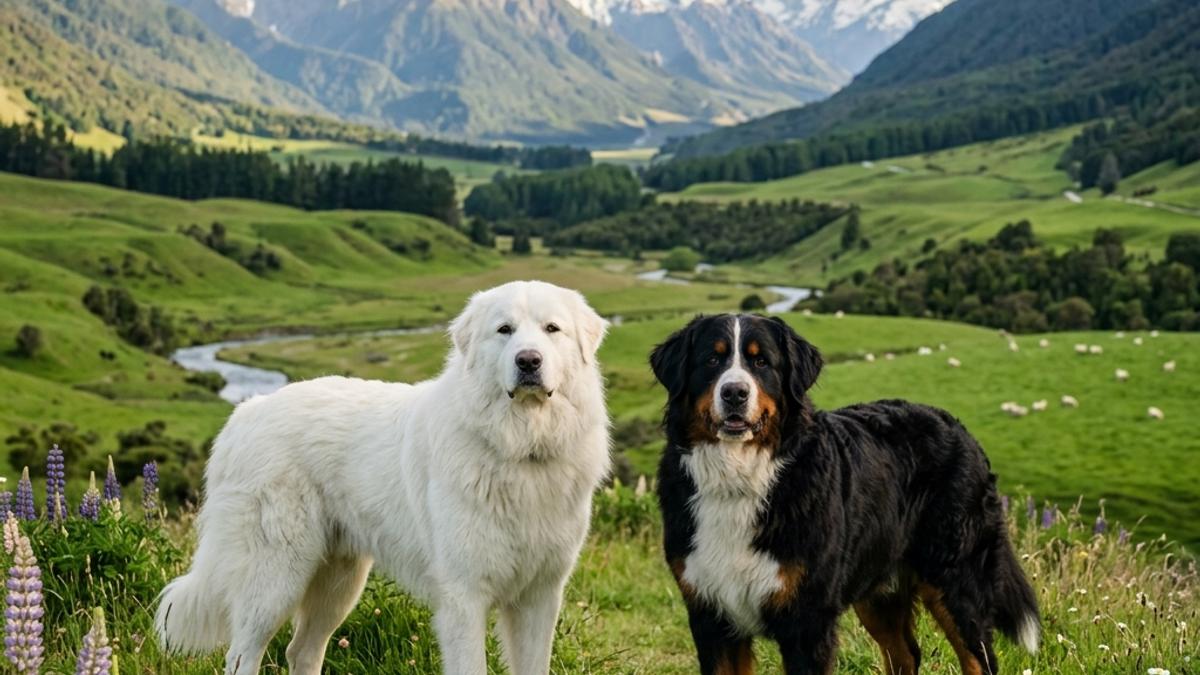
The Great Pyrenees lives 10–12 years — not dramatically longer, but meaningfully so given the Berner's baseline. Some Pyrenees live to 14+.
Ask any Bernese breeder about health testing — responsible NZ Berner breeders test for hip and elbow dysplasia, and some test for von Willebrand's disease. Cancer rates are unfortunately elevated in the breed, which contributes to the shorter lifespan.
Training
The Bernese Mountain Dog (★★★★☆) is significantly more trainable than the Great Pyrenees (★★★☆☆). Berners are responsive, enjoy learning, and succeed in obedience and even competitive dog sports. They take well to reward-based training from puppyhood.
Great Pyrenees are intelligent — but that intelligence is applied to independent decision-making rather than compliance with human commands. A Pyrenees will follow a command if it agrees the command makes sense; if it doesn't, it may simply ignore you. This is normal for the breed, not a training failure. Recall is particularly difficult to establish reliably — Pyrenees should be in securely fenced areas, as their livestock guardian instinct can take them long distances if they detect a perceived threat. See our dog recall training guide.
NZ climate considerations
Both breeds are cold-climate adapted and can struggle in warm, humid conditions.
- Great Pyrenees: The thick white double coat provides insulation against cold and some protection from sun — it actually helps regulate temperature both ways if kept properly groomed and not shaved. However, in Auckland or Northland's humid summers, heat management is essential.
- Bernese Mountain Dog: Similar cold-climate adaptation. Berners also struggle in warm weather. Access to shade, fresh water, and cool indoor spaces during NZ summer is important for both breeds.
Both suit South Island or elevated NZ locations better than warm northern regions. If you're in a warmer NZ region, ensure climate-controlled indoor access, and limit exercise to cooler parts of the day in summer. See our NZ summer pet safety guide.
Space requirements
Neither breed is suitable for apartments (Pyrenees: ★☆☆☆☆; Bernese: ★★☆☆☆). Both need:
- A large, securely fenced section — particularly the Pyrenees, which may roam to investigate perceived threats
- Enough space for a large dog to move comfortably inside the house
- Indoor living (these are not outdoor-kennel dogs despite their size)
A lifestyle block or large suburban section suits both. See best dog breeds for lifestyle blocks and farms NZ.
Cost and practicalities
Bernese Mountain Dogs are typically more expensive to purchase ($3,000–$5,000 from NZ breeders) than Great Pyrenees ($1,800–$3,500). Both are large dogs, so ongoing food costs, vet costs, and boarding costs are proportionally higher than medium-sized breeds.
For budgeting, see our cost of owning a dog NZ guide. Registration under the NZ Dog Control Act is required regardless of breed — see our dog registration guide.
Who each breed suits in NZ
Great Pyrenees suits you if:
- You want a gentle, protective giant with independent character
- You have a large property, ideally with livestock or as a lifestyle block dog
- You can accept lower trainability and less predictable recall
- You're in a cooler NZ region
- You want a longer-lived large breed (10–12 years)
Bernese Mountain Dog suits you if:
- You want a large family dog that's highly trainable and genuinely responsive
- You want a breed that's exceptionally warm, friendly, and sociable with your whole household
- You're in a cooler NZ region with good shade and ventilation in summer
- You can prepare emotionally and practically for a 7–10 year lifespan
Both suit you if:
- You have a large fenced section and cool indoor access
- You want a gentle giant that's excellent with children
Use our Find a Breed tool to compare more large breeds.
Quick takeaways
- Both are large, gentle, family-friendly breeds — excellent with children
- Bernese is more trainable and sociable; Pyrenees is more independent and protective
- Bernese lifespan (7–10 years) is notably shorter — an important factor for family planning
- Great Pyrenees needs secure fencing due to its tendency to roam
- Both need cool indoor access in NZ's warmer regions
See also
- Great Pyrenees breed profile
- Bernese Mountain Dog breed profile
- Great Dane vs Saint Bernard NZ
- Best dog breeds for lifestyle blocks and farms NZ
- NZ summer pet safety
- Find a Breed
---
References
- American Kennel Club (AKC), Great Pyrenees Breed Information: https://www.akc.org/dog-breeds/great-pyrenees/
- American Kennel Club (AKC), Bernese Mountain Dog Breed Profile: https://www.akc.org/dog-breeds/bernese-mountain-dog/
- Merck Veterinary Manual, Hip Dysplasia in Dogs: https://www.merckvetmanual.com/musculoskeletal-system/arthropathies-and-related-disorders-in-small-animals/hip-dysplasia-in-dogs
- MPI New Zealand, Code of Welfare for Dogs, checked 2026-06-05: https://www.mpi.govt.nz/animals/animal-welfare/codes/all-animal-welfare-codes/code-of-welfare-dogs/
---
*This guide provides general information. Individual dogs vary — consult a registered NZ vet and reputable breeders before choosing either breed.*
Free PetMall tools
Related guides
petmall.co.nz
Shop at PetMall
The products below are practical support items for your pet. PetMall ships across New Zealand.
- Dog FoodStart with food that matches your dog's life stage and activity level — and change brands slowly over 7–10 days.
- Dog TreatsTraining rewards and everyday treats — small, soft pieces work best for consistent reinforcement.
- Dog ToysA small rotation of chew, fetch, and puzzle toys usually works better than buying a large variety at once.
- Dog GroomingA gentle brush and the right shampoo make maintenance easier — especially for dogs that get muddy on walks.
- Leads & HarnessesComfort matters: padded contact points and adjustable fit help reduce rubbing on longer walks or tramping weekends.
- Flea & Worm TreatmentFor NZ conditions, look for protection that fits your routine (monthly vs longer-lasting) and your dog's weight range.