Great Dane vs Saint Bernard NZ: Which Giant Breed Is Right for You?
Great Dane or Saint Bernard? Both are massive, gentle NZ giant breeds — but different in energy, drool level, lifespan and NZ lifestyle fit. Compare before you commit.
Choosing a giant dog breed is one of the biggest lifestyle decisions a NZ dog owner can make — and it needs to be made with eyes fully open. Both the Great Dane and the Saint Bernard are gentle giants with calm temperaments and enormous size, but they differ meaningfully in energy level, drool, health risks and cost. Here's the honest comparison.
Quick comparison
| Great Dane | Saint Bernard | |
|---|---|---|
| Size | Giant — 45–90 kg, 71–86 cm | Giant — 64–120 kg, 65–90 cm |
| Lifespan | 7–10 years | 8–10 years |
| Energy level | Moderate — surprisingly calm indoors | Low–moderate |
| Drool | Moderate (varies by line) | Very high — breed-defining |
| Grooming | Very low | Moderate (roughcoat sheds heavily) |
| Exercise (daily) | 45–60 minutes | 30–45 minutes |
| Good with kids? | Yes — gentle and patient | Yes — famously gentle |
| NZ price estimate | $2,000–$4,000 | $2,000–$4,000 |
Full profiles: Great Dane · Saint Bernard
Size: understanding what "giant" actually means
Great Dane: tall and lean — the world's tallest dog breed. A male Great Dane can reach 86 cm at the shoulder and weigh over 70 kg. They're physically massive but not heavy in a compact way — they're more like a large, elegant structure than a dense block. Their size is primarily vertical.
Saint Bernard: massive and broad — the world's heaviest dog breed. A large male Saint Bernard can exceed 100 kg. Their weight is proportional and dense — they're heavy-boned and heavy-bodied. Saint Bernards require more physical space to move around and more food per day than most Great Danes.
In NZ practical terms: both breeds need large vehicles, large houses (not apartments), large furniture (a Great Dane will want to be on the couch — that's 65+ kg of dog) and large veterinary bills when anything goes wrong.
The drool question
This is not trivial. Saint Bernards drool copiously — it is an unavoidable feature of the breed's long, loose lips and jowls. There are Saint Bernard owners who keep towels in every room and accept it as part of the experience. There are people who genuinely cannot cope with the amount of drool. You need to honestly assess which camp you're in before committing.
Great Danes vary more by line and individual — some are relatively dry-mouthed; heavier-jowled individuals drool more. Generally less extreme than a Saint Bernard.
Temperament
Both breeds are famously gentle, calm and family-oriented.
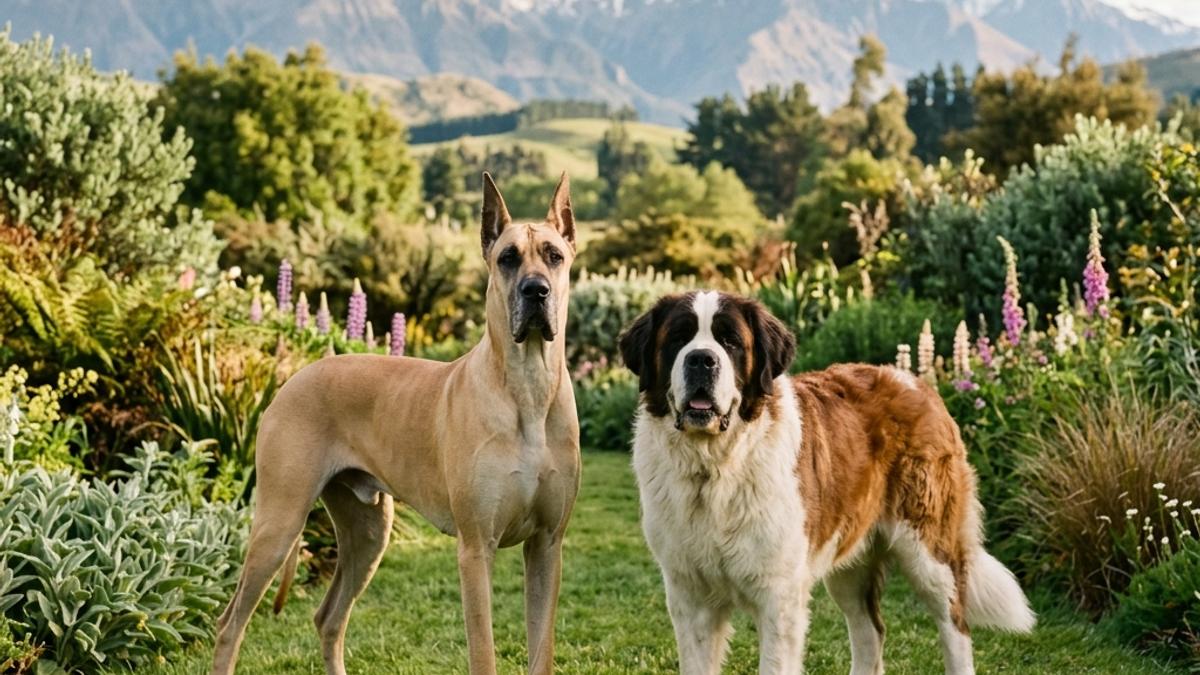
Great Dane: confident and dignified. They're alert without being reactive, affectionate without being clingy, and generally have good impulse control for their size once mature. Puppies are a different story — a 40 kg Great Dane puppy is still a boisterous puppy with all the coordination issues that implies. Early training to establish gentle leash manners and "four on the floor" behaviour is non-negotiable. See our stop dog pulling on the lead NZ guide — a Great Dane that pulls is genuinely difficult to manage physically.
Saint Bernard: slower, more placid and more patient even than a Great Dane. They're often considered one of the most gentle breeds in existence, particularly with children. They're less energetic indoors and are content with a comfortable bed and regular short walks. Their patience can shade into stubbornness — Saint Bernards are not the most biddable dogs and training needs to start early to establish habits before they're full size.
Exercise needs
Both breeds need less vigorous exercise than their size might suggest — another counterintuitive feature of giant breeds.
Great Dane: 45–60 minutes daily. They enjoy a good walk but are not high-endurance dogs. Avoid excessive exercise in the first 18–24 months while the giant skeleton is still developing — over-exercise of a growing Great Dane can contribute to joint damage.
Saint Bernard: 30–45 minutes daily. They tire more easily than a Great Dane due to their weight. They thrive with gentle, regular walks rather than vigorous exercise. They're not suitable for running companions but are excellent for slow, enjoyable walks in NZ's cooler regions.
NZ climate note: both breeds struggle with heat. Great Danes and Saint Bernards have limited heat tolerance — avoid exercise in NZ's hot midday conditions (particularly Northland, Hawke's Bay, Nelson summers). Saint Bernards, with their heavier coats, suffer more in heat. Both breeds need access to shade and fresh water in all conditions.
Grooming
Great Dane: short, smooth coat. Very easy to maintain — weekly wipe-down, occasional bath. Very low shedding.
Saint Bernard: comes in two coat varieties:
- *Shorthair:* dense double coat with moderate shedding — manageable with weekly brushing
- *Roughcoat (longhair):* heavy double coat with significant seasonal shedding. Requires brushing 2–3 times weekly and is particularly heavy during NZ autumn and spring shed seasons.
Either Saint Bernard variety sheds more than a Great Dane.
Health: both breeds carry significant giant-breed risks
*General information only — consult a registered NZ vet for your dog's specific health care.*
Giant breeds as a category have higher health risks and costs than average-sized dogs, and shorter lifespans. Both breeds below 10 years average lifespan is the honest reality.
Great Dane is prone to:
- Bloat/GDV (Gastric Dilatation-Volvulus): the leading cause of death in Great Danes. Deep-chested, fast-eating giant breeds are at high risk. A slow feeder, two smaller meals per day (not one large), and avoiding vigorous exercise within 1–2 hours of feeding significantly reduce risk. Many Great Dane owners elect to have prophylactic gastropexy (tacking the stomach) done during desexing surgery — discuss with your NZ vet.
- Hip dysplasia (buy from hip-scored lines)
- Cardiomyopathy (buy from cardiac-tested lines)
- Wobbler syndrome (cervical instability)
Saint Bernard is prone to:
- Hip and elbow dysplasia (buy from scored lines — essential given the body weight on joints)
- Bloat/GDV (similar deep-chest risk to Great Danes)
- Heart conditions (including sub-aortic stenosis — cardiac screening of breeding dogs)
- Eye conditions (entropion — eyelid rolling inward)
- The sheer weight of a Saint Bernard places extraordinary stress on joints throughout life
Both breeds have significant veterinary care costs over their lifespans. Pet insurance in NZ is strongly recommended for both — a single bloat/GDV surgery can cost $5,000–$10,000+.
NZ cost and ongoing expenses
Purchase price: $2,000–$4,000 from responsible NZ breeders for either breed.
Food: giant breeds eat significantly more than average dogs. A Great Dane may eat 4–6 cups of large-breed kibble per day; a Saint Bernard up to 7–8 cups. NZ premium large-breed kibble costs add up.
Veterinary: giant-breed vet costs (anaesthesia doses, surgery complexity, medication amounts) are typically higher than smaller breeds. Factor in GDV risk and joint disease management costs.
Equipment: large crates, large beds ($200–$500+), large vehicles or a vehicle modification — all significant costs.
Which breed suits you?
Choose a Great Dane if:
- You want a tall, elegant giant that's moderate in energy and exercise needs
- Less drool is preferred (varies, but generally less than a Saint Bernard)
- You're comfortable with the GDV risk and ideally will discuss prophylactic gastropexy with your vet
- You prefer a confident, dignified dog over an extremely placid one
Choose a Saint Bernard if:
- You want the ultimate calm, patient family giant
- NZ's cooler regions are where you live — Saint Bernards handle South Island/Central Otago winters well
- Drool doesn't concern you (be honest with yourself here)
- You prefer lower exercise needs and extreme gentleness above all other traits
For both breeds: research NZ breeders carefully, buy from health-tested lines, and honestly assess your home size, vehicle, budget and commitment to a 8–10 year relationship with a very large dog.
Quick takeaways
- Both are calm, gentle NZ giant breeds — the decision comes down to size preference, energy, drool and NZ climate
- Great Danes are taller and leaner; Saint Bernards are heavier, calmer and drooly
- Both have significant health risks (GDV especially) and short lifespans of 7–10 years
- Both need early leash training — a full-grown giant pulling on lead is physically dangerous
- Heat sensitivity is real for both breeds in NZ's warmer regions
- Budget carefully: food, vet, equipment costs are substantially higher than medium-sized dogs
Related reading
- Great Dane breed profile NZ
- Saint Bernard breed profile NZ
- Pet Bowl Types NZ (slow feeders for GDV-risk breeds)
- Stop a Dog Pulling on the Lead NZ
- Best Family Dog Breeds NZ
- Compare any two breeds side by side
---
References
- Merck Veterinary Manual, "Gastric Dilation and Volvulus in Small Animals" — GDV is an acute, life-threatening emergency, and Great Danes and Saint Bernards are named among the deep-chested breeds at highest risk; checked 2026-07-07: https://www.merckvetmanual.com/digestive-system/surgical-problems-of-the-gastrointestinal-tract-in-small-animals/gastric-dilation-and-volvulus-in-small-animals
- Orthopedic Foundation for Animals (OFA), "Hip Dysplasia" — radiographic screening and grading of breeding dogs to reduce inherited hip dysplasia, essential given the joint loading in both giant breeds; checked 2026-07-07: https://ofa.org/diseases/hip-dysplasia/
---
*This guide provides general breed-comparison information for NZ prospective dog owners. Health information is general only — consult a registered NZ vet for advice specific to your dog.*
Free PetMall tools
Related guides
petmall.co.nz
Shop at PetMall
The products below are practical support items for your pet. PetMall ships across New Zealand.
- Dog FoodStart with food that matches your dog's life stage and activity level — and change brands slowly over 7–10 days.
- Dog TreatsTraining rewards and everyday treats — small, soft pieces work best for consistent reinforcement.
- Dog ToysA small rotation of chew, fetch, and puzzle toys usually works better than buying a large variety at once.
- Dog GroomingA gentle brush and the right shampoo make maintenance easier — especially for dogs that get muddy on walks.
- Leads & HarnessesComfort matters: padded contact points and adjustable fit help reduce rubbing on longer walks or tramping weekends.
- Flea & Worm TreatmentFor NZ conditions, look for protection that fits your routine (monthly vs longer-lasting) and your dog's weight range.