Sphynx vs Devon Rex NZ: Which Low-Shedding, People-Focused Cat Is Right for You?
Sphynx or Devon Rex? Both are low-shedding, highly social NZ cat breeds that bond intensely with their owners. Compare appearance, care needs and personality to choose yours.
Both breeds appeal to NZ cat owners who want an intensely social, low-shedding companion — but they're more different than they look at first glance. The Sphynx is hairless and requires surprisingly involved skin care; the Devon Rex has a delicate wavy coat that sheds minimally but needs its own maintenance. Both are "people cats" that do not suit owners who want an independent, low-interaction pet.
Quick comparison
| Sphynx | Devon Rex | |
|---|---|---|
| Coat | Hairless (soft suede feel) | Short wavy/curly, very fine — minimal shedding |
| Size | Medium — 3.5–7 kg | Small-medium — 3–5 kg |
| Energy level | Very high | High |
| Temperament | Extremely social, demanding | Very social, playful, pixie-like |
| Talkativeness | Moderate-high | Moderate |
| Warmth-seeking | Extreme — will seek heat sources | High |
| Good with kids? | Yes, with active children | Yes |
| NZ price estimate | $1,500–$3,000 | $1,200–$2,500 |
| Grooming | Weekly bathing required | Gentle brushing 2–3x weekly |
Full profiles: Sphynx · Devon Rex
Appearance
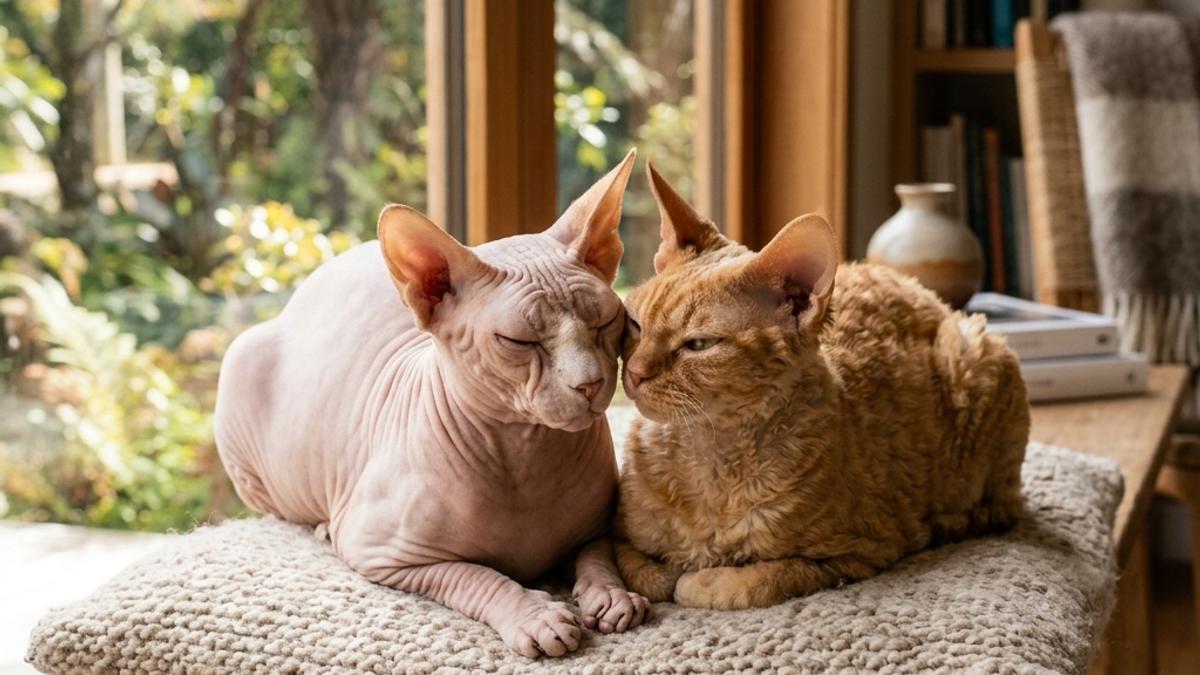
Sphynx: not quite hairless — covered in a very fine peach-fuzz down that gives the skin a warm, suede-like feel. The exposed skin shows every wrinkle and the cat's actual pigmentation (a black Sphynx has dark grey/black skin). Large ears, distinctive angular face and warm, pot-bellied appearance. They are immediately striking and generate strong reactions.
Devon Rex: has a short, wavy, elfin coat that looks like an artistic rendering of a cat's fur. Large ears, large eyes, triangular face and a compact, slightly angular body. The "pixie cat" appearance is consistently described as distinctive and otherworldly. Their coat is fragile — the delicate wavy hair breaks easily, which is why brushing technique matters.
Temperature and NZ climate
Sphynx: hairless cats lose body heat rapidly and will actively seek the warmest spot available at all times — on you, under duvets, near heaters, in sunny patches. In New Zealand's cooler regions (Central Otago, Southland, Canterbury in winter) a Sphynx will need a heated indoor environment. Jumpers and cat coats are genuinely useful for Sphynx cats, not just aesthetic accessories.
Devon Rex: also feels cold more easily than fully-coated breeds, but has better insulation than a Sphynx. NZ winters in cooler regions are manageable with good indoor heating and warm sleeping spots. Both breeds are strictly indoor-only recommendations for NZ — outdoors in cool weather is uncomfortable for both, and both have no UV protection.
Skin and coat care
This is the most underestimated ownership consideration for both breeds.
Sphynx: the absence of fur means body oils accumulate on the skin (coat would normally absorb them). This needs to be managed with weekly bathing — a proper gentle cat bath, not just a wipe-down. Without regular bathing, Sphynx cats become greasy and develop blackhead-like build-up in skin folds. Ears also produce more wax than coated cats and need weekly cleaning. This is genuinely more grooming work than most fully-coated cat breeds.
Devon Rex: the fine wavy coat is beautiful but fragile. Over-brushing breaks the delicate hairs and creates bald patches. The coat should be gently stroked with a very soft bristle brush or simply a hand wipe 2–3 times weekly — enough to remove loose hair, not vigorous brushing. Ear cleaning weekly. Nails need regular trimming (shared with Sphynx — both tend to accumulate grime around nail beds without fur to keep it off).
Personality
Sphynx: among the most extroverted and demanding of all cat breeds. Sphynx cats will follow you from room to room, greet visitors at the door, sleep on your head and generally insert themselves into every activity. They're playful, enjoy learning tricks and are genuinely dog-like in their engagement. A Sphynx left alone for extended periods will protest loudly and destructively. They need either constant human company or a compatible cat companion.
Devon Rex: equally social and playful, but with a slightly more impish, mischievous quality — they are often described as "pixie cats" for their elfin appearance and tendency to get into things. Devons are inventive and will problem-solve (open doors, raid cupboards). They're affectionate and enjoy laps and shoulders, but slightly less overwhelming in their social demands than a Sphynx. Still not a low-interaction breed — they want to be involved.
Both breeds do well in multi-pet households and adapt to dogs that will accept them. Neither suits a household where they'll be alone all day without enrichment or company.
Health considerations
*General information only — consult a registered NZ vet for your cat's specific health care.*
Sphynx cats are prone to hypertrophic cardiomyopathy (HCM — the leading cause of cardiac disease in cats generally, but elevated in Sphynx), hereditary myopathy (a muscle weakness condition in some lines) and skin conditions related to their hairless state. Reputable NZ Sphynx breeders should echocardiogram-screen breeding cats for HCM. Average lifespan is 9–15 years.
Devon Rex are also prone to HCM, as well as Devon Rex myopathy (hereditary muscle weakness, DNA testable) and patellar luxation. Reputable NZ Devon Rex breeders screen for these. Average lifespan is 9–15 years.
Both breeds have elevated HCM risk compared to moggies — factor in annual or bi-annual cardiac monitoring costs with your NZ vet.
How big is the Sphynx risk in NZ specifically? A 2024 study in *Animals* echocardiogram-screened 55 apparently healthy Sphynx cats in New Zealand and diagnosed HCM in 40% of them, at a median age of 5.8 years (range 2.4–13.1 years). Two things follow for Kiwi buyers: this is not a rare overseas problem, and because HCM prevalence rises with age, one clear scan on a young cat is not a lifetime clearance — for breeding cats and for your own cat, repeat screening as they age.
Cost in NZ
Both are specialist breeds:
- Sphynx: $1,500–$3,000 from reputable NZ breeders
- Devon Rex: $1,200–$2,500
Both have waitlists from quality breeders — demand typically exceeds supply for well-bred kittens. Beware cheap listings that cut corners on HCM screening.
Which breed suits you?
Choose a Sphynx if:
- The hairless appearance specifically appeals to you
- You're prepared for weekly bathing as a genuine maintenance routine
- You want the most socially demanding, attention-seeking cat companion available
- You live in a warmer NZ region (Auckland, Waikato, Bay of Plenty, Nelson) or have a well-heated home
Choose a Devon Rex if:
- You want a low-shedding companion without the hairless appearance and bathing requirements
- You prefer a slightly more manageable social demand than a Sphynx
- You love the distinctive wavy coat and pixie appearance
- You're interested in a more mischievous, inventive personality type
For either breed: do not buy without HCM screening documentation from the breeder. Do not leave them alone all day. Do provide warm indoor environments and companion animals or consistent human presence.
Quick takeaways
- Both are low-shedding, highly social NZ cats that bond intensely and need constant company
- Sphynx requires weekly bathing (skin oil management) — more care than most coated breeds
- Devon Rex requires gentle handling of its fragile wavy coat — no vigorous brushing
- Both seek warmth actively and need heated NZ homes in cool regions
- Both have elevated HCM cardiac risk — health-screened breeders are essential
- Sphynx is the more socially demanding; Devon Rex is slightly more independent but still very people-focused
Related reading
- Sphynx cat breed profile NZ
- Devon Rex cat breed profile NZ
- Best Low-Shedding Cat Breeds NZ
- Cat Grooming at Home NZ
- Best Cat Breeds for First-Time Owners NZ
- Cat hub — breeds and guides
---
References
- VCA Hospitals — Sphynx cat breed profile, checked 2026-07-08: https://vcahospitals.com/know-your-pet/cat-breeds/sphynx
- Animals (Basel), 2024 — Prevalence of Hypertrophic Cardiomyopathy and ALMS1 Variant in Sphynx Cats in New Zealand (55 NZ cats screened, HCM in 40%, median age 5.8 years), checked 2026-07-31: https://pmc.ncbi.nlm.nih.gov/articles/PMC11428990/
---
*This guide provides general breed-comparison information for NZ cat owners. Health information is general only — consult a registered NZ vet for advice specific to your cat.*
Free PetMall tools
Related guides
petmall.co.nz
Shop at PetMall
The products below are practical support items for your pet. PetMall ships across New Zealand.
- Cat FoodStart with food that matches your cat's life stage — change brands slowly over 7–10 days to avoid digestive upset.
- Cat LitterClumping or crystal, most cats prefer an unscented litter and a clean tray — one tray per cat plus one spare is the NZ rule of thumb.
- Cat TreatsGreat for bonding and training — keep treats under 10% of daily calories to protect your cat's waistline.
- Cat ToysA small rotation of toys (feather wand, puzzle feeder, and comfort toy) usually works better than buying many at once.
- Cat GroomingRegular brushing cuts hairballs and shedding — essential for long-haired breeds like Ragdolls and British Longhairs.
- Flea & Worm TreatmentFor NZ conditions, choose protection that fits your cat's weight and lifestyle (indoor vs outdoor) and keep it regular.