How to Stop a Dog Barking NZ: Positive Training for Neighbour Peace
Stop dog barking NZ guide: find the trigger, reduce rehearsals, reward quiet choices, handle neighbour complaints and use enrichment safely.
To stop a dog barking in NZ, first work out what the barking is doing for the dog. Barking at the gate, window, courier, neighbours, other dogs or when bored all need slightly different plans. Use management to reduce repeated barking, reward quiet alternatives, add exercise and enrichment, and handle neighbour concerns calmly. Punishment and anti-bark devices are not the answer.
Barking is information
Barking is normal dog communication. The problem is not that your dog has a voice; the problem is when barking becomes frequent, intense, or disruptive in a flat, townhouse, suburban section or close-fenced street.
SPCA New Zealand's excessive barking advice starts with the cause. Dogs may bark because of boredom, excitement, fear, breed tendencies, barrier frustration, visitors, other dogs, lack of enrichment, or changes in routine. If barking has changed suddenly or seems linked to discomfort, involve your vet or a qualified professional before treating it as a simple training issue.
For everyday barking patterns, the training question is: what does the dog get from barking? Distance from a scary thing? Attention? Access to the window? The courier leaving? A burst of excitement? Once you know the payoff, you can change the setup.
Start a barking diary
For three days, write down:
- Time of day.
- Where the dog was.
- What happened just before the barking.
- How long it lasted.
- What made it stop.
- Whether the dog had exercise, food, toileting and rest.
Patterns appear quickly. A dog who barks at 3 pm when school kids pass the fence needs a different plan from a dog who barks at possums at night or hallway sounds in an apartment building.
In NZ homes, common triggers include courier vans, rubbish trucks, neighbours walking past shared driveways, cats on fences, kids on scooters, visitors at the gate, birds on the lawn, and dogs passing close to windows.
Cut down rehearsal first
Training is hard if your dog practises the barking loop all day. Management is not cheating; it stops the habit getting stronger while you teach.
Try the simplest changes first:
| Barking setup | Management change |
|---|---|
| Window or gate watching | Block the view with film, curtains, a baby gate or moving furniture |
| Fence running | Bring the dog inside during peak footpath times |
| Couriers at the door | Use a parcel drop spot away from the main window |
| Hallway noises | Play low background sound and reward calm mat time |
| Night noises | Bring the dog into a quieter sleeping area |
| Bored backyard barking | Add sniff walks, puzzle feeding and supervised indoor rest |
This is especially important in Auckland apartments, Wellington townhouses, Christchurch subdivisions and any shared-wall housing where barking travels faster than you expect.
Teach "hear it, check in"
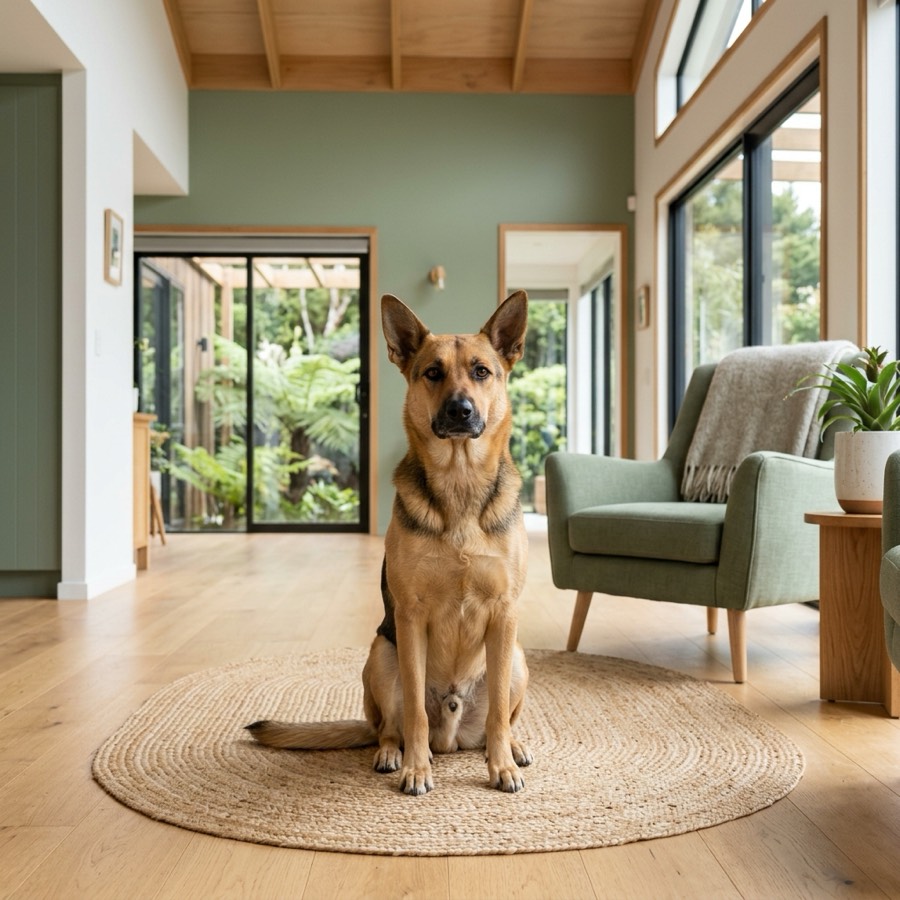
For alert barking, do not wait until the dog is already shouting. Start with mild sounds at low intensity.
When your dog hears a sound and looks towards it, mark the moment they look back at you. Reward away from the window or gate. Over time the pattern becomes:
- Dog hears sound.
- Dog looks at human.
- Human rewards calm check-in.
- Dog does not need to escalate.
Use tiny food rewards, praise, a toy, or a sniff break. If your dog cannot eat or turn away, the trigger is too close or too intense. Increase distance, close the curtains, or practise at quieter times.
Reward quiet before barking starts
Many owners accidentally reward barking by waiting until the dog is loud, then giving attention. Instead, catch the moments before barking.
Reward:
- Looking at a passer-by without barking.
- Coming away from the window.
- Settling on a mat.
- Chewing a toy while people pass.
- Responding to their name.
- Taking a sniff break instead of fence running.
For attention barking, keep your response boring when the dog barks at you, then re-engage when they offer a quieter behaviour. Ask for an easy cue such as "touch", "sit", or "on your mat", then reward.
Add enrichment that actually fits the dog
Under-stimulated dogs often invent noisy jobs. Daily enrichment gives them legal work.
Good options:
- Scatter feeding on grass or a towel.
- Snuffle mats.
- Stuffed food toys.
- Scent games around the lounge.
- Short positive training sessions.
- Tug with rules.
- Calm chew time after a walk.
Bunnings NZ listed dog toys from about NZD $2.48 for simple rope toys to NZD $20.99 for a three-pack of balls, checked on 4 June 2026. You do not need a cupboard full of toys. Rotate a few safe options and pair them with human attention, sniffing and rest.
For working breeds, terriers and alert small dogs, mental work is not optional. A quick toilet walk may not be enough to prevent barking at every movement outside.
Neighbour and council context
Keep this neutral. Neighbours are not automatically unreasonable, and dog owners are not automatically careless. Barking can affect shift workers, babies, elderly neighbours, home offices and shared-wall sleep.
Auckland Council lets people complain about dogs that are barking and directs barking complaints through its dog complaint process. Govt.nz also explains that under the Dog Control Act, councils can become involved where a dog causes problems such as barking at people. The Department of Internal Affairs notes that dog owners must ensure their dogs do not become a nuisance, including by barking or roaming.
If a neighbour raises barking, ask for useful detail: time, duration, where the dog was, and what they noticed. A calm note or conversation can give you training data before it becomes a formal complaint. If you receive a council letter, treat it as information, not a character judgement. Adjust the management plan and document what you change.
What not to do
Do not yell at the dog. To many dogs, human shouting simply joins the barking event.
Do not use shock, citronella or ultrasonic anti-bark collars. SPCA New Zealand warns that anti-bark collars and devices rely on punishment and can worsen stress, fear or other behaviour problems.
Do not use muzzles to stop barking. SPCA warns that anti-barking muzzles can interfere with panting, drinking and normal behaviour, and incorrect use may breach New Zealand animal welfare rules.
Do not debark or devoicing as a convenience fix. SPCA advocates reward-based training and management for excessive barking.
A 7-day barking reset
Day 1: Track
Write the barking diary. Do not try to fix everything at once.
Day 2: Block the biggest trigger
Use curtains, window film, gates, indoor time, or a different rest zone.
Day 3: Add one enrichment routine
Use scatter feeding, a stuffed toy or a scent game before the usual barking window.
Day 4: Practise calm check-ins
Reward looking at you after a low-level sound.
Day 5: Teach mat time
Reward your dog for choosing a bed or mat away from the window.
Day 6: Reduce attention barking
Go quiet when barking starts, then reward calm alternatives.
Day 7: Review
Count what changed: shorter barking, fewer episodes, faster recovery, or better responses to cues. Keep the useful parts.
When to get help
Get help from a reward-based trainer or behaviour consultant if barking is escalating, linked to lunging, happening for long periods when the dog is alone, or creating serious neighbour conflict. For sudden unusual barking or signs your dog is not themselves, start with your vet.
Use the Dog Behaviour Decoder to map the pattern, then combine enrichment, training, rest and environmental changes.
Key takeaways
- Barking is normal, but repeated loud barking needs a plan.
- Find the trigger before choosing the fix.
- Reduce rehearsal with curtains, gates, indoor routines and calmer setups.
- Reward quiet check-ins and calm alternatives before barking escalates.
- Avoid shock, citronella, ultrasonic collars, anti-barking muzzles and debarking.
- Treat council or neighbour feedback as practical information, then document your changes.
Related reading
- Dog Behaviour Decoder
- Dog Enrichment NZ
- Dog Training Tools Guide NZ
- Dog Toys Guide NZ
- Stop Dog Pulling on Lead NZ
- Dog Recall Training NZ
- New Dog Owner First 30 Days NZ
---
Reference sources
- SPCA New Zealand: Excessive barking in dogs, checked 2026-06-04. https://www.spca.nz/advice-and-welfare/article/excessive-barking-in-dogs
- SPCA New Zealand: Training Methods and Devices, checked 2026-06-04. https://www.spca.nz/advocacy/position-statements/article/training-methods-and-devices
- SPCA New Zealand: Debarking and Devoicing, checked 2026-06-04. https://www.spca.nz/advocacy/position-statements/article/debarking-and-devoicing
- Auckland Council: Make a complaint about a dog, checked 2026-06-04. https://www.aucklandcouncil.govt.nz/dogs-animals/problems-dogs/Pages/make-complaint-about-dog.aspx
- New Zealand Government: Dog problems and complaints, checked 2026-06-04. https://www.govt.nz/browse/housing-and-property/neighbourhood-problems/dog-problems-and-complaints/
- Department of Internal Affairs: Dog Control, your rights and remedies, checked 2026-06-04. https://www.dia.govt.nz/Dog-Control-Your-rights-and-remedies
- Bunnings New Zealand: Dog Toys, price examples checked 2026-06-04. https://www.bunnings.co.nz/products/pet-supplies/dogs/dog-toys
Free PetMall tools
Related guides
petmall.co.nz
Shop at PetMall
The products below are practical support items for your pet. PetMall ships across New Zealand.
- Dog FoodStart with food that matches your dog's life stage and activity level — and change brands slowly over 7–10 days.
- Dog TreatsTraining rewards and everyday treats — small, soft pieces work best for consistent reinforcement.
- Dog ToysA small rotation of chew, fetch, and puzzle toys usually works better than buying a large variety at once.
- Dog GroomingA gentle brush and the right shampoo make maintenance easier — especially for dogs that get muddy on walks.
- Leads & HarnessesComfort matters: padded contact points and adjustable fit help reduce rubbing on longer walks or tramping weekends.
- Flea & Worm TreatmentFor NZ conditions, look for protection that fits your routine (monthly vs longer-lasting) and your dog's weight range.