Pet Nail Trimming NZ: Low-Stress Claw Care for Dogs and Cats
Pet nail trimming NZ guide: low-stress dog and cat claw checks, tools, quick awareness and when to use a groomer or vet.
Pet nail trimming in NZ works best when it is calm, gradual and tiny. Handle paws often, trim only the tip you can confidently see, reward cooperation, and stop before your dog or cat panics. If claws are dark, overgrown, painful, curled, split, or your pet is distressed, use a groomer or vet clinic instead of forcing it at home.
The quick answer
Dogs and cats both need claw checks, but they do not need the same routine. SPCA New Zealand says dogs' nails may need trimming if they touch the ground when standing and that owners should avoid cutting the quick. RSPCA and Cats Protection both recommend gentle cat claw trimming, usually just the tip, and stopping if the cat becomes stressed.
The safest home routine is:
- Handle paws before clippers appear.
- Use pet nail clippers, not household scissors.
- Trim a tiny amount at a time.
- Reward and stop early.
- Use good light.
- Ask for help before nails become a battle.
Why nails matter
Long nails can change how a pet stands, catch on fabric, scratch people, or make walking uncomfortable. Cats also need scratching outlets to maintain claws naturally. Dogs who walk mostly on soft grass may not wear nails down like dogs on footpaths.
New Zealand pets vary widely. An indoor Ragdoll in Auckland, a senior dog in a carpeted Wellington flat, a farm dog on gravel, and a kitten learning scratching posts all need different claw care.
Dog nail trimming basics
SPCA New Zealand says if a dog's nails touch the ground when they are standing, trimming may be needed. The dog should be relaxed, and you should only trim the end of the nail.
Dog nail plan:
| Step | What to do |
|---|---|
| 1 | Touch paw, reward, stop |
| 2 | Hold paw for one second, reward, stop |
| 3 | Let dog sniff clippers, reward |
| 4 | Clip one tiny nail tip if the dog is relaxed |
| 5 | Finish with praise, food or a favourite calm activity |
Do not try to finish all four paws in one session if your dog is new to it. One nail a day is still progress.
Use Dog Behaviour Decoder if your dog freezes, growls, hides, yelps, pulls away or guards paws. Those are information, not stubbornness.
Cat claw trimming basics
Cats need a gentler setup. RSPCA UK recommends trimming in a calm place and not forcing the cat. Cats Protection also says to trim only the transparent tip and avoid the pink quick.
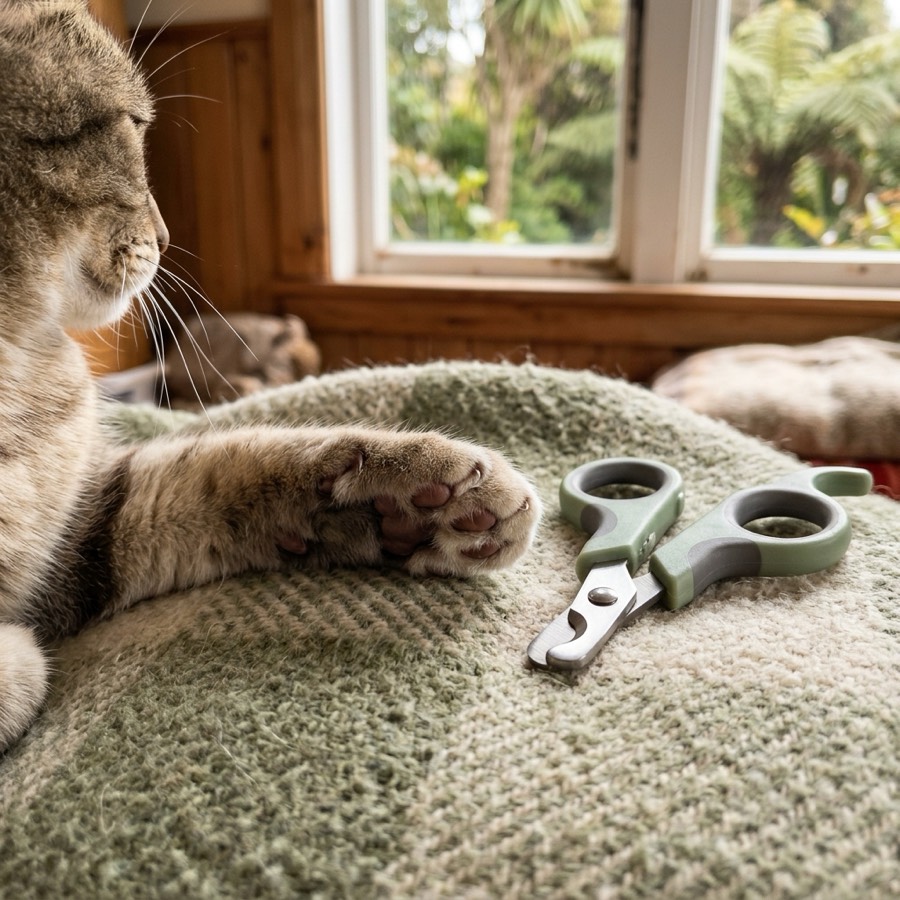
Cat plan:
- Trim after a nap, not during zoomies.
- Hold the paw lightly.
- Press gently so the claw extends.
- Clip only the very tip.
- Do one or two claws, then stop.
- Use treats or a calm voice.
For many cats, the best trimming session is boring and short. If your cat is swishing their tail, growling, turning to bite or trying to leave, stop. Use Cat Behaviour Decoder to track stress signals.
The quick: what to know
The quick is the living part of the nail. In light nails, it may look pink. In dark nails, it can be hard to see. That is why tiny trims are safer than bold cuts.
This guide does not give a home first-aid plan for cut quicks. If you cut too far, your pet is distressed, or bleeding does not settle quickly, call your vet clinic for advice.
If dark nails make you nervous, book a groomer or vet nurse and ask them to show you where they would trim. A hands-on demo is worth more than guessing from a screen.
Tools and setup
You do not need a lot of gear.
| Tool | Useful for | Notes |
|---|---|---|
| Small cat clippers | Cats and very small dogs | Easier for tiny claws |
| Scissor-style dog clippers | Many dogs | Choose size to match nail thickness |
| Grinder | Some dogs who dislike clipping | Introduce sound slowly |
| Towel or mat | Grip and calm station | Avoid slippery floors |
| Treats | Positive association | Use tiny rewards |
Do not use blunt clippers. They squeeze the nail and make the job harder.
Scratching posts are cat nail care too
Cats maintain claws through scratching. That does not replace trimming for every cat, but it helps. If your cat scratches furniture, the answer is not just clipping; it is giving better scratching options.
Read Stop Cat Scratching Furniture NZ and Cat Scratching Posts Guide NZ for setup. A sturdy vertical post, horizontal scratcher and good placement can reduce frustration for everyone.
SPCA New Zealand's declawing article explains why declawing is not normal nail care. Pet nail trimming means maintaining the nail tip, not removing claws.
How often should you trim?
There is no perfect NZ schedule. Check weekly and trim when needed.
Dogs may need more frequent trimming if:
- they mostly walk on grass;
- they are older and less active;
- nails click loudly on hard floors;
- dew claws do not wear down;
- paws are hard to handle, so you only trim tiny amounts.
Cats may need more frequent checks if:
- they are indoor-only;
- they are senior;
- claws catch in bedding;
- they do not use scratching posts much;
- you notice curved or thick-looking claws.
The MPI dog and cat welfare codes both include expectations around appropriate care and handling. Nail checks are a practical part of that day-to-day care.
Low-stress training routine
Set a two-week goal: make paw handling boring.
| Day range | Goal |
|---|---|
| 1-3 | Touch paw, reward, stop |
| 4-6 | Hold paw briefly, reward, stop |
| 7-9 | Show clippers, reward, no trimming |
| 10-12 | Clip one tiny tip if relaxed |
| 13-14 | Repeat one or two nails, then stop |
This is especially useful for kittens, puppies and newly adopted pets. Pair it with other gentle grooming habits from Cat Grooming at Home NZ, How Often to Bathe a Dog NZ, and Dog Grooming Brushes Guide NZ.
When to use a groomer or vet
Use professional help if claws are curled, embedded-looking, split, very thick, very dark and long, painful to touch, or your pet becomes highly distressed. Also ask for help if you are physically unsure how to hold your pet safely.
Professional trimming is not a failure. It is often kinder and cheaper than turning nail care into a fear habit. In NZ, many vet clinics, groomers and some pet stores can help with simple claw trims. Prices vary in NZD by location, pet size and handling difficulty, so ask before booking.
Common mistakes
The first mistake is waiting until all nails are long. Short frequent checks are easier.
The second mistake is trying to finish every nail in one sitting.
The third mistake is chasing the pet with clippers. That teaches avoidance.
The fourth mistake is clipping cats without scratching options. Claws need normal outlets.
The fifth mistake is using human scissors or old blunt clippers.
Key takeaways
- Check nails weekly; trim only when needed.
- Start with paw handling before clipping.
- Trim tiny tips and avoid the quick.
- Stop if your pet becomes stressed.
- Cats need scratching outlets as part of claw care.
- Use a groomer or vet for overgrown, painful, curled or difficult nails.
Related reading
- Cat Grooming at Home NZ
- How Often to Bathe a Dog NZ
- Dog Grooming Brushes Guide NZ
- Stop Cat Scratching Furniture NZ
- Cat Scratching Posts Guide NZ
- Dog Behaviour Decoder
- Cat Behaviour Decoder
---
Reference sources
- SPCA New Zealand: Trimming your dog's nails, checked 2026-06-04. https://www.spca.nz/advice-and-welfare/article/trimming-your-dogs-nails?cat=&subcat=
- RSPCA UK: Grooming your cat, checked 2026-06-04. https://www.rspca.org.uk/adviceandwelfare/pets/cats/health/grooming
- PDSA: How to clip your cat's claws, checked 2026-06-04. https://www.pdsa.org.uk/pet-help-and-advice/pet-health-hub/other-veterinary-advice/how-to-clip-your-cat-s-claws
- Cats Protection: How to trim cat claws, checked 2026-06-04. https://www.cats.org.uk/help-and-advice/health/how-to-trim-cat-claws
- SPCA New Zealand: Declawing, checked 2026-06-04. https://www.spca.nz/advice-and-welfare/article/declawing
- MPI New Zealand: Code of Welfare - Dogs, checked 2026-06-04. https://www.mpi.govt.nz/animals/animal-welfare/codes/all-animal-welfare-codes/code-of-welfare-dogs/
- MPI New Zealand: Code of Welfare - Cats, checked 2026-06-04. https://www.mpi.govt.nz/animals/animal-welfare/codes/all-animal-welfare-codes/code-of-welfare-cats/