Dog Brush Types NZ: How to Choose the Right Brush for Your Dog's Coat
Which dog brush do you actually need? Match slicker, bristle, deshedding, pin brush and undercoat rake to your dog's specific coat type for faster, easier grooming.
The most common grooming mistake NZ dog owners make is using the wrong brush for their dog's coat type. A slicker brush on a Labrador's short double coat does almost nothing useful; a bristle brush on a Poodle won't reach the wool-like layer where mats form. Matching the tool to the coat saves time, reduces shedding mess around the house, and makes grooming genuinely comfortable for your dog.
Here's what each brush type does and which NZ-common coat types it suits.
The main dog brush types
1. Slicker brush — the all-rounder for medium to long coats
A slicker brush has fine, short wire pins set close together on a flat or curved pad. It detangles, removes loose fur, smooths the coat and can reach through a medium-to-long outer coat to the layer below. It's the most versatile grooming brush available.
Best for:
- Medium-length coats (Golden Retrievers, Spaniels, Border Collies)
- Long silky coats (Shih Tzus, Maltese, Yorkies) — use gently with light strokes
- Poodles, Cavoodles and similar wool/curly coats — the only brush type that works into the dense, tangle-prone layer before mats set
Technique: use light, short strokes, work in sections and brush in the direction of hair growth. Heavy pressure bends the pins and can scratch the skin — the brush should glide, not drag.
Not ideal for: very short flat coats (Boxer, Staffy, Greyhound) — the pins have nothing to grip and can scratch thin-coated dogs.
2. Bristle brush — for short coats and finishing
A bristle brush has natural or synthetic bristles packed closely together. It lifts surface dirt, distributes coat oils and gives a shine finish. It's used primarily on short to medium smooth coats.
Best for:
- Short, smooth coats (Labrador, Boxer, Vizsla, Staffordshire Bull Terrier, Greyhound)
- As a finishing brush after a slicker session on medium-coated dogs
- Puppies being introduced to brushing — soft bristles are non-threatening
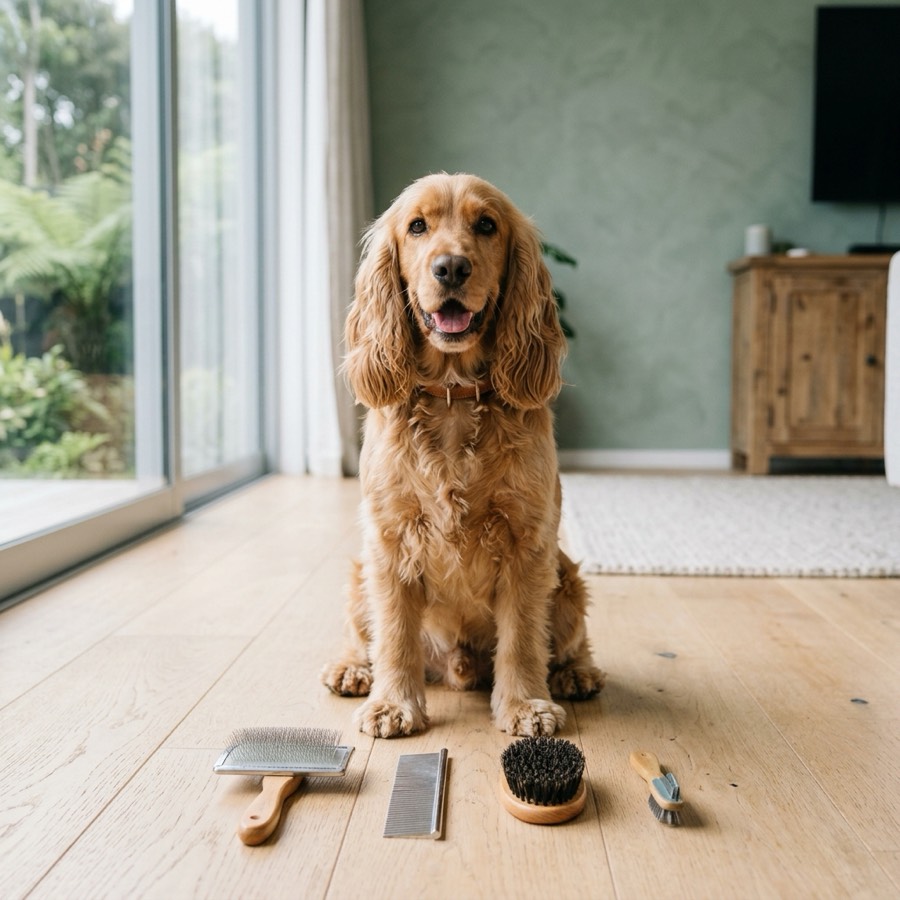
What it won't do: it doesn't penetrate a thick undercoat or remove heavy seasonal shedding — that needs a deshedding tool.
3. Deshedding tool (Furminator-style) — for heavy shedders with double coats
Deshedding tools have finely-spaced, stainless steel tines that reach through the topcoat and pull out loose undercoat hair before it ends up on your furniture and floors. They dramatically reduce seasonal shedding in double-coated breeds.
Best for:
- Heavy double-coat shedders: German Shepherds, Huskies, Malamutes, Samoyeds, Golden Retrievers, Labradors, Corgis
- NZ owners who find their floors and couches overwhelmed with fur during spring and autumn coat changes
How to use: use no more than 1–2 times per week during shedding season, and 2–4 times a month in off-season. Do not use on the same area repeatedly in one session — the fine teeth can irritate skin if over-used. Stop if you see skin redness.
Never use on: single coats, curly coats (Poodles, Bichons), wire coats, or soft silky coats — the aggressive teeth strip coat that should be there.
4. Pin brush — for long silky coats
A pin brush has widely-spaced metal pins with or without rubber tips, set in a flexible cushion pad. It detangles long, silky flowing coats gently without breakage, and is often used in combination with a slicker brush.
Best for:
- Long silky coats: Afghan Hounds, Setters, Cocker Spaniels, Cavalier King Charles Spaniels
- Any long-coated dog as a daily detangling brush between deeper groom sessions
How it differs from a slicker: the wider pin spacing is gentler on fine silky hair that breaks easily. For dense woolly coats (Poodles), the slicker is more effective.
5. Undercoat rake — for thick, dense or double coats
An undercoat rake has widely-spaced teeth that penetrate deep into a thick double coat and remove dead, matted undercoat. It's often used before bathing to remove bulk, or for very thick-coated breeds where a slicker can't reach the dense underlayer.
Best for:
- Very thick double coats: Chow Chows, Huskies, Malamutes, Akitas, Saint Bernards
- Large dogs with dense coats that a slicker or deshedding tool can't fully reach
- Pre-bath detangling on heavily coated dogs
Technique: rake in the direction of coat growth with light pressure. Do not force through mats — work them out gently with your fingers or a mat splitter first.
6. Rubber grooming mitt — for baths and short coats
A rubber grooming mitt fits over your hand and uses rubber nubs to massage and loosen dead fur, especially effective when used wet during bathing.
Best for:
- Short smooth coats that love massage (Labradors, Boxers, Staffies, Dalmatians)
- Bathing — the wet fur releases much more easily with a rubber mitt
- Dogs that resist brush handling — the mitt-as-petting approach builds positive association
Which brush for my dog's coat?
| Coat type | Primary brush | Secondary / optional |
|---|---|---|
| Short smooth (Labrador, Boxer, Staffy, Greyhound) | Bristle brush or rubber mitt | Deshedding tool (shedding seasons) |
| Double coat, heavy shedder (GSD, Husky, Golden, Corgi) | Deshedding tool | Slicker brush, undercoat rake |
| Medium wavy/fluffy (Border Collie, Cavalier, Spaniel) | Slicker brush | Pin brush, bristle for finish |
| Long silky (Shih Tzu, Maltese, Setter) | Pin brush + slicker | Bristle for finishing shine |
| Curly / wool (Poodle, Cavoodle, Bichon Frise) | Slicker brush | Fine-tooth comb to check for mats |
| Very thick double (Husky, Malamute, Chow, Akita) | Undercoat rake | Slicker brush, deshedding tool |
| Wire coat (Schnauzer, Wire Fox Terrier) | Slicker brush | Pin brush |
NZ grooming notes
- In NZ's humid north (Auckland, Northland, Bay of Plenty), dogs with dense double coats are more prone to "hot spots" — infected patches under matted fur in warm wet conditions. Brush more frequently (at least twice a week) during humid summer months to prevent this.
- Long-coated dogs in rural NZ areas pick up seeds and burrs readily — brush after every outdoor trip during seed season to prevent mats forming around burrs.
- Professional groomers in NZ charge around $60–$120 for a full groom depending on breed and size. Regular home brushing significantly reduces the time (and cost) of professional groom visits.
- For how often to bathe between brushing sessions, see our how often to bathe a dog NZ guide.
How to introduce a dog to brushing
Start young and make it positive. Use a bristle brush or rubber mitt for a puppy's first sessions — nothing with hard pins on a dog who hasn't learned to accept grooming. Keep sessions short (1–2 minutes), reward with treats, and gradually build duration. By the time your puppy is an adult, brushing should be a normal part of routine rather than a battle.
For grooming products and brush selection, see our dog grooming brushes guide NZ for brand options available in New Zealand.
Quick takeaways
- Match the brush to the coat type — wrong brush = frustration and no result
- Slicker brush: medium to long coats, curly/wool coats — the most versatile option
- Bristle brush: short smooth coats and finishing
- Deshedding tool: double-coated heavy shedders, used 1–2x/week max
- Pin brush: long silky coats where breakage is a concern
- Rubber mitt: short-coated dogs and bathing sessions
- In NZ's humid north, brush double-coated dogs at least 2x/week in summer to prevent hot spots
Related reading
- Dog Grooming Brushes Guide NZ
- How Often to Bathe a Dog NZ
- Cat Grooming at Home NZ
- Dog breeds in NZ — find your match
Shop dog grooming tools at PetMall
Looking for dog brushes in New Zealand? PetMall stocks grooming tools with nationwide delivery.
---
References
- VCA Animal Hospitals, Hot Spots in Dogs, checked 2026-08-08: https://vcahospitals.com/know-your-pet/hot-spots-in-dogs
- MPI New Zealand, Code of Welfare for Dogs (physical care), checked 2026-06-05: https://www.mpi.govt.nz/animals/animal-welfare/codes/all-animal-welfare-codes/code-of-welfare-dogs/
---
*This guide provides general grooming information for NZ dog owners. For breed-specific grooming advice or skin conditions, consult a registered NZ vet or professional groomer.*
Free PetMall tools
Related guides
petmall.co.nz
Shop at PetMall
The products below are practical support items for your pet. PetMall ships across New Zealand.
- Dog GroomingA gentle brush and the right shampoo make maintenance easier — especially for dogs that get muddy on walks.
- Dog FoodStart with food that matches your dog's life stage and activity level — and change brands slowly over 7–10 days.
- Dog TreatsTraining rewards and everyday treats — small, soft pieces work best for consistent reinforcement.
- Dog ToysA small rotation of chew, fetch, and puzzle toys usually works better than buying a large variety at once.
- Leads & HarnessesComfort matters: padded contact points and adjustable fit help reduce rubbing on longer walks or tramping weekends.
- Flea & Worm TreatmentFor NZ conditions, look for protection that fits your routine (monthly vs longer-lasting) and your dog's weight range.