Staffordshire Bull Terrier vs Bull Terrier NZ: What's the Difference?
Staffy or Bull Terrier? Two breeds often confused in NZ. Compare appearance, temperament, legal status and NZ suitability to understand the real differences.
The Staffordshire Bull Terrier and the Bull Terrier are frequently confused in New Zealand — in casual conversation, on social media, and sometimes even in council documentation. They are distinct breeds with different appearances, different temperament profiles and different legal considerations in some NZ contexts. This guide explains the genuine differences so you can make an informed choice.
The NZ context: why this matters more than just breed curiosity
New Zealand has a significant Staffordshire Bull Terrier population — the Staffy is one of the most common dogs in NZ rescue and SPCA facilities, and also one of the most popular breeds in NZ working-class and suburban households. The Bull Terrier is less common but still well-represented.
Councils and the general public sometimes confuse these breeds (and various crossbreeds) with Pit Bull types, which are restricted under the Dog Control Amendment Act 2003. Clear identification matters for NZ owners.
Both the Staffordshire Bull Terrier and the Bull Terrier are legal, unrestricted breeds in New Zealand. Neither is a restricted breed under current NZ law. Individual dogs of any breed can be declared dangerous or menacing by a council based on behaviour, but breed restriction applies only to American Pit Bull Terrier type dogs, Japanese Tosa, Dogo Argentino and Brazilian Fila.
Quick comparison
| Staffordshire Bull Terrier | Bull Terrier | |
|---|---|---|
| Size | Medium — 11–17 kg, 36–41 cm | Medium-large — 18–30 kg, 45–55 cm |
| Build | Compact, muscular, broader than tall | Egg-shaped head, muscular, longer legs |
| Head shape | Broad, round skull — no egg shape | Distinctive oval/egg-shaped profile |
| Coat | Short, smooth | Short, smooth (white, or coloured) |
| Energy level | High — people-oriented | High — independent streak |
| NZ price estimate | $500–$1,500 | $1,000–$2,500 |
Full profiles: Staffordshire Bull Terrier · Bull Terrier
How to tell them apart visually
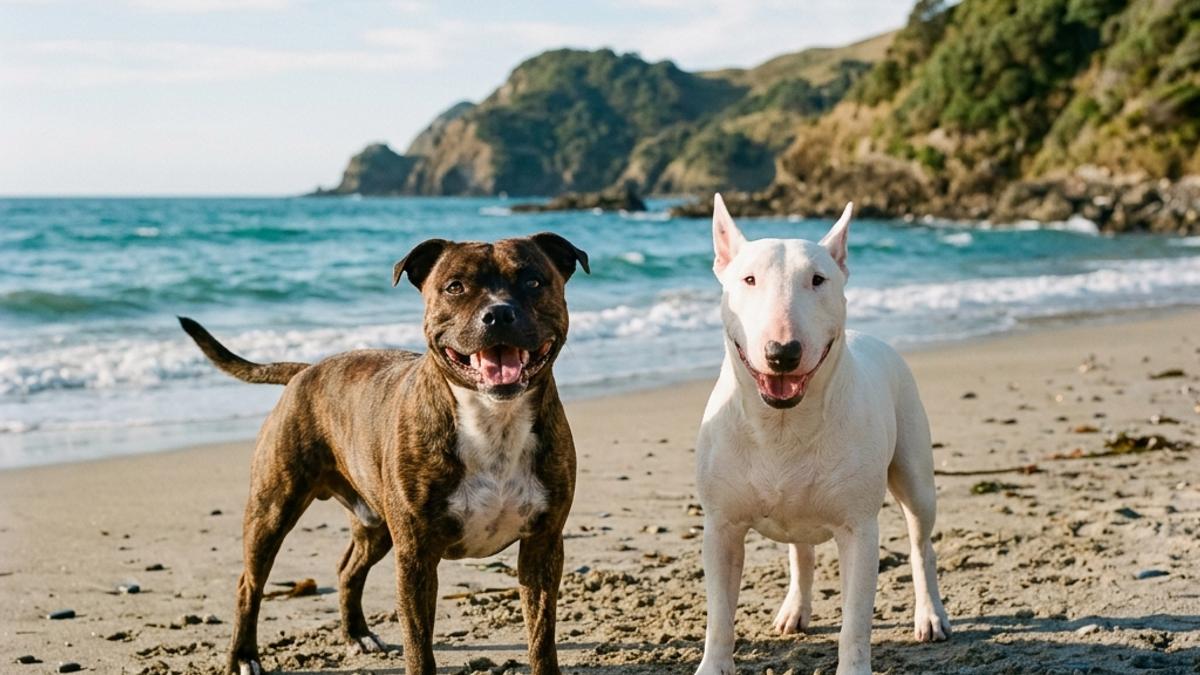
Staffordshire Bull Terrier: the Staffy's most distinctive feature is its broad, short skull with well-defined cheeks and a distinct stop (the angle between forehead and muzzle). They're compact — wider across the chest relative to their height, with short legs for their body size. They're solidly built but not large. Classic colouring is brindle, red, fawn, black, blue or white, in any combination.
Bull Terrier: the Bull Terrier's defining feature is its completely unique head — oval-shaped in profile, with no stop (the skull curves continuously from the top of the head to the nose tip). No other breed has this head shape. Bull Terriers are taller and longer-legged than Staffies, with a less cobby build. Classic white Bull Terriers are the most recognisable; coloured varieties (brindle, red, black) also exist.
The two breeds are not similar in head shape once you know what to look for. The Staffy has a conventional head profile; the Bull Terrier's is unique in the entire dog world.
Temperament
Staffordshire Bull Terrier: Staffies are famous in NZ and worldwide for their affection with people — the breed is often called the "nanny dog" for its historically close relationship with children. They're enthusiastic, loyal, and genuinely love human company. The Staffy's challenge is dog-to-dog relationships: they were originally developed for dog fighting (as was the Bull Terrier's predecessor), and some Staffies retain significant dog aggression that requires management. Proper socialisation from puppyhood significantly reduces this, but NZ Staffy owners should always assess their dog's individual dog-to-dog temperament honestly.
Bull Terrier: more independent and stubborn than a Staffy. Bull Terriers are loyal and affectionate to their family but have a characteristic tenacity — when they decide they want something, they're persistent. They're playful, can be clownish, and some Bull Terrier owners describe their dog as having a particular sense of mischief. They can also have dog-to-dog challenges, particularly intact males. Bull Terriers generally suit experienced dog owners who appreciate an independent, character-driven dog rather than a consistently biddable one.
Exercise needs
Both breeds are energetic and need real daily exercise.
Staffy: 45–60 minutes of vigorous exercise daily. They love to play, run and wrestle. Without adequate exercise and mental stimulation, Staffies become destructive — their jaw strength and persistence make them effective dismantlers of furniture, bedding and garden features.
Bull Terrier: 60+ minutes daily. They have more endurance than a Staffy and need genuine aerobic exercise. Under-exercised Bull Terriers are challenging to manage at home and may develop compulsive behaviours (spinning, obsessive behaviours are documented in the breed).
Training
Staffy: responds well to reward-based training. Staffies are people-pleasers at heart — they want your approval, which makes them trainable. The challenge is their physical strength and reactivity to other dogs; training should include consistent on-leash manners and managed interactions. See our stop dog pulling on the lead NZ guide.
Bull Terrier: needs consistent, patient training with clear boundaries. Their independence means they'll test what rules are enforced. Positive reinforcement works; harsh corrections create a dog that simply waits for an opportunity to do what it wants. Puppy class from 8–12 weeks is especially important for Bull Terriers given their tenacity and physical strength.
NZ rescue and adoption context
The Staffordshire Bull Terrier is the breed most represented in NZ rescue and SPCA facilities — by a significant margin. Many of these dogs were acquired by owners who didn't research the exercise, training and dog-to-dog management needs of the breed. If you're considering a Staffy, adoption is absolutely worth exploring. Most NZ SPCA facilities and breed-specific rescues have Staffies available.
For a Staffy adoption, discuss the dog's dog-to-dog history with the rescue honestly. Some Staffies do very well with other dogs; others need to be the only dog in the household.
Which breed suits you?
Choose a Staffordshire Bull Terrier if:
- You want an extremely people-focused, affectionate medium dog
- You're prepared for dog-to-dog management and responsible socialisation
- You're open to rescue adoption (strongly encouraged given NZ pound populations)
- You want an adaptable, apartment-or-house-friendly active companion
Choose a Bull Terrier if:
- You want a more independent, character-driven dog with the distinctive egg-head appearance
- You have experience with strong-willed breeds and appreciate the tenacity
- You can provide genuine vigorous daily exercise
- You're drawn to the breed's history and unique personality type
For either breed: research breed-specific training groups in NZ; both breeds have active owner communities with useful experience. See our best dogs for first-time owners NZ guide — neither breed is typically recommended for first-time dog owners.
Quick takeaways
- Both are legal, unrestricted breeds in NZ — not Pit Bull types
- Staffies and Bull Terriers are distinct breeds: different head shape, size and temperament
- Both are people-oriented, high-energy dogs that need daily vigorous exercise
- Dog-to-dog management is a real consideration for both breeds; assess individually
- Staffordshire Bull Terriers are the most common dog in NZ rescue — consider adoption
- Neither breed suits first-time owners; both benefit from reward-based training from puppyhood
Related reading
- Staffordshire Bull Terrier breed profile NZ
- Bull Terrier breed profile NZ
- Stop a Dog Pulling on the Lead NZ
- Best Dogs for First-Time Owners NZ
- Best Family Dog Breeds NZ
- Dog Registration NZ: Council Checklist
---
Sources
- https://www.akc.org/dog-breeds/staffordshire-bull-terrier/
- https://www.akc.org/dog-breeds/bull-terrier/
- https://www.merckvetmanual.com/musculoskeletal-system/arthropathies-and-related-disorders-in-small-animals/hip-dysplasia-in-dogs
- https://www.legislation.govt.nz/act/public/1996/0013/latest/DLM374319.html
Free PetMall tools
Related guides
petmall.co.nz
Shop at PetMall
The products below are practical support items for your pet. PetMall ships across New Zealand.
- Dog FoodStart with food that matches your dog's life stage and activity level — and change brands slowly over 7–10 days.
- Dog TreatsTraining rewards and everyday treats — small, soft pieces work best for consistent reinforcement.
- Dog ToysA small rotation of chew, fetch, and puzzle toys usually works better than buying a large variety at once.
- Dog GroomingA gentle brush and the right shampoo make maintenance easier — especially for dogs that get muddy on walks.
- Leads & HarnessesComfort matters: padded contact points and adjustable fit help reduce rubbing on longer walks or tramping weekends.
- Flea & Worm TreatmentFor NZ conditions, look for protection that fits your routine (monthly vs longer-lasting) and your dog's weight range.