How to Remove Pet Urine Smell and Stains NZ: Carpet & Furniture
Remove dog and cat urine smell and stains from carpet, couch and mattress in NZ. Enzyme-cleaner steps, wool-carpet care, and when to see your vet.
A dog accident on the lounge carpet or a cat missing the tray is one of the most common — and most frustrating — jobs Kiwi pet owners face, because the smell keeps coming back on warm, damp days. This guide covers why pet urine is so stubborn, how to clean it from carpet, couches and mattresses, what to avoid, and when a repeat problem is really a job for your vet.
The quick answer
Blot fresh urine straight away, rinse with cool water, then treat the spot with an enzymatic (enzyme) cleaner made for pet urine and let it dwell as the label directs. Enzyme cleaners break down the part of dried urine that ordinary cleaners leave behind, which is what stops the smell returning. Do not reach for ammonia, and be cautious with hot water and steam cleaners. If a house-trained dog or cat keeps urinating indoors, book a vet check before assuming it is behaviour.
Why pet urine smells so stubborn
Fresh urine is mostly water and rinses easily. The problem is what dries and stays behind. As urine breaks down it leaves salts and uric-acid residue bonded into carpet fibres, underlay and upholstery foam. Household detergents lift the surface stain but leave that residue in place, and on a humid Auckland or Northland day it draws moisture back in and releases odour again — which is why a spot you "cleaned" last month smells worse after rain.
This is the reason vets and welfare bodies point owners to enzyme cleaners rather than air fresheners. The ASPCA advises cleaning accidents "with an enzymatic cleanser designed to neutralize pet odors," and VCA Hospitals recommends "a commercially available product that contains enzymes to degrade the urine." The Cornell Feline Health Center puts the principle plainly: odours must be neutralised, not just deodorised, to escape a cat's very sensitive nose. Enzyme products work on the residue itself, so you are removing the source of the smell instead of covering it.
Step by step: carpet
- Blot, do not rub. Press down firmly with white paper towels or an old towel to soak up as much liquid as you can. Rubbing pushes urine deeper into the pile and backing.
- Rinse with cool water. Pour a little cool or room-temperature water on the spot and blot again. This dilutes the salts before they set. Avoid hot water at this stage.
- Apply the enzyme cleaner generously. Fresh urine often soaks right through to the underlay, so the cleaner needs to reach as deep as the urine did. Follow the label — most need to stay wet on the spot for a set dwell time to work.
- Let it dwell, then blot. Cover the area or leave it as directed, then blot up the excess. Let the spot air-dry rather than forcing it with heat.
- Repeat if needed. Old or heavy spots often take two or three treatments. That is normal, not a sign the product has failed.
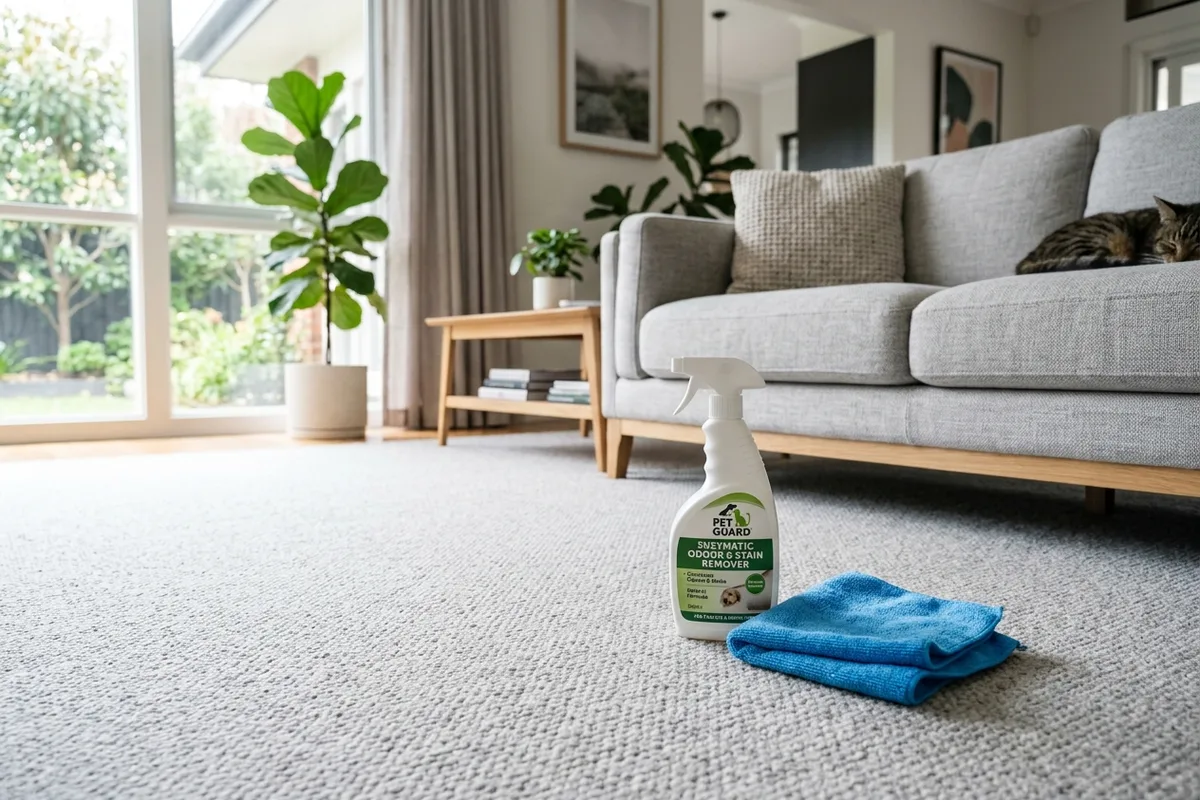
Furniture, couches and mattresses
Upholstery and mattresses follow the same blot-rinse-enzyme routine, with two cautions. First, check colourfastness by testing the cleaner on a hidden seam before you treat a visible cushion. Second, do not soak foam cushions or a mattress — over-wetting drives urine deeper and can trap moisture that grows mould in our humid climate. Work in from the edges, use only as much cleaner as the label suggests, and let the item dry fully, ideally in airflow or gentle sun. Removable covers can usually be machine-washed; check the care label first.
Hard floors: lino, vinyl, tile and timber
Sealed hard floors are the easy case — wipe up promptly, wash with a pet-safe floor cleaner, and check the grout lines and skirting boards where urine pools. The trap is the join: urine that runs under a vinyl edge, into a floorboard gap or along a skirting can keep smelling long after the surface looks clean. Lift and check edges if a hard-floor smell lingers.
What to avoid
- Ammonia cleaners. The ASPCA warns that urine already contains ammonia, "therefore cleaning with ammonia could attract your cat to the same spot to urinate again." Cornell adds that ammonia — and vinegar — smell like urine to cats and can be irritating, so they are a poor choice near litter areas.
- Steam cleaners and hot water on fresh stains. Heat can bake urine's proteins and pigment deeper into man-made fibres, making a stain and smell far harder to shift. Treat with an enzyme cleaner first; save any hot-water extraction for after.
- Just masking it. Sprays and deodorisers cover the smell for a day. If the residue is still in the fibre, the odour returns — and so, often, does the pet.
Finding the spots you can't see
Cats and marking dogs often revisit the same hidden patch. Dried urine glows under a UV (black-light) torch in a darkened room — the quickest way to map old spots on carpet, skirting and couch bases before you treat them. It is a cheap tool and worth it in a multi-pet home.
NZ wool carpet and renting
Many Kiwi homes have wool or wool-blend carpet, which needs a gentler hand than synthetic. Bremworth, a New Zealand wool carpet maker, advises you "never, ever rub a wet wool carpet spill" and instead blot with plain white paper towels, act immediately, and use room-temperature water rather than hot. Do not submerge or over-soak wool, and keep bleach and harsh solvents off it entirely — a set-in wool stain is a job for a professional carpet cleaner, not a stronger chemical. Most enzyme cleaners are wool-safe, but always spot-test on a hidden corner first.
If you are renting, urine damage can put your bond at risk, so treat accidents fast and keep receipts if you bring in a professional cleaner before an inspection. Deep contamination that has reached the underlay sometimes cannot be fully removed by surface cleaning at all, and the honest answer is that badly soaked underlay may need replacing.
When it's a vet issue, not a cleaning issue
No cleaner fixes the reason a pet is urinating indoors. If a previously house-trained dog or cat starts having accidents — especially suddenly — treat it as a health question first. The Merck Veterinary Manual states that "the first step is always to exclude medical problems, because any condition affecting urine volume, frequency, control, or ability to access the litter box can contribute to soiling." VCA Hospitals gives the same advice for dogs: if house soiling "has started suddenly, it is important to ask your veterinarian to check for a physical illness." Urinary tract infection, bladder stones, diabetes, kidney disease and age-related incontinence all show up this way, and a male cat straining and unable to pass urine is an emergency — ring a vet immediately.
Behaviour matters too, but not as punishment. Cornell notes cats do not soil out of spite and that punishing them can make the problem worse; stress, a dirty or poorly placed tray, a house move or a new pet are common triggers. Sort the cause and the cleaning becomes a one-off, not a weekly chore.
Honest limits of home remedies
Baking soda and white vinegar are popular DIY fixes, and they have a place — baking soda absorbs moisture and freshens, and a weak vinegar rinse can lift fresh residue on sealed hard floors. But be realistic: neither reliably destroys the dried residue soaked deep into carpet and underlay, and clinical sources caution that vinegar smells like urine to cats. For anything beyond a fresh, shallow accident, a proper enzyme cleaner does the job that home remedies can only partly do.
Key takeaways
- Blot fresh urine, rinse with cool water, then use an enzyme cleaner made for pet urine — it targets the residue that makes smells return.
- Avoid ammonia cleaners (they invite re-marking) and hot water or steam on fresh stains (heat sets them in).
- Treat NZ wool carpet gently: blot, don't rub; room-temperature water; spot-test; no bleach.
- Old or deep contamination may need repeat treatments, a professional clean, or in bad cases new underlay.
- Repeat indoor urination is a vet question first — rule out medical causes before blaming behaviour.
Related reading
Sources
- ASPCA: Litter Box Problems, checked 2026-07-12. https://www.aspca.org/pet-care/cat-care/common-cat-behavior-issues/litter-box-problems
- Cornell Feline Health Center: Feline Behavior Problems — House Soiling, checked 2026-07-12. https://www.vet.cornell.edu/departments-centers-and-institutes/cornell-feline-health-center/health-information/feline-health-topics/feline-behavior-problems-house-soiling
- Merck Veterinary Manual: Behavior Problems of Cats, checked 2026-07-12. https://www.merckvetmanual.com/behavior/behavior-of-cats/behavior-problems-of-cats
- VCA Hospitals: Dog Behavior Problems — House Soiling, checked 2026-07-12. https://vcahospitals.com/know-your-pet/dog-behavior-problems-house-soiling
- Bremworth (NZ wool carpets): Wool Carpet Stain Removal Guide, checked 2026-07-12. https://bremworth.co.nz/pages/wool-carpet-stain-guide
Free PetMall tools
Related guides
petmall.co.nz
Shop at PetMall
The products below are practical support items for your pet. PetMall ships across New Zealand.
- ODARID Stain & Odour RemoversPurpose-made pet stain and odour removers — treating the source beats masking the smell, especially for urine on carpet.
- Dog FoodStart with food that matches your dog's life stage and activity level — and change brands slowly over 7–10 days.
- Dog TreatsTraining rewards and everyday treats — small, soft pieces work best for consistent reinforcement.
- Dog ToysA small rotation of chew, fetch, and puzzle toys usually works better than buying a large variety at once.
- Dog GroomingA gentle brush and the right shampoo make maintenance easier — especially for dogs that get muddy on walks.
- Leads & HarnessesComfort matters: padded contact points and adjustable fit help reduce rubbing on longer walks or tramping weekends.
- Flea & Worm TreatmentFor NZ conditions, look for protection that fits your routine (monthly vs longer-lasting) and your dog's weight range.