Newfoundland vs Bernese Mountain Dog NZ: Two Gentle Giants Compared
Newfoundland or Bernese Mountain Dog in New Zealand? Both are gentle, family-loving giant breeds — but they differ in size, coat, heat tolerance, and lifespan. Here's what each ownership looks like.
Newfoundlands and Bernese Mountain Dogs are both beloved gentle giants — enormous, good-natured dogs that are devoted to families and famously patient with children. Both attract owners who want a large, calm companion. They're similar enough to invite comparison, but different enough that choosing between them matters.
At a glance
| Newfoundland | Bernese Mountain Dog | |
|---|---|---|
| Weight | M: 59–68 kg / F: 45–54 kg | M: 36–52 kg / F: 32–43 kg |
| Lifespan | 9–10 years | 7–10 years |
| NZ price (registered breeder) | $3,000–$5,000 | $3,000–$5,000 |
| Friendliness | ★★★★★ | ★★★★★ |
| Trainability | ★★★★ | ★★★★ |
| Energy | ★★★ | ★★★ |
| Grooming needs | ★★★★ | ★★★ |
| Apartment life | ★ | ★★ |
| With kids | ★★★★★ | ★★★★★ |
| With other pets | ★★★★ | ★★★★ |
The most important shared fact: short lifespan
Both breeds live short lives relative to smaller dogs. The Bernese Mountain Dog averages 7–10 years; the Newfoundland averages 9–10 years.
Owning a giant breed means accepting an accelerated timeline. You will get 7–10 years with a well-cared-for Newfoundland or Bernese in most cases. This doesn't make them less worthwhile — many owners of giant breeds describe the experience as uniquely rewarding — but it should be factored honestly into the decision.
The Newfoundland's slightly longer expected minimum (9 years vs 7) gives it a marginal edge on lifespan, but both are in the short end of the canine spectrum.
Size: Newfoundland significantly larger
The Newfoundland is one of the largest dog breeds in the world. Males at 59–68 kg are notably bigger and heavier than male Bernese Mountain Dogs at 36–52 kg. This matters practically:
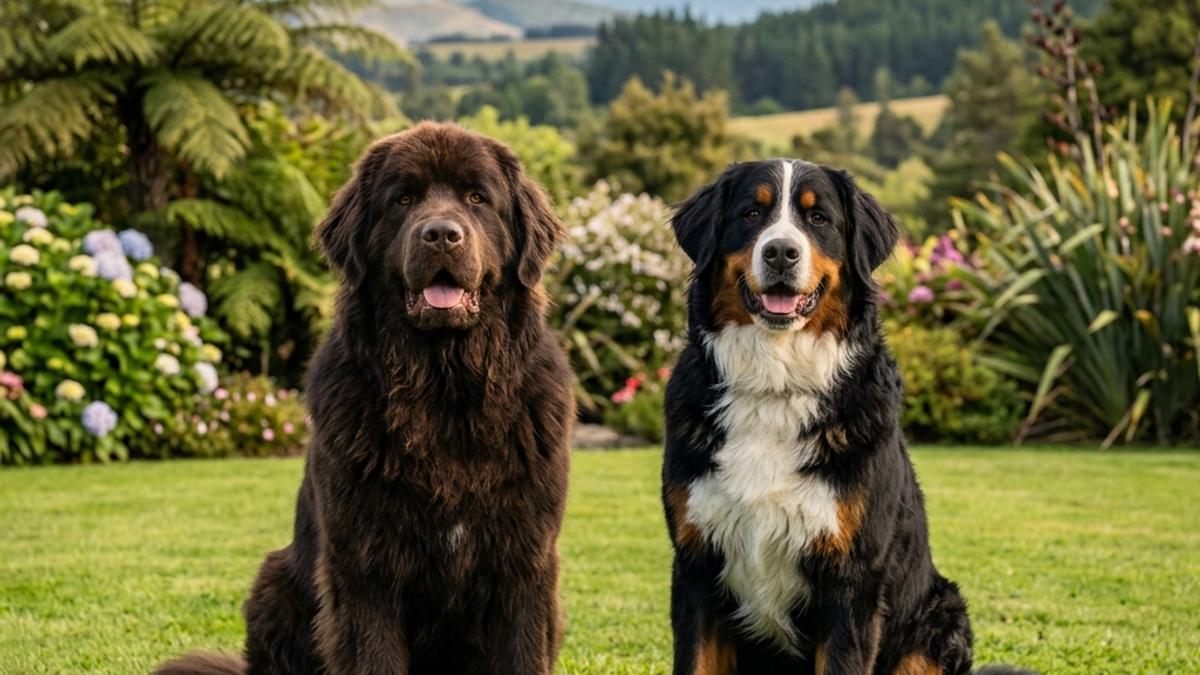
- Food cost: A Newfoundland may eat roughly 0.6–0.9 kg (about 5–7 cups) of quality dry food daily, adjusted to body condition. Over 10 years, food alone is a significant expense.
- Vet cost: Procedures, medications, and hospitalisation for giant breeds cost more due to dosage volume and equipment requirements.
- Transport: Newfoundlands need a large vehicle (SUV, wagon, or van). A smaller Bernese may fit in a large family hatchback.
- Physical management: Walking a Bernese requires some physical strength; walking an untrained Newfoundland of 65 kg requires considerably more. Early leash manners training is essential for both.
Temperament: both gentle giants, similar personality
Both breeds score 5/5 on friendliness and 5/5 for kids — the maximum. They are among the calmest, most gentle large breeds available. Neither is a guard dog, and neither is aggressive. Both are patient, devoted, and good-natured in ways that are reliably consistent across the breed.
The Bernese was developed in the Swiss Alps as a farm dog — herding, cart-pulling, and companionship. The Newfoundland was developed in Newfoundland, Canada, as a water rescue and fishing assistance dog, with a legendary reputation for rescuing drowning humans.
Practical temperament difference: Newfoundlands are water dogs at heart — if there's a lake, river, or beach, they will typically want to be in it. This can be a joy or a management challenge depending on your NZ lifestyle. Bernese Mountain Dogs don't share this particular water obsession.
Grooming
Newfoundland (grooming 4/5): Double-coated, with a longer, coarser outer coat and a dense undercoat. Significant shedding — particularly in seasonal moults. Brushing 3–4 times weekly is realistic maintenance; professional grooming every 2–3 months is recommended. Newfoundlands also drool — a lesser-discussed but practically significant reality for NZ homes with light-coloured furniture.
Bernese Mountain Dog (grooming 3/5): A slightly lower grooming commitment. Still double-coated with significant shedding, particularly during seasonal moults. Brushing 2–3 times weekly. Professional grooming useful but less frequently required than for the Newfoundland's coat.
NZ climate consideration: Both breeds have coats designed for cold climates. Auckland's humid summers are uncomfortable for both — shade, fresh water, and avoiding midday exercise during summer is important. South Island conditions are better suited to both breeds. The Newfoundland's denser, water-resistant coat traps heat more than the Bernese's in warm weather.
Exercise: both moderate
Both score 3/5 on energy — moderate for giant breeds. They don't need marathon exercise, but they need consistent daily activity: a solid walk (45–60 minutes) plus time in a yard. A giant dog left without exercise or mental engagement becomes restless and can be destructive simply due to their size.
Neither is suitable for apartments (1/5 and 2/5) — their physical size alone is the constraint, not just their exercise needs. A large house with a generous fenced section is the appropriate NZ home for either breed. Lifestyle blocks are ideal.
NZ availability
Both breeds are available in New Zealand but not common. Registered breeders are relatively few for both, and waiting lists apply. Prices are similar ($3,000–$5,000 from registered breeders). Check Dogs New Zealand (NZKC) for current breeder contacts for both breeds.
Newfoundlands and Bernese Mountain Dogs both appear occasionally in SPCA and breed rescue — giant breed rehoming is not rare, as owners underestimate the commitment.
Which is right for you?
Choose a Newfoundland if:
- You specifically want the largest, most impressive dog on this list
- You live near water and want a dog that shares your love of swimming
- You can manage the drool and higher grooming requirement
- The slightly longer lifespan range (9–10 vs 7–10 years) matters to you
Choose a Bernese Mountain Dog if:
- You want a large, stunning tri-coloured dog with slightly lower grooming maintenance
- You prefer a dog without the strong water obsession
- A slightly more manageable size (36–52 kg vs 59–68 kg) is important for your household
- You specifically want the Bernese's Swiss working dog heritage and appearance
Neither is right if:
- You live in an apartment or small home (both score 1–2 for apartment life)
- You're not prepared for the short lifespan and the associated costs of giant breed ownership
- You can't handle NZ's warmer climates carefully for double-coated giant breeds
Related guides
- Best family dog breeds NZ
- Best dog breeds for lifestyle blocks and farms NZ
- Great Dane vs Saint Bernard NZ
- Dog grooming at home NZ
- Dog brush types NZ
- Find a breed tool
- Compare breeds tool
---
Sources
- https://www.akc.org/dog-breeds/newfoundland/
- https://www.akc.org/dog-breeds/bernese-mountain-dog/
- https://www.merckvetmanual.com/musculoskeletal-system/arthropathies-and-related-disorders-in-small-animals/hip-dysplasia-in-dogs
- https://www.legislation.govt.nz/act/public/1996/0013/latest/DLM374319.html
Free PetMall tools
Related guides
petmall.co.nz
Shop at PetMall
The products below are practical support items for your pet. PetMall ships across New Zealand.
- Dog FoodStart with food that matches your dog's life stage and activity level — and change brands slowly over 7–10 days.
- Dog TreatsTraining rewards and everyday treats — small, soft pieces work best for consistent reinforcement.
- Dog ToysA small rotation of chew, fetch, and puzzle toys usually works better than buying a large variety at once.
- Dog GroomingA gentle brush and the right shampoo make maintenance easier — especially for dogs that get muddy on walks.
- Leads & HarnessesComfort matters: padded contact points and adjustable fit help reduce rubbing on longer walks or tramping weekends.
- Flea & Worm TreatmentFor NZ conditions, look for protection that fits your routine (monthly vs longer-lasting) and your dog's weight range.