Himalayan vs Persian NZ: Two High-Maintenance Lap Cats Compared
Himalayan or Persian for your NZ home? Both are luxurious, calm flat-faced cats with demanding coats — but the Himalayan's colourpoint pattern and Siamese heritage add one key difference.
The Himalayan and the Persian are so closely related that some registries consider the Himalayan a colour variety of the Persian rather than a separate breed. Both are large, flat-faced, long-haired cats bred for calm companionship. If you're drawn to either, understanding the difference — and the shared grooming commitment — will help you choose well.
The core difference
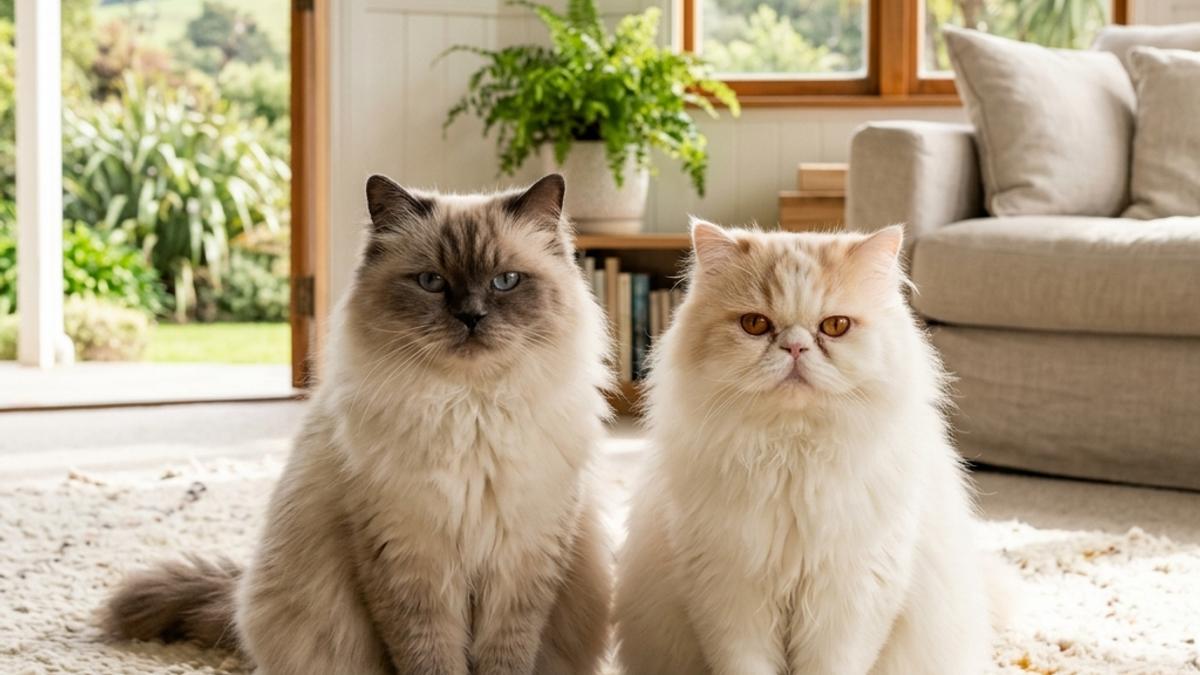
The Himalayan is a Persian with Siamese-introduced colourpoint colouring (pale body, darker face, ears, legs, and tail) and blue eyes — always. The Persian comes in a wider range of colours and patterns. Otherwise, they share the same flat face, long coat, calm temperament, and high grooming needs. If you love the colourpoint look, choose the Himalayan. If you prefer more colour options, choose the Persian. The care commitment is almost identical.
How closely related? In the Cat Fanciers' Association the Himalayan is not judged as a separate breed at all — it is one of the Persian's seven colour divisions, the pointed pattern, and every Himalayan colour class requires deep vivid blue eyes.
Side-by-side overview
| Himalayan | Persian | |
|---|---|---|
| Weight | 3–6 kg | 3.5–7 kg |
| Lifespan | 9–15 years | 12–17 years |
| NZ Price (breeder) | $800–$2,500 | Varies — verify with NZ breeders |
| NZ Price (adoption) | $150–$350 via SPCA | $150–$350 via SPCA (rare) |
| Energy level | ★★☆☆☆ | ★★☆☆☆ |
| Trainability | ★★★☆☆ | ★★★☆☆ |
| Grooming needs | ★★★★★ | ★★★★★ |
| Apartment suitability | ★★★★★ | ★★★★★ |
| Good with kids | ★★★★☆ | ★★★★☆ |
| Good with other pets | ★★★★☆ | ★★★☆☆ |
*Scores from PetMall breed profiles (1–5). Both breeds score ★★★★★ for grooming needs — this is a five-star commitment, not a casual undertaking.*
Appearance
Himalayan: Always colourpoint — the body is pale cream to white, with the "points" (face mask, ears, legs, tail) in a contrasting colour (seal, blue, chocolate, lilac, flame, or tortoiseshell). Always has blue eyes, which is a breed constant derived from the Siamese heritage that created the colourpoint colouring. The coat is long, thick, and silky.
Persian: Comes in an enormous range of colours and patterns — solid (white, black, blue, red), bicolour, tabby, shaded, smoke, parti-colour. Eye colour varies by coat colour (copper, gold, green, or odd-eyed in white Persians). Equal coat length and texture to the Himalayan.
Both have the flat, brachycephalic face — the defining feature of both breeds — which creates specific health and daily care obligations.
The grooming reality: a genuine daily commitment
Both breeds score ★★★★★ on grooming — the maximum. This is not hyperbole.
Daily requirements:
- Coat brushing: The long, fine coat mats rapidly — a Himalayan or Persian left unbrushed for three days can develop painful mats that must be cut out. Daily brushing with a steel comb and slicker brush is the baseline. Missing a day occasionally is recoverable; missing a week is not.
- Eye cleaning: The flat skull misroutes the tear ducts, causing chronic eye discharge (epiphora). The area below the eyes must be wiped clean at least once — preferably twice — daily with a damp cloth or cotton pad. Without this, tear staining leads to skin irritation and bacterial infection in the folds.
- Face fold cleaning: The folds around the nose and below the eyes also trap moisture. Dry carefully after wiping.
- Professional grooming: Most NZ owners of either breed have them professionally groomed every 6–8 weeks for a bath, blow-dry, and de-tangle. Some owners keep the cats in a "lion cut" (body fur clipped short) during NZ summer to reduce grooming workload and heat discomfort.
If you travel frequently or can't maintain a daily grooming routine, neither of these breeds suits your lifestyle. A Persian or Himalayan in poor coat is in genuine discomfort.
The brachycephalic health considerations
Both breeds have extreme flat faces — the same face type as the Exotic Shorthair — with the same associated health implications:
- Breathing difficulties (audible breathing, snoring, difficulty with exercise or heat)
- Dental crowding from the compressed jaw
- Chronic epiphora (eye discharge) requiring daily cleaning as described above
- Polycystic kidney disease (PKD) — an inherited condition seen most often in Persians and, among other breeds, Himalayans and British Shorthairs. The cysts are present from before birth but start microscopic; they can be detected in kittens from around six months, while clinical signs of kidney failure usually appear at about seven years of age. That gap is exactly why a breeder's DNA or ultrasound result matters more than the cat looking well in the kitten pen — ask for it in writing
Lifespan note: The Himalayan's NZ profile lifespan of 9–15 years is slightly shorter at the low end than the Persian (12–17 years). This variability is likely related to the degree of facial flatness in individual lines — less extreme faces tend to have fewer health complications and live longer. When purchasing in NZ, selecting a breeder who prioritises "traditional" or "doll-face" type (less extreme flat face) can significantly affect the cat's quality of life and lifespan.
Temperament
Both breeds are calm, gentle, and quiet. They're not demanding or vocal cats — they prefer to sit near you or be held, and they adapt well to apartment or house living without needing outdoor access.
Himalayan: The Siamese heritage adds a slight edge of personality — Himalayans are a little more interactive and vocal than the typical Persian, though nothing like an actual Siamese. They'll occasionally engage in play and make soft, chirping vocalisations.
Persian: Possibly the most serene and placid of all domestic cat breeds. Content to sit in one spot for extended periods. Less likely to initiate play than the Himalayan. Extremely patient and gentle, even with rough-handed children (though children should always be taught respectful cat interaction regardless of the breed's tolerance).
Both are indoor-only in NZ — their nature and health make them poorly suited to outdoor risks.
NZ climate and summer heat
Both breeds are poor performers in heat. The flat face restricts airflow, and the thick coat adds to thermal load. In Auckland, Northland, or Waikato summers:
- Air-conditioned indoor access is important
- Summer professional "lion cuts" are commonly chosen by NZ owners to reduce coat volume
- Limit activity in warm parts of the day
- Always have fresh cool water available
Both breeds are more comfortable in NZ's cooler regions or in well-ventilated, climate-controlled homes. See our NZ summer pet safety guide for heat management tips.
Who each breed suits in NZ
Himalayan suits you if:
- You love the colourpoint pattern and blue eyes specifically
- You want a slightly more interactive Persian-type cat
- You can commit to daily grooming and daily eye cleaning
- You choose a breeder who PKD-tests their cats and selects for good airway function
Persian suits you if:
- You prefer more colour variety (any non-colourpoint pattern)
- You want the most serene, placid lap cat available
- You can maintain the same daily grooming commitment
- You prioritise a potentially longer-lived line (choose traditional/doll-face type breeders)
Both suit you if:
- You have an indoor home or apartment and want a luxurious, calm companion
- You can genuinely commit to daily coat and eye care
- You're a patient, gentle household — children or not, the pace is calm
For lower-maintenance alternatives, see our Exotic Shorthair vs British Shorthair NZ comparison. For all cat comparisons, use the Find a Breed tool.
Quick takeaways
- Himalayan = colourpoint Persian with blue eyes; Persian = all other colours/patterns; care is virtually identical
- Both score ★★★★★ grooming — this is a real, daily commitment, not an occasional task
- Both require daily eye cleaning due to flat-face tear duct issues
- Ask breeders for PKD DNA test certificates — this is a known, testable disease in both breeds
- Both are indoor-only in NZ; both struggle in heat — choose less extreme face types where possible
See also
- Himalayan breed profile
- Persian breed profile
- Exotic Shorthair vs British Shorthair NZ
- Indoor vs outdoor cat NZ
- Cost of owning a cat NZ
- Find a Breed
---
References
- MPI New Zealand, Code of Welfare for Companion Cats, checked 2026-06-05: https://www.mpi.govt.nz/animals/animal-welfare/codes/all-animal-welfare-codes/code-of-welfare-companion-cats/
- Cat Fanciers' Association, Persian breed standard (seven colour divisions, including the Himalayan pointed division), checked 2026-08-25: https://cfa.org/breed/persian/
- Cornell Feline Health Center, Polycystic Kidney Disease (breeds affected, detection from six months, clinical onset around seven years), checked 2026-08-25: https://www.vet.cornell.edu/departments-centers-and-institutes/cornell-feline-health-center/health-information/feline-health-topics/polycystic-kidney-disease
---
*This guide provides general information. Brachycephalic health varies significantly by individual and breeding line — consult a registered NZ vet and breed-aware NZ breeders before choosing.*
Free PetMall tools
Related guides
petmall.co.nz
Shop at PetMall
The products below are practical support items for your pet. PetMall ships across New Zealand.
- Cat FoodStart with food that matches your cat's life stage — change brands slowly over 7–10 days to avoid digestive upset.
- Cat LitterClumping or crystal, most cats prefer an unscented litter and a clean tray — one tray per cat plus one spare is the NZ rule of thumb.
- Cat TreatsGreat for bonding and training — keep treats under 10% of daily calories to protect your cat's waistline.
- Cat ToysA small rotation of toys (feather wand, puzzle feeder, and comfort toy) usually works better than buying many at once.
- Cat GroomingRegular brushing cuts hairballs and shedding — essential for long-haired breeds like Ragdolls and British Longhairs.
- Flea & Worm TreatmentFor NZ conditions, choose protection that fits your cat's weight and lifestyle (indoor vs outdoor) and keep it regular.