Birman vs Ragdoll NZ: Two Gentle, Colourpoint Cats Compared
Birman or Ragdoll for your NZ home? Both are gentle, affectionate colourpoint cats — but there are key differences in size, grooming, personality and what they need. Compare here.
The Birman and the Ragdoll are both gentle, colourpoint (pointed coat pattern), semi-long-haired cats that regularly top popularity lists for indoor cat breeds in New Zealand. They're similar enough to be confused, but there are real differences worth understanding before you choose.
The essential difference
The Ragdoll is larger, floppier, and more passive — famously going limp when picked up. The Birman is slightly smaller, more playful and curious, and distinguished by its unique white "gloves" on all four paws. Both are excellent indoor cats; which one suits you comes down to size preference and how active a companion you want.
Side-by-side overview
| Birman | Ragdoll | |
|---|---|---|
| Weight | 3.5–6.5 kg | 4.5–9 kg |
| Lifespan | 12–16 years | 12–17 years |
| NZ Price (breeder) | Varies — verify with NZ breeders | Varies — verify with NZ breeders |
| NZ Price (adoption) | $150–$350 via SPCA (rare) | $150–$350 via SPCA (rare) |
| Energy level | ★★☆☆☆ | ★★☆☆☆ |
| Trainability | ★★★☆☆ | ★★★☆☆ |
| Grooming needs | ★★☆☆☆ | ★★★☆☆ |
| Apartment suitability | ★★★★★ | ★★★★★ |
| Good with kids | ★★★★☆ | ★★★★☆ |
| Good with other pets | ★★★☆☆ | ★★★☆☆ |
*Scores from PetMall breed profiles (1–5). Both breeds score ★★★★★ for apartment suitability — they're equally excellent indoor cats.*
Appearance: the Birman's signature gloves
The most distinctive visual difference is the Birman's white paws — clean, symmetrical white "gloves" on all four feet are a breed standard requirement. A Birman without gloves is not a correctly marked Birman. This marking, combined with the blue eyes, colourpoint coat, and silky semi-long fur, makes the Birman immediately recognisable.
The Ragdoll is larger — males can reach 9 kg, making it one of the largest domestic cat breeds. They come in several colour and pattern variations (colourpoint, mitted, bicolour) with the classic Ragdoll being a blue-eyed colourpoint. Their large, sturdy frame and thick coat give them a substantial, plush appearance.
Both breeds have blue eyes and the colourpoint pattern (lighter body, darker face/ears/legs/tail), with the colour darkening as kittens age into adults.
Personality and temperament
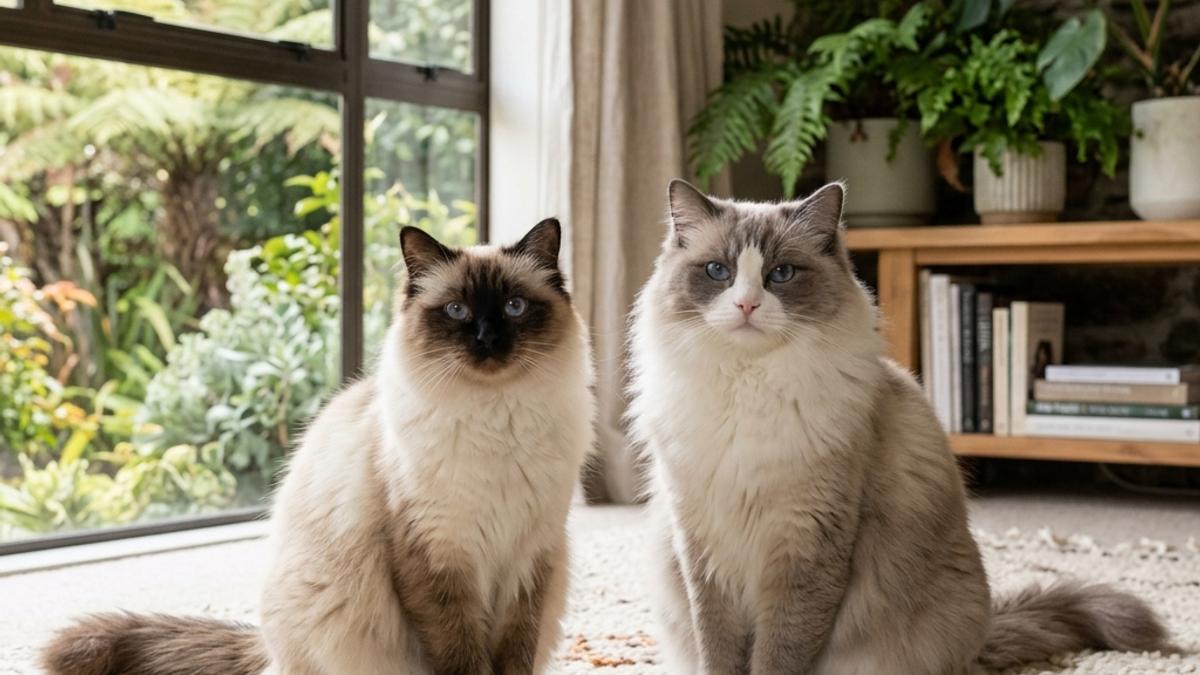
Birmans are affectionate but not passive. They follow their owners around with curiosity, enjoy interactive play, and like to be in the middle of household activity. They're dog-like in their attentiveness — greeting you at the door, following you to different rooms, chirping softly when they want attention. They adapt well to other pets and children but appreciate respectful handling.
Ragdolls are famously docile. The breed name comes from their tendency to go limp and relaxed when held, making them unusually tolerant of being carried and cuddled. They're quieter and less demanding than Birmans — content to sit on your lap for hours. Ragdolls rarely scratch or bite even when overstimulated, which makes them exceptionally suited to children and first-time cat owners. This passivity can also mean they're slow to recognise danger, so indoor-only living is strongly recommended.
Neither breed is suited to being left alone for extended periods daily. Both do better with feline company or a human household that has someone home regularly.
Grooming
This is where the practical difference shows up most.
The Birman's semi-long coat has minimal undercoat, which means it's less prone to matting than many long-haired breeds. A thorough brushing once a week is generally sufficient outside of seasonal shedding, making the Birman the lower-maintenance option in this comparison (★★☆☆☆). This is an asset for NZ owners in humid regions where matted coats are a summer problem.
The Ragdoll's coat is fuller with more undercoat and requires more attention — brushing 2–3 times per week is recommended to prevent tangles and manage shedding. Their grooming score (★★★☆☆) reflects this higher commitment. During NZ spring/autumn, shedding can be significant.
Neither breed needs professional grooming routinely, but a professional de-shed or trim can be helpful during heavy moult periods.
Indoor-only living in NZ
Both breeds are strongly recommended as indoor-only in New Zealand. Their trusting, gentle nature and low prey-drive make them poorly suited to outdoor risks — NZ's roads, cats that are more streetwise, and NZ's native wildlife (which cats impact). See our indoor vs outdoor cat NZ guide for context on why indoor living is increasingly recommended for pedigree cats in NZ.
Both breeds adapt exceptionally well to indoor life given regular play, enrichment, and human companionship. See our indoor cat enrichment guide for ideas.
Health
Both breeds are generally healthy (★★☆☆☆ = low health issue history). Points to be aware of:
- Birman: Ask breeders about hereditary conditions including gangliosidosis (lysosomal storage disorder in some lines) and kidney disease. Responsible breeders test for these.
- Ragdoll: Heart disease (hypertrophic cardiomyopathy, HCM) is present in the breed. The RagaMuffin and some Ragdoll lines carry a known genetic mutation; responsible breeders test breeding cats for HCM. Always ask for cardiac screening results.
In NZ, a vet check-up annually plus desexing, microchipping, and vaccinations are standard. See our NZ vet costs guide.
NZ availability and price
Both breeds are bred in NZ, though availability varies. Neither will be cheap from a reputable breeder — expect to be on a waitlist. Prices fluctuate with demand; verify with current NZ breeders or the New Zealand Cat Fancy (NZCF) registry.
Avoid purchasing from sellers who cannot provide health test results for parents, NZCF registration papers, or access to meet the kitten's mother.
Who each breed suits in NZ
Birman suits you if:
- You want a moderately active, playful companion that stays curious
- You want lower grooming maintenance relative to other semi-long-haired breeds
- You live alone or in a small household and want genuine interaction
- You want a medium-sized cat (3.5–6.5 kg)
Ragdoll suits you if:
- You want the most laid-back, tolerant indoor cat breed available
- You have young children or a busy, active household — Ragdolls are the most forgiving
- You can commit to 2–3 weekly brushing sessions
- You want a large, plush cat that loves being held
Both suit you if:
- You want an indoor-only, apartment-friendly NZ cat
- You prefer a quiet, affectionate breed over an independent or demanding one
- You want a breed that's good with children and other pets
Use the Find a Breed tool to compare more breeds. For more cat guides, see new kitten checklist NZ and cost of owning a cat NZ.
Quick takeaways
- Birman: medium-sized, distinctive white gloves, active and curious, lower grooming needs
- Ragdoll: larger (to 9 kg), famously docile and floppy, slightly more grooming required
- Both are indoor-only recommended in NZ; both excel as apartment cats
- Ragdoll suits families with children well; Birman suits interactive one-on-one companionship
- Ask Ragdoll breeders for HCM cardiac screening results; ask Birman breeders for hereditary disease testing
See also
- Birman breed profile
- Ragdoll breed profile
- Maine Coon vs Ragdoll NZ
- Ragdoll vs British Shorthair NZ
- Indoor vs outdoor cat NZ
- Find a Breed
---
References
- The International Cat Association (TICA), Birman Breed Information: https://tica.org/breed/birman/
- The International Cat Association (TICA), Ragdoll Breed Profile: https://tica.org/breed/ragdoll/
- Merck Veterinary Manual, Hypertrophic Cardiomyopathy in Cats: https://www.merckvetmanual.com/circulatory-system/cardiomyopathy-in-dogs-and-cats/hypertrophic-cardiomyopathy-in-dogs-and-cats
- MPI New Zealand, Code of Welfare for Companion Cats, checked 2026-06-05: https://www.mpi.govt.nz/animals/animal-welfare/codes/all-animal-welfare-codes/code-of-welfare-companion-cats/
---
*This guide provides general information for NZ cat owners. For health advice specific to your cat, consult a registered New Zealand vet.*
Free PetMall tools
Related guides
petmall.co.nz
Shop at PetMall
The products below are practical support items for your pet. PetMall ships across New Zealand.
- Cat FoodStart with food that matches your cat's life stage — change brands slowly over 7–10 days to avoid digestive upset.
- Cat LitterClumping or crystal, most cats prefer an unscented litter and a clean tray — one tray per cat plus one spare is the NZ rule of thumb.
- Cat TreatsGreat for bonding and training — keep treats under 10% of daily calories to protect your cat's waistline.
- Cat ToysA small rotation of toys (feather wand, puzzle feeder, and comfort toy) usually works better than buying many at once.
- Cat GroomingRegular brushing cuts hairballs and shedding — essential for long-haired breeds like Ragdolls and British Longhairs.
- Flea & Worm TreatmentFor NZ conditions, choose protection that fits your cat's weight and lifestyle (indoor vs outdoor) and keep it regular.