Aquarium Filter Types NZ: HOB, Canister, Sponge and Internal Filters Compared
Which aquarium filter suits your NZ tank? Compare hang-on-back, canister, sponge, undergravel and internal power filters — what each does, what tank size and fish type they suit, and what to watch for.
The filter is the most important piece of equipment in your aquarium. Without adequate filtration, ammonia from fish waste builds up rapidly — this is the primary cause of fish deaths in home aquariums, and it's largely preventable by choosing and maintaining the right filter. Here's what each main type does and how to choose for your NZ setup.
The three types of filtration your filter needs to do
Good filtration is not just about removing visible debris. A complete filter addresses three things:
- Mechanical filtration: Removing solid particles (uneaten food, fish waste) from the water
- Biological filtration: Hosting the beneficial bacteria (Nitrosomonas and Nitrobacter) that convert toxic ammonia → nitrite → nitrate. This is the most important function.
- Chemical filtration: Removing dissolved compounds via activated carbon or other media (useful but not always necessary in a well-maintained freshwater tank)
The best filters maximise biological filtration surface area and flow rate relative to tank volume. The rating to look for is turnover rate — how many times per hour the filter passes the full tank volume through itself. For most tropical fish, aim for 4–8× turnover per hour; for goldfish or heavily stocked tanks, 8–10×.
The main filter types
1. Hang-on-back (HOB) / power filters
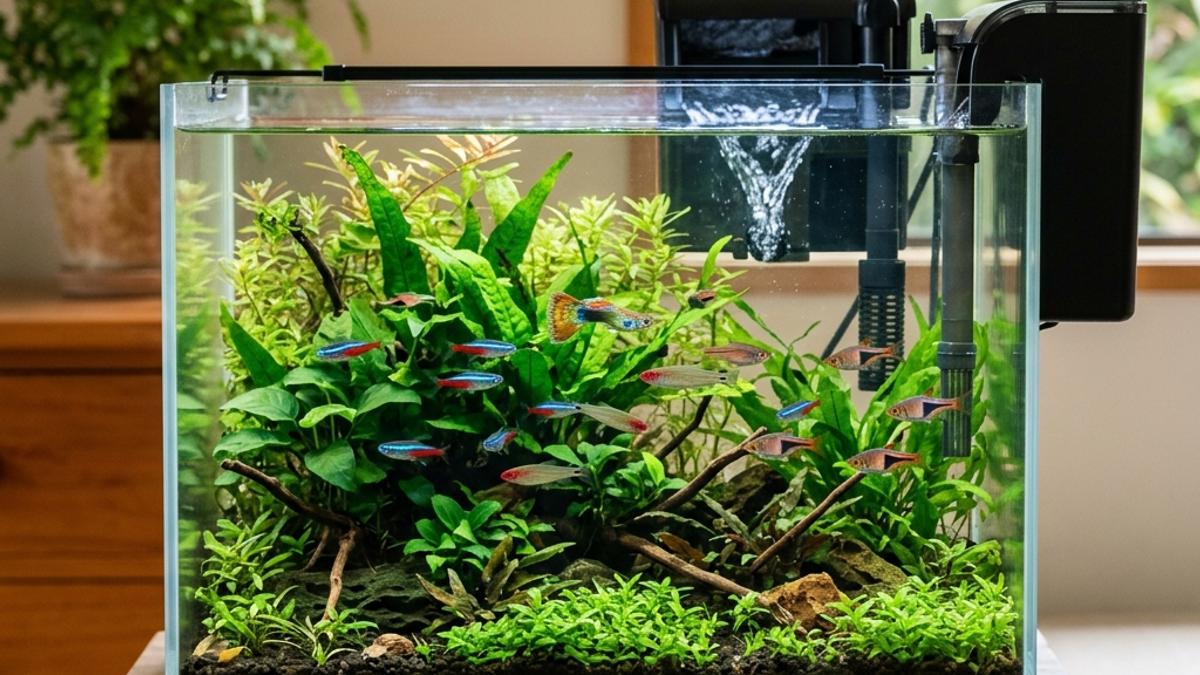
A motor-and-filter-box unit that hangs on the back wall of the tank, drawing water up through a tube and returning it over a waterfall weir.
How it works: Water is drawn from inside the tank via an intake tube, passes through filter media (usually a pad, then biological media, sometimes carbon), and falls back into the tank. The waterfall creates surface agitation, which aids oxygen exchange.
Pros:
- Simple to set up — requires no plumbing
- Easy media changes without disassembling the filter
- The waterfall creates surface agitation (good for oxygenation)
- Very widely available at NZ pet shops
- Affordable range: from around $30 for small models to $150+ for larger HOBs
Cons:
- Takes up no tank interior space, but the box hanging on the outside can be aesthetically intrusive on open-top tanks
- Standard media cartridges that come with many HOBs are designed for frequent replacement (and purchase) — consider replacing the cartridge with a mesh bag of biological media (bio balls, ceramic rings) plus a separate mechanical sponge, which you rinse rather than discard
- Not ideal for very large tanks (over 200 L); canister filters are more powerful for large setups
- The waterfall noise can be audible in quiet rooms
Best for: Beginners, tanks up to 150–200 L, and community tropical fish setups. The standard recommended filter type for first-time NZ aquarium owners.
NZ availability: Available at most pet shops. Brands including Aqua One, Aqua Clear, Fluval, and Juwel are commonly stocked.
2. Canister filters
An external filter unit that sits below the tank inside the cabinet. Water is drawn down through hoses, passes through large volumes of filter media in the sealed canister, and is pumped back up to the tank.
How it works: The sealed canister can be filled with large quantities of biological, mechanical, and chemical media — far more than a HOB. The return water is typically delivered via a spray bar or lily pipe beneath the water surface.
Pros:
- Very high filtration capacity relative to noise and energy use — the large media volume supports a much larger bacterial colony than HOBs
- Quiet — the motor and water movement are contained outside the tank, below the cabinet
- Handles large or heavily stocked tanks well: 200–600 L tanks are the sweet spot
- Maintenance is less frequent — typically every 4–6 weeks for established tanks, versus more frequent for HOBs
- The return can be configured as a spray bar or lily pipe — a lily pipe below the surface produces less noise and surface disturbance, which some fish (bettas, in particular) prefer
Cons:
- Higher upfront cost: quality canister filters for a 200–400 L tank run $150–$400+ NZD
- More complex to set up — requires filling the canister, priming the pump, and routing hoses
- If the canister goes without power for more than a few hours, the anaerobic conditions inside can kill the beneficial bacteria and produce a toxic sulphur-smelling burst of bad water when restarted — always restart gradually after a power outage
- Requires a cabinet to house the unit under the tank
Best for: Experienced aquarists, tanks over 150 L, heavily planted tanks (where surface agitation from a HOB waterfall would drive off CO₂), and high-bioload setups (large cichlids, goldfish ponds, large community tanks).
NZ availability: Fluval, Eheim, and Aqua One canister filters are commonly available in NZ. Fluval 207/307 and Eheim Classic series are well-regarded choices.
3. Sponge filters
A simple foam sponge block connected to an air pump via airline tubing. Air bubbles drawn through the sponge create a current that pulls water through the sponge, which acts as both mechanical and biological filtration.
How it works: The sponge provides a large surface area for beneficial bacteria. As the bacteria colony establishes on the sponge, the filter becomes increasingly effective at biological filtration. The gentle current is created by air, not a motor.
Pros:
- Very gentle flow — ideal for bettas (who prefer still or near-still water), shrimp tanks, and fry tanks (baby fish can be sucked into standard filter intakes — sponge filters eliminate this risk)
- Minimal cost: a sponge filter and air pump can be under $30 NZD
- Easy maintenance: squeeze the sponge in old tank water (not tap water, which kills the bacteria) to remove solid debris while preserving the bacterial colony
- No moving parts in the water — quiet, reliable
- Frequently used as a secondary filter in breeding tanks and hospital/quarantine tanks
Cons:
- Limited mechanical filtration capacity — not suitable for larger tanks or high-bioload setups as a sole filter
- The air pump itself makes a low humming or buzzing noise — this can be audible, particularly at night
- Aesthetically prominent inside the tank
Best for: Betta tanks (especially in NZ, where bettas are one of the most popular fish), shrimp tanks, fry rearing tanks, nano tanks (under 40 L), and as a secondary or quarantine filter.
4. Internal power filters
A self-contained unit that sits submerged inside the tank, drawing water through a sponge or media compartment and returning it via a directional nozzle.
How it works: A small submersible pump inside the unit draws water through the filter media, returning it into the tank. Most have adjustable flow direction.
Pros:
- Compact and self-contained — no external components
- Widely available at low price points (from $15–$50 NZD)
- The directional return can be angled to create a gentle current pattern
Cons:
- Takes up space inside the tank — the unit is visible
- Smaller media volume than a HOB or canister — less biological filtration capacity
- Flow rate adjustments are limited — may be too strong for very small tanks, too weak for larger ones
- Generally considered the weakest filtration option for a properly stocked tank
Best for: Temporary or quarantine tanks, very small tanks (under 30 L), or as a supplemental secondary filter. Not recommended as the sole filter for a well-stocked community tank.
5. Undergravel filters (UGF)
Perforated plates that sit under the gravel substrate, drawing water down through the gravel via an air lift tube, using the substrate itself as a biological filter medium.
Status: Largely obsolete and not recommended for new setups.
Why not recommended:
- The gravel bed traps detritus, requiring regular vacuuming to prevent anaerobic zones developing under the plates
- Incompatible with live plants (whose roots are disrupted by the flow)
- Maintaining and replacing substrate disturbs the entire established filter bed
- Modern sponge, HOB, and canister filters outperform UGFs for equivalent or lower cost
Note: If you're taking on a second-hand tank that has an undergravel filter, consider upgrading to a sponge or HOB filter at your first maintenance opportunity.
Filter size guidelines
The stated "tank size" on filter packaging is typically an optimistic maximum. As a practical guide:
| Tank volume | Recommended filter type | Minimum flow rate |
|---|---|---|
| Under 40 L | Sponge or small internal | 4× volume/hour |
| 40–100 L | Small HOB or internal | 4–6× volume/hour |
| 100–200 L | Medium HOB | 6–8× volume/hour |
| 200–400 L | Large HOB or small canister | 6–8× volume/hour |
| 400 L+ | Canister or dual filter | 6× volume/hour |
For goldfish tanks: use at least 8–10× turnover — goldfish produce significantly more waste than tropical fish.
The nitrogen cycle: why a new filter takes time
A new filter has no beneficial bacteria. It typically takes 4–8 weeks for the bacterial colony to establish (the "nitrogen cycle"). During this period, ammonia and nitrite levels in a new tank rise and then fall as the bacteria population grows. This is normal but requires careful management:
- Test water weekly with an ammonia/nitrite test kit during cycling
- Don't add fish before cycling is complete, or add only very slowly
- A cycled sponge filter from an established tank can be moved to a new setup to seed it with bacteria, dramatically shortening this period
Related guides
- Beginner aquarium setup NZ
- Aquarium water changes NZ
- Beginner betta and goldfish care NZ
- Fish food types NZ
- Fish hub — all NZ fish guides
---
References
- MPI New Zealand, biosecurity and aquarium regulations: https://www.mpi.govt.nz/biosecurity/
- OATA (Ornamental Aquatic Trade Association), How to test water quality in your freshwater tank/aquarium, checked 2026-08-04: https://ornamentalfish.org/what-we-do/advice-information/care-sheets/caresheets-tropical-freshwater-fish/how-to-test-water-quality-in-your-freshwater-tank-aquarium/
---
*This guide provides general technical information for aquarium keepers. Specific tank requirements vary by species — consult a specialist NZ aquarium retailer for setup advice for your fish.*
Related guides
petmall.co.nz
Shop at PetMall
The products below are practical support items for your pet. PetMall ships across New Zealand.
- Filters & MediaA good filter is the heart of a healthy tank — choose low-flow models for bettas and long-finned fish.
- Fish FoodMatch food to your fish — floating pellets for bettas, sinking for bottom feeders. Feed small amounts your fish finish in a couple of minutes.
- Tank Cleaning & MaintenanceA gravel vacuum and an algae scraper do more for water quality than any gadget — most beginner tank problems are maintenance, not equipment.
- Heating & LightingA heater is essential for tropical fish through NZ winters — most bettas and community fish want a stable 24–28°C.
- Water TreatmentDechlorinator and test kits are non-negotiable — stable water quality prevents most beginner fish losses.