Siamese vs Burmese NZ: Which Vocal, Social Cat Breed Is Right for You?
Siamese or Burmese? Both are talkative, affectionate and people-oriented cats popular in NZ. Compare temperament, grooming, noise level and family fit to choose yours.
If you want a cat that actually engages with you — that follows you around, talks back, and considers your lap its personal property — you're probably looking at either a Siamese or a Burmese. Both are among the most people-oriented cat breeds available in New Zealand. The question is which personality style suits your household.
Quick comparison
| Siamese | Burmese | |
|---|---|---|
| Build | Slender, angular, long | Medium, muscular, rounded |
| Coat | Short, fine, point-coloured | Short, fine, single solid colour |
| Talkativeness | Very loud and persistent | Vocal but softer |
| Energy level | High | High–moderate |
| Independence | Low — needs company | Very low — highly people-dependent |
| Good with kids? | Yes, with early socialisation | Yes — often described as "dog-like" |
| NZ price estimate | $800–$1,800 | $800–$1,800 |
| Grooming | Very low | Very low |
See the full profiles: Siamese · Burmese
Temperament: what's the actual difference?
Both breeds are deeply social and unsuitable for homes where they'll be alone for long periods every day. The key difference is *how* they express that social need.
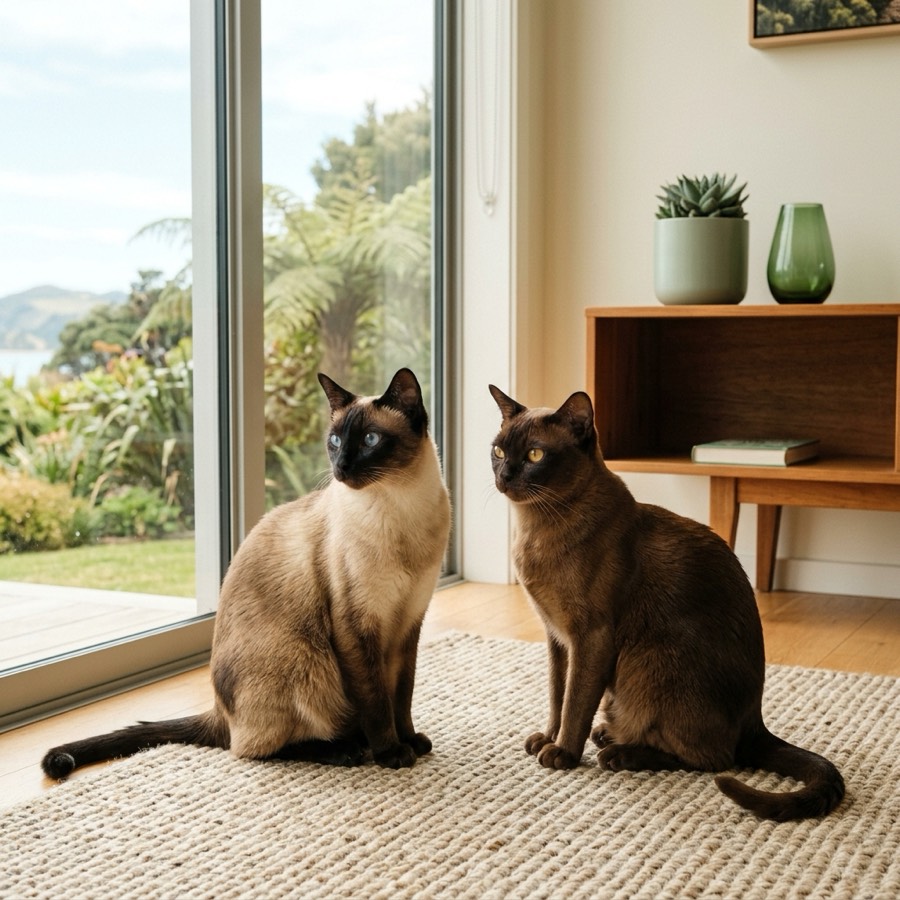
Siamese are direct, opinionated and loud. They will tell you when they want attention, when they're displeased, and — often — when they have an opinion about nothing in particular. The Siamese voice is famously distinctive: loud, low-pitched and persistent. Siamese form strong bonds with one or two people and can be more selective about strangers. They're curious, intelligent and prone to getting into mischief if under-stimulated.
Burmese are often described as the breed most like living with a friendly dog. They are affectionate with almost everyone, extremely tactile, and tend toward a softer, chirping voice rather than the demanding Siamese yowl. Burmese follow their people from room to room and are known for draping themselves over humans given any opportunity. They're calmer overall than Siamese — still playful and active, but less intense.
For NZ households with children: both breeds work well, but the Burmese's easygoing approach to most people makes it slightly easier to manage with young kids. The Siamese's selectivity means it needs more patience from children who want to handle it on their terms.
Noise level
This deserves its own section because it's often underestimated.
The Siamese is genuinely loud. New owners often describe being surprised at the volume — it's closer to a baby crying than a typical cat meow, and the breed will use that voice at 2am if it wants company or notices something interesting. If you live in a NZ apartment with thin walls, be aware that a Siamese at full voice is audible through walls.
The Burmese is vocal and communicative, but at a much more manageable volume. You'll know when your Burmese wants attention, but you're less likely to have noise complaints from neighbours.
Grooming
Both breeds have very short, fine single coats that require almost no grooming. A weekly wipe-down with a rubber mitt or soft cloth is enough. Both are average shedders — not heavy, but not non-shedding.
Neither breed is suitable for someone who wants a low-interaction pet. The grooming is easy; the emotional demand on your time is not.
Health considerations
*General information only — for your cat's specific health, consult a registered NZ vet.*
Siamese cats have a higher genetic predisposition to certain conditions including dental issues, progressive retinal atrophy (PRA) and amyloidosis (a protein-deposit disease affecting organs). Reputable NZ breeders screen for known issues. Average lifespan is 12–15 years.
Burmese cats are prone to hypokalaemia (low blood potassium), which is manageable with dietary support. They also have a higher rate of hypertrophic cardiomyopathy (HCM) compared to many breeds. NZ Burmese breeders should screen for these. Average lifespan is 12–16 years.
Living situation
Both breeds are best suited to indoor or supervised-outdoor homes given NZ's native wildlife risks and the social dependency of both breeds — neither will thrive being left to wander unsupervised.
Both cope well in NZ apartments if they have enough human interaction and enrichment. Neither needs outdoor access to be happy — provided they have company, play time and climbing/perching options. For indoor enrichment ideas, see our cat scratching post and tree types NZ guide.
Which breed suits you?
Consider a Siamese if:
- You want an intensely engaging, opinionated companion
- You work from home or have consistent company throughout the day
- Noise level is not a concern (apartment with thick walls, house, tolerance for loud cats)
- You find strong personality and communication appealing
Consider a Burmese if:
- You want an affectionate, people-oriented cat that's a little easier to live with
- You have young children or frequent visitors
- Apartment noise level matters — the Burmese is much quieter
- You want the social engagement of a "people cat" without the full-volume Siamese experience
For either breed: do not get one if they will spend the majority of the day alone. Both breeds develop behavioural problems — excessive vocalisation, destructive behaviour, anxiety — without adequate social interaction. A second cat as a companion is strongly recommended for any household where the cat will be alone for 8+ hours regularly.
Quick takeaways
- Both are highly social, vocal and people-dependent — unsuitable for owners who want an independent, low-interaction cat
- Siamese are louder, more opinionated and more selective with people; Burmese are softer, friendlier to everyone and often described as "dog-like"
- Both have minimal grooming needs and live 12–16 years
- If noise in an NZ apartment is a concern, the Burmese is the safer choice
- Neither breed should be left alone all day without a companion cat or consistent human interaction
- Expect $800–$1,800 from a reputable NZ breeder; buy from health-screened lines
Related reading
- Siamese cat breed profile NZ
- Burmese cat breed profile NZ
- Best Cat Breeds for First-Time Owners NZ
- Best Low-Shedding Cat Breeds NZ
- Cat Scratching Post Types NZ
- Cat hub — breeds and guides
---
References
- The Governing Council of the Cat Fancy (GCCF), Siamese Breed Profile: https://www.gccfcats.org/getting-a-cat/choosing/cat-breeds/siamese/
- The Governing Council of the Cat Fancy (GCCF), Burmese Breed Profile: https://www.gccfcats.org/getting-a-cat/choosing/cat-breeds/burmese/
- Merck Veterinary Manual, Hypertrophic Cardiomyopathy in Cats: https://www.merckvetmanual.com/circulatory-system/cardiomyopathy-in-dogs-and-cats/hypertrophic-cardiomyopathy-in-dogs-and-cats
- VCA Hospitals — Siamese cat breed profile, checked 2026-07-08: https://vcahospitals.com/know-your-pet/cat-breeds/siamese
---
*This guide provides general breed-comparison information for NZ cat owners. Health information is general only — consult a registered NZ vet for advice specific to your cat.*
Free PetMall tools
Related guides
petmall.co.nz
Shop at PetMall
The products below are practical support items for your pet. PetMall ships across New Zealand.
- Cat FoodStart with food that matches your cat's life stage — change brands slowly over 7–10 days to avoid digestive upset.
- Cat LitterClumping or crystal, most cats prefer an unscented litter and a clean tray — one tray per cat plus one spare is the NZ rule of thumb.
- Cat TreatsGreat for bonding and training — keep treats under 10% of daily calories to protect your cat's waistline.
- Cat ToysA small rotation of toys (feather wand, puzzle feeder, and comfort toy) usually works better than buying many at once.
- Cat GroomingRegular brushing cuts hairballs and shedding — essential for long-haired breeds like Ragdolls and British Longhairs.
- Flea & Worm TreatmentFor NZ conditions, choose protection that fits your cat's weight and lifestyle (indoor vs outdoor) and keep it regular.