Boxer vs Labrador NZ: Which Family Dog Breed Is Right for You?
Boxer or Labrador? Both are popular, family-friendly NZ dogs with big personalities. Compare energy, trainability, grooming, health and cost to find your match.
Two of the most popular family dogs in New Zealand — and both are excellent choices if your household suits them. The Labrador Retriever is reliably the top-registered dog breed in NZ year after year; the Boxer is a firm favourite for active families who want personality in a large, athletic package. They're different enough that choosing between them should come down to your lifestyle and what you want from a dog.
Quick comparison
| Boxer | Labrador Retriever | |
|---|---|---|
| Size | Large — 25–32 kg, 53–63 cm | Large — 25–36 kg, 54–62 cm |
| Lifespan | 10–12 years | 10–12 years |
| Energy level | High — needs vigorous daily exercise | High — needs daily exercise but more flexible |
| Trainability | High (but clownish) | Very high — among the most trainable breeds |
| Grooming | Very low | Low (but seasonal shedding) |
| Good with kids? | Excellent — playful and protective | Excellent — gentle and patient |
| NZ price estimate | $1,500–$2,500 | $1,500–$2,500 |
| Legal in NZ? | Yes | Yes |
Full profiles: Boxer · Labrador Retriever
Personality and temperament
Boxers are clowns. They are exuberant, comedic, physically expressive dogs that never quite lose the puppy energy — many Boxer owners describe their dog acting puppy-like well into their five or six years of age. They're deeply devoted to their family, protective of children, and can be wary of strangers until properly introduced. Boxers bounce — literally — and play physically, which is fantastic with older kids and active adults but can be overwhelming for toddlers or frail elderly people.
Labradors are the archetypal easy, friendly, everyone-gets-along dog. They're generally accepting of strangers, other dogs, children and novel situations. Labs are optimistic in temperament — they tend to approach life with enthusiasm and a wagging tail. They're less physically boisterous than Boxers; they'll still knock a child over in excitement, but it's less of a sports tackle. Their trainability and biddability mean they adapt to most NZ households from small sections to lifestyle blocks.
For NZ families: both are outstanding. The Boxer suits a more physically active household where someone is home much of the day. The Labrador is the more adaptable of the two — it can handle a wider range of owners, households and schedules.
Exercise needs
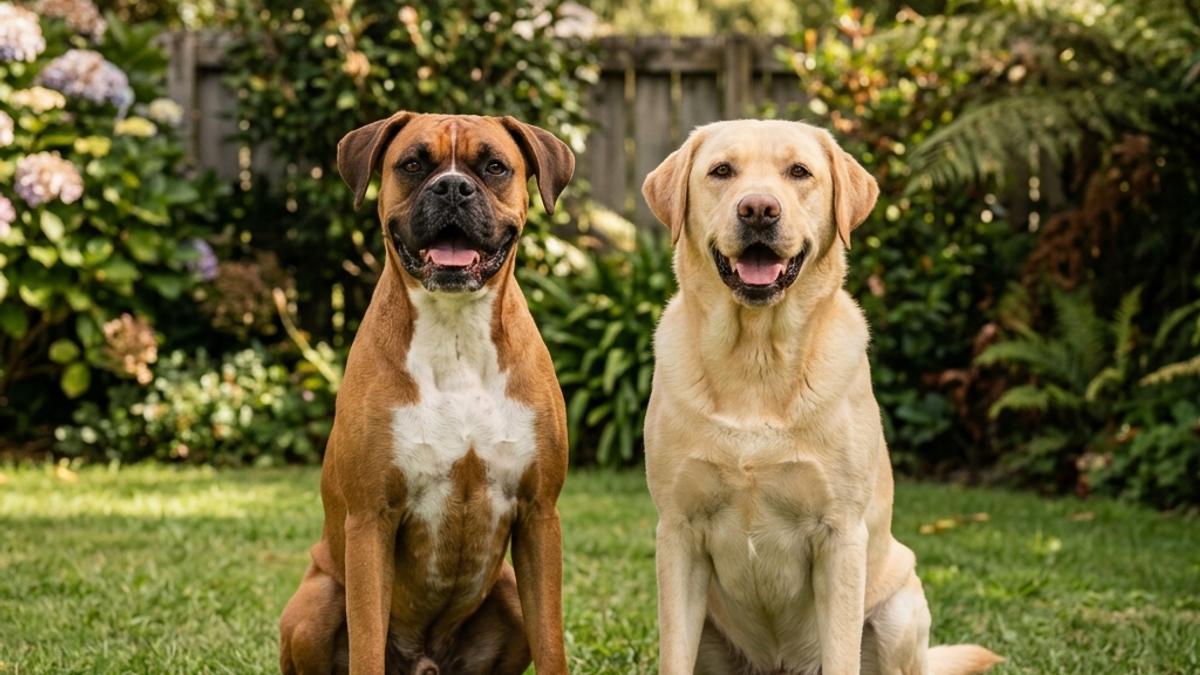
Boxer: needs vigorous exercise — at least 60–90 minutes daily. They are athletic, fast and need to run, not just walk. Under-exercised Boxers become destructive and highly vocal. They do better with space — a garden or section — and do not suit apartments.
Labrador: needs 60+ minutes of daily exercise, but is more forgiving of missed days than a Boxer. Labs are strong swimmers and love water — a common NZ advantage on coasts, rivers and lakes. They're excellent fetch dogs and will happily retrieve in water for as long as you'll throw.
Both breeds are poor candidates for being kennelled outdoors and left alone for long stretches. Both thrive as household members, not yard dogs.
Trainability
The Labrador is widely regarded as one of the easiest breeds to train with reward-based methods — which is why they dominate as guide dogs, detection dogs and therapy dogs worldwide. They want to please, pick up commands quickly and maintain focus well in training environments.
Boxers are intelligent but come with a caveat: they have a sense of humour. They'll learn commands quickly but may offer you a series of wrong answers with great enthusiasm before landing on the right one, especially as adolescents. Consistent, positive training from puppyhood produces excellent results. Boxers that don't go through proper training channels can be challenging to manage at full size.
Both breeds benefit enormously from puppy class — see our best dogs for first-time owners NZ guide for what to expect.
Grooming
Boxer: minimal grooming. Short, tight coat that sheds moderately and only needs a weekly wipe-down and occasional bath. No professional grooming needed. A rubber grooming mitt works well.
Labrador: also low-maintenance but with seasonal shedding. The double coat blows out twice a year — during NZ autumn and spring — and the volume of fur is impressive. Weekly brushing with a deshedding tool during shed seasons significantly reduces the hair on your furniture. In between blow-outs, a weekly brush keeps shedding manageable.
Health considerations
*General information only — consult a registered NZ vet for your dog's specific health care.*
Boxers have a notably high cancer rate compared to most breeds — cancer is the leading cause of death in the breed. They are also prone to heart conditions (aortic stenosis, dilated cardiomyopathy), hip dysplasia and the brachycephalic issues common to flat-faced dogs. Brachycephalic features in Boxers are generally milder than breeds like French Bulldogs, but NZ owners in hot climates (Northland, Hawke's Bay, Nelson) should be aware of heat sensitivity. Buy from cardiac-tested, hip-scored lines.
Labradors are prone to hip and elbow dysplasia (buy from hip/elbow scored parents), exercise-induced collapse (EIC — a genetic condition) and obesity. Labs have a strong food motivation and will overeat if given the opportunity — portion control is essential from puppyhood. Average lifespan is similar to Boxers at 10–12 years.
NZ cost
Both breeds are similarly priced from responsible NZ breeders: expect $1,500–$2,500 depending on lineage and health testing. Working-line Labradors from hunt or detection dog lines may be priced differently. Show-line dogs from extensively health-tested parents sit at the top of the range.
Which breed suits you?
Choose a Boxer if:
- You want a physically active, expressive companion that matches high household energy
- You have children aged 5+ who enjoy rough-and-tumble play
- Someone is home most of the day — Boxers don't do well left alone all day
- You love personality and comedy over predictable compliance
Choose a Labrador if:
- You want maximum trainability and a reliable, adaptable companion
- You have toddlers, elderly family members or first-time dog owners in the household
- You want a dog that adapts to slightly more varied schedules
- Water activities, hunting or field sports are part of your NZ outdoor lifestyle
Quick takeaways
- Both are large, family-friendly, active NZ dogs — the choice is personality style, not quality
- Boxers are bouncier, more expressive and more protective; Labs are more adaptable and easier to train
- Both need 60+ minutes of daily exercise; neither suits being left alone all day as a yard dog
- Labradors shed more seasonally; Boxers have very low grooming needs
- Both are NZ-legal with no breed restrictions; both around $1,500–$2,500 from responsible breeders
- Health screen: cardiac + hips for Boxers; hips + elbows + EIC for Labradors
Related reading
- Boxer breed profile NZ
- Labrador Retriever breed profile NZ
- Best Family Dog Breeds NZ
- Best Dogs for First-Time Owners NZ
- Labrador vs Golden Retriever NZ
- Compare any two breeds side by side
---
References
- American Kennel Club (AKC), Labrador Retriever Breed Profile: https://www.akc.org/dog-breeds/labrador-retriever/
- Merck Veterinary Manual, Hip Dysplasia in Dogs: https://www.merckvetmanual.com/musculoskeletal-system/arthropathies-and-related-disorders-in-small-animals/hip-dysplasia-in-dogs
- American Kennel Club — Boxer breed standard, checked 2026-07-08: https://www.akc.org/dog-breeds/boxer/
---
*This guide provides general breed-comparison information for NZ prospective dog owners. Health information is general only — consult a registered NZ vet for advice specific to your dog.*
Free PetMall tools
Related guides
petmall.co.nz
Shop at PetMall
The products below are practical support items for your pet. PetMall ships across New Zealand.
- Dog FoodStart with food that matches your dog's life stage and activity level — and change brands slowly over 7–10 days.
- Dog TreatsTraining rewards and everyday treats — small, soft pieces work best for consistent reinforcement.
- Dog ToysA small rotation of chew, fetch, and puzzle toys usually works better than buying a large variety at once.
- Dog GroomingA gentle brush and the right shampoo make maintenance easier — especially for dogs that get muddy on walks.
- Leads & HarnessesComfort matters: padded contact points and adjustable fit help reduce rubbing on longer walks or tramping weekends.
- Flea & Worm TreatmentFor NZ conditions, look for protection that fits your routine (monthly vs longer-lasting) and your dog's weight range.