Norwegian Forest Cat vs Siberian NZ: Two Large Forest Cats Compared
Norwegian Forest Cat or Siberian for your NZ home? Both are large, fluffy, and active — but key differences in temperament and allergen levels may determine which suits you best.
The Norwegian Forest Cat and the Siberian are both large, forest-adapted, semi-long-haired cats that look strikingly similar. They're frequently confused — and that confusion is understandable, because both breeds have thick double coats, tufted ears, bushy tails, and an athletic build. But they have genuine differences worth understanding, particularly if low-allergen potential is a factor in your household.
Side-by-side overview
| Norwegian Forest Cat | Siberian | |
|---|---|---|
| Weight | 4–7 kg | 4–7 kg |
| Lifespan | 12–16 years | 12–15 years |
| NZ Price (breeder) | Breeders quote on enquiry (Sept 2026) | Breeders quote on enquiry (Sept 2026) |
| NZ Price (adoption) | $75–$299 via SPCA (fees by age) | $75–$299 via SPCA (fees by age; rare) |
| Energy level | ★★★☆☆ | ★★★☆☆ |
| Trainability | ★★★★☆ | ★★★★☆ |
| Grooming needs | ★★★☆☆ | ★★★☆☆ |
| Apartment suitability | ★★★☆☆ | ★★★☆☆ |
| Good with kids | ★★★★★ | ★★★★★ |
| Good with other pets | ★★★★☆ | ★★★★☆ |
*Scores from PetMall breed profiles (1–5).*
How to tell them apart
Both breeds look remarkably similar, but there are consistent differences:
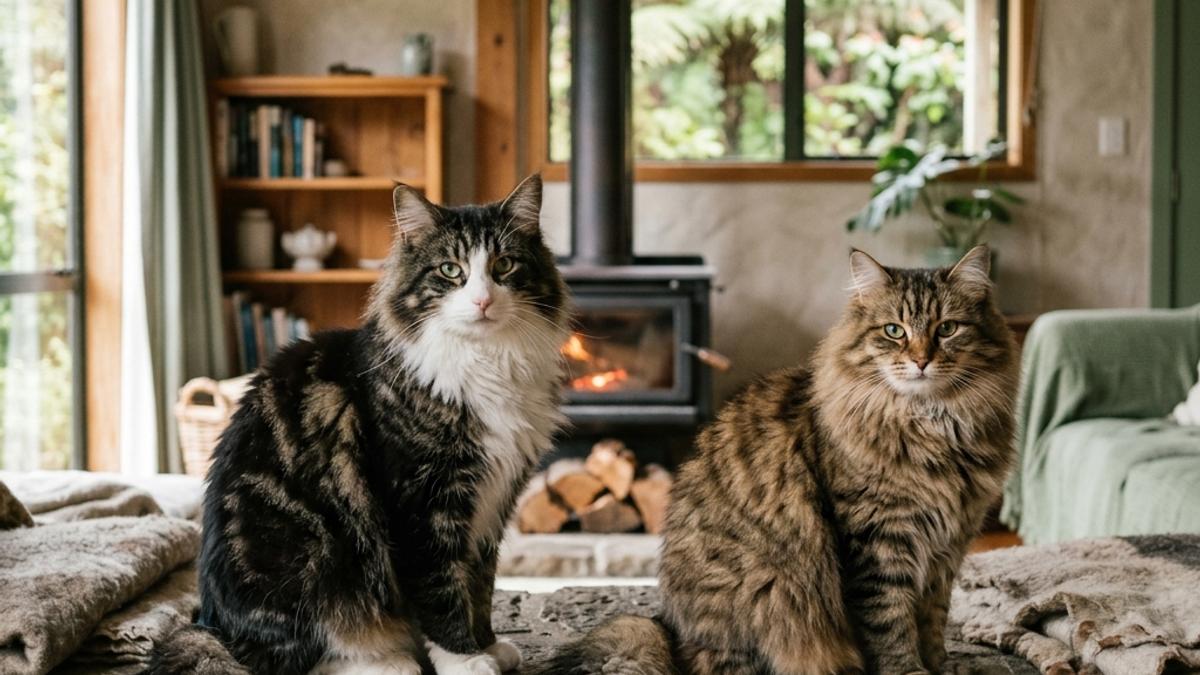
- Norwegian Forest Cat (Wegie): More angular, triangular head profile; straight nose in profile; longer, more angular body. Coat is water-repellent with a dense, woolly undercoat and slightly coarser outer guard hairs.
- Siberian: Rounder, more modified-wedge head; slight downward curve on nose in profile ("concave" when viewed from the side); slightly more rounded, barrel-chested body. Coat is triple-layered (undercoat, awn hairs, guard hairs) and often described as silkier.
Both have tufted ears, large paws (sometimes with "snowshoe" tufts between toes), and a full, bushy tail.
The low-allergen claim: separating fact from marketing
The Siberian is often marketed as a "low-allergen" or "hypoallergenic" cat. This claim needs careful unpacking for NZ buyers.
The background: Human cat allergies are primarily caused by the protein Fel d 1, produced mainly in the cat's salivary and sebaceous glands (and in smaller amounts in the lacrimal and anal glands). Cats transfer it to their coat when they groom, and from there it reaches the household on shed hair and dander — which is why coat length has far less to do with allergy than people assume.
The reality: the immunology literature is blunt about the breed claim. A 2019 review in *Allergy* states that all cats produce Fel d 1 regardless of breed, age, hair length, sex, housing or body weight, and that there are no allergen-free or hypoallergenic cats. What the same work found instead is how enormous the *individual* variation is: an 80-fold difference in salivary Fel d 1 between the lowest and highest producers in a 64-cat group, and up to a 76-fold swing within the same cat measured at different times. That is the effect people are actually noticing when they meet "a Siberian that didn't set me off".
The specific evidence for Siberians is thinner than the marketing suggests. A small 2014 study in *Clinical and Translational Allergy* did measure lower coat Fel d 1 in cats from hypoallergenic-marketed breeds than in ordinary cats — but it compared 8 cats against 6. That is a signal worth noting, not a basis for spending several thousand dollars on the assumption that a pedigree will protect an allergic household.
- No cat breed is hypoallergenic. All cats produce Fel d 1.
- Individual variation is the dominant factor, and it moves within a single cat across the year.
- Some Siberians do test low. So do some moggies at the SPCA. Breed alone does not predict it.
- The only reliable way to know whether a specific cat will trigger your allergy is to spend repeated time with that specific cat.
If allergy is a consideration, ask Siberian breeders whether they test their cats for Fel d 1 levels (some do) — and treat a test result as being about *that cat*, not about the breed. Spend multiple visits with any prospective kitten before committing, and be honest with yourself about what happens on visit three rather than visit one. Keep in mind that people react differently — one household member may be fine while another reacts.
See our hypoallergenic dogs NZ guide for context on how the "low allergen" claim works across species — the same nuance applies to cats.
Temperament differences
Both breeds are known for being active, intelligent, and people-oriented — more interactive than many cat breeds. But there are personality nuances.
Norwegian Forest Cat: Independent and observant, with the character of a cat that's confident in its own space. Wegies are affectionate but on their own schedule — they'll come for attention when they want it, and are content exploring or resting alone when they don't. Their forest-cat heritage makes them excellent climbers; they're happiest in environments with vertical space (tall cat trees, shelves, access to windows).
Siberian: Generally considered warmer and more dog-like in following their owners around. Siberians are playful well into adulthood, enjoy games, and tend to be more assertive about seeking human interaction than Wegies. They're sociable with guests and adapt well to new people and situations.
Both breeds score ★★★★★ for good with kids and ★★★★☆ for good with other pets — genuinely family-friendly breeds.
Activity and climbing
Both breeds are active and athletic — they need:
- At least one large cat tree with climbing options
- Interactive play daily (wand toys, fetch, puzzle feeders)
- Space to move and explore
Neither is a good fit for a tiny, low-stimulation apartment without enrichment. Both do well in larger homes or apartments with dedicated cat furniture. See our indoor cat enrichment NZ guide for ideas.
Grooming
Both breeds require similar grooming commitment:
- Brushing 2–3 times a week normally; daily during seasonal shedding (spring/autumn)
- Pay attention to areas prone to matting: behind ears, under 'armpits', on the belly
- Neither requires regular professional grooming unless severe matting occurs
NZ climate note: both breeds carry a thick coat built for cold climates. In Auckland and Northland's warm, humid summers, expect increased shedding and the need to ensure adequate ventilation and cool resting spots. South Island or elevated regions suit both breeds better climate-wise.
Health considerations
*General information only — consult a registered NZ vet for advice about your cat.*
Both breeds are robust, long-lived cats, but each has one inherited condition worth naming before you choose a breeder.
Norwegian Forest Cat — glycogen storage disease type IV (GSD IV). This is the breed-defining genetic test. GSD IV is an autosomal recessive defect of the glycogen branching enzyme gene (*GBE1*): abnormal glycogen accumulates in muscle, liver and nerve cells. Most affected kittens die at or shortly after birth from hypoglycaemia; the ones that survive the newborn period look completely normal until progressive neuromuscular degeneration begins from around five months of age. Because it is recessive, two healthy carriers can produce affected kittens — which is exactly why a DNA test exists. UC Davis's Veterinary Genetics Laboratory reports three possible results: N/N (clear, cannot pass it on), N/GSD (carrier, passes it to half its kittens, itself unaffected), and GSD/GSD (affected — fatal). Ask an NZ Norwegian Forest Cat breeder for the *GBE1 test results of both parents*. Carrier-to-clear pairings are perfectly responsible breeding; carrier-to-carrier is not.
Siberian — HCM and PKD. The CFA notes that Siberian breeders typically genetic-test carefully to manage the hereditary conditions found in the breed, hypertrophic cardiomyopathy and polycystic kidney disease among them. HCM is the most common heart disease in cats, affecting as many as one in seven, and Merck stresses that most cases are subclinical — an apparently healthy cat can go straight to heart failure, a clot lodged in the hind limbs, or sudden death. Screening is a cardiologist echocardiogram, and because it is a snapshot rather than a genetic verdict, ask *when* the parents were last scanned. PKD is autosomal dominant and settled permanently by a DNA test.
Both breeds: these are slow-maturing cats — TICA notes the Norwegian Forest Cat can take up to five years to reach full maturity, and the CFA says the same of the Siberian. Feed and body-condition-score them as growing cats for longer than you would a moggie, and do not let a breeder use "he's still filling out" to wave away an underweight kitten.
NZ availability
The Norwegian Forest Cat is more established in NZ than the Siberian, with more registered breeders through the New Zealand Cat Fancy (NZCF). Siberian breeders in NZ are fewer in number, which can mean longer waitlists.
Who each breed suits in NZ
Norwegian Forest Cat suits you if:
- You want a large, confident, independent cat with striking forest-cat appearance
- You enjoy a cat that's affectionate on its own terms
- You can provide climbing infrastructure and space to explore
- You're in a cooler NZ region or have good home ventilation
Siberian suits you if:
- Reducing allergen exposure is a factor (and you're willing to test the specific cat first)
- You want a more persistently interactive and dog-like companion
- You can provide the same enrichment and space as a Wegie would need
- You're prepared for a longer waitlist
Both suit you if:
- You want a large, impressive, active cat that's genuinely good with children and other pets
- You're comfortable with semi-long-haired coat maintenance
Use the Find a Breed tool to compare more cats, or see our best cats for seniors NZ and new kitten checklist NZ.
Quick takeaways
- Both are large, fluffy, forest-type cats with similar energy and temperament profiles
- Treat the "low-allergen Siberian" claim carefully: no cat breed is hypoallergenic, and individual cats vary up to 80-fold in Fel d 1 — test the individual cat, not the breed label
- Norwegian Forest Cat is more independent; Siberian tends to be more dog-like and interactive
- Both need climbing space, regular grooming, and active play
- Norwegian Forest Cat is more available in NZ; Siberian has longer waitlists
- Ask for the GBE1 (GSD IV) DNA results of both parents for a Norwegian Forest Cat, and PKD DNA plus a dated cardiologist echo for a Siberian
See also
- Norwegian Forest Cat breed profile
- Siberian breed profile
- Maine Coon vs Ragdoll NZ
- Persian vs Norwegian Forest Cat NZ
- Indoor cat enrichment NZ
- Find a Breed
---
References
- MPI New Zealand, Code of Welfare for Companion Cats, checked 2026-06-05: https://www.mpi.govt.nz/animals/animal-welfare/codes/all-animal-welfare-codes/code-of-welfare-companion-cats/
- TICA — Norwegian Forest breed page (coat, temperament, slow maturity), checked 2026-08-26: https://tica.org/breed/norwegian-forest/
- Cat Fanciers' Association — Siberian breed page (genetic testing, HCM/PKD, slow maturity), checked 2026-08-26: https://cfa.org/breed/siberian/
- UC Davis Veterinary Genetics Laboratory — Glycogen Storage Disease type IV (GSD IV) in Norwegian Forest Cats, checked 2026-08-26: https://vgl.ucdavis.edu/test/gsd-iv-cat
- Merck Veterinary Manual — Hypertrophic Cardiomyopathy in Dogs and Cats, checked 2026-08-26: https://www.merckvetmanual.com/circulatory-system/cardiomyopathy-in-dogs-and-cats/hypertrophic-cardiomyopathy-in-dogs-and-cats
- Satyaraj et al., *Allergy* 2019 — Keep the cat, change the care pathway: a transformational approach to managing Fel d 1, the major cat allergen (no hypoallergenic cats; 80-fold between-cat variation), checked 2026-08-26: https://pmc.ncbi.nlm.nih.gov/articles/PMC7156987/
- Satorina et al., *Clinical and Translational Allergy* 2014 — Do hypoallergenic cats exist? Determination of major cat allergen Fel d 1 production in normal and hypoallergenic cat breeds, checked 2026-08-26: https://pmc.ncbi.nlm.nih.gov/articles/PMC4072467/
---
*This guide provides general information. No cat breed is hypoallergenic — test individual cats if allergy is a concern. Consult a registered NZ vet for health advice.*
Free PetMall tools
Related guides
petmall.co.nz
Shop at PetMall
The products below are practical support items for your pet. PetMall ships across New Zealand.
- Cat FoodStart with food that matches your cat's life stage — change brands slowly over 7–10 days to avoid digestive upset.
- Cat LitterClumping or crystal, most cats prefer an unscented litter and a clean tray — one tray per cat plus one spare is the NZ rule of thumb.
- Cat TreatsGreat for bonding and training — keep treats under 10% of daily calories to protect your cat's waistline.
- Cat ToysA small rotation of toys (feather wand, puzzle feeder, and comfort toy) usually works better than buying many at once.
- Cat GroomingRegular brushing cuts hairballs and shedding — essential for long-haired breeds like Ragdolls and British Longhairs.
- Flea & Worm TreatmentFor NZ conditions, choose protection that fits your cat's weight and lifestyle (indoor vs outdoor) and keep it regular.