Irish Wolfhound vs Scottish Deerhound NZ: Giant Sighthounds Compared
Irish Wolfhound or Scottish Deerhound in New Zealand? Both are ancient, gentle giants — but they differ significantly in size, lifespan, and what ownership actually costs. Here's what you need to know.
Irish Wolfhounds and Scottish Deerhounds are both tall, shaggy, gentle sighthounds with ancient histories. They're often confused or mentioned together, and both attract a small but dedicated following in New Zealand. If you're drawn to giant sighthound breeds, here's how they genuinely compare.
At a glance
| Irish Wolfhound | Scottish Deerhound | |
|---|---|---|
| Weight | M: 64–82 kg / F: 52–64 kg | M: 39–50 kg / F: 34–43 kg |
| Lifespan | 6–8 years | 8–11 years |
| NZ price (registered breeder) | $3,000–$5,000 | $3,000–$5,000 |
| Friendliness | ★★★★ | ★★★★ |
| Trainability | ★★★★ | ★★★★ |
| Energy | ★★★ | ★★★ |
| Grooming needs | ★★★ | ★★★ |
| Apartment life | ★ | ★★ |
| With kids | ★★★★★ | ★★★★★ |
| With other pets | ★★★★ | ★★★★ |
The most important difference: lifespan
Irish Wolfhound: 6–8 years. This is one of the shortest lifespans of any dog breed, and it is the single most important consideration for any prospective owner. You are making a large commitment — financially, emotionally, and logistically — for a dog that will likely be gone before a smaller breed would reach middle age.
Scottish Deerhound: 8–11 years. Still relatively short compared to smaller breeds, but a meaningful improvement over the Wolfhound.
Giant breeds generally have shorter lifespans — this is well-established in veterinary literature — but the Irish Wolfhound's expected span is particularly compressed. Wolfhound owners frequently describe the grief of losing a dog so early, and the awareness of that timeline shapes the whole experience of owning one. Anyone drawn to the breed should factor this fully into their decision.
Size difference
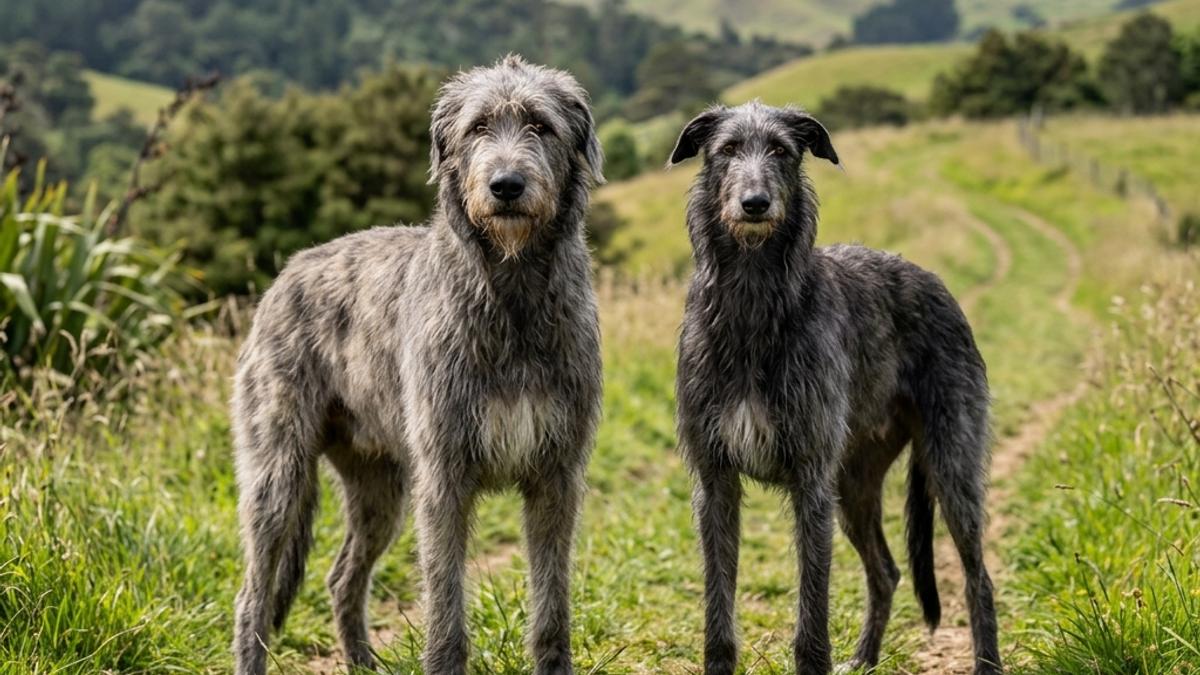
Irish Wolfhound: The tallest breed in the world by typical shoulder height (76–86 cm for males). Weight of 64–82 kg. They require significantly more space, food, and structural accommodation than almost any other breed.
Scottish Deerhound: Large — 39–50 kg for males, shoulder height typically 76–81 cm — but noticeably lighter-boned and lighter overall than the Wolfhound. The Deerhound has a more greyhound-like build, while the Wolfhound has a more substantial, muscular frame.
The practical implications of size:
- Food: An Irish Wolfhound eats roughly 1–2 kg of quality dry food per day depending on activity and formulation. Over an 8-year lifespan, food alone represents a significant cost.
- Vet costs: Procedures (anaesthesia doses, surgical procedures, x-rays) scale with size. Wolfhound vet bills are among the largest of any companion animal.
- Transport and housing: Standard cars may not accommodate an Irish Wolfhound without a large SUV or van. Regular family houses usually manage, but check doorways, stairs, and vehicle accessibility.
Temperament: gentle, calm, noble
Both breeds share the sighthound temperament: calm and gentle indoors, explosive speed and prey drive outdoors. Both are described as gentle giants — their size belies their quiet, dignified indoor manner.
Irish Wolfhound: Known for a particularly noble, serene temperament. They are not guard dogs — they lack the alertness and territorial drive that guard breeds have. They may greet intruders with the same gentle curiosity they show everyone else. The breed phrase "gentle when stroked, fierce when provoked" reflects their historical purpose as war and hunting dogs; the modern NZ pet Wolfhound rarely has occasion for the latter.
Scottish Deerhound: Similar temperament — calm, loyal, affectionate. Slightly more typical sighthound reactivity to movement than the Wolfhound; their lighter build makes this more apparent. Both breeds have strong prey drive (they were bred to course deer and elk), which requires secure fencing and careful off-lead management around small animals.
Exercise and space
Both are moderate-energy dogs (3/5) despite their size. Adult Irish Wolfhounds and Deerhounds are not hyperactive — they prefer lounging around the home interspersed with bursts of activity. A daily walk plus a safe space to run freely (a large, securely fenced section or paddock) is the typical requirement.
Both score poorly on apartment life (1/5 and 2/5). This isn't just about exercise — their physical size means they can't move comfortably in small spaces. A NZ lifestyle block or property with a large, securely fenced paddock is the ideal environment for either breed.
The prey drive issue is important in NZ: both breeds will chase small animals, birds, and potentially livestock if given the opportunity. High, solid fencing (minimum 1.8 m; some Wolfhound owners recommend 2 m or higher) is essential.
Grooming: both are moderate
Both score 3/5 on grooming. They have rough, wiry outer coats that benefit from weekly brushing to remove dead hair and prevent matting. Neither requires professional grooming as frequently as heavily-coated breeds, but hand-stripping is periodically useful to maintain coat texture.
The rough, open coat sheds dirt well — both breeds tend to stay relatively clean between baths. However, Wolfhounds in wet NZ conditions (Auckland winter rain, South Island conditions) can carry significant outdoor mess inside.
NZ availability
Both breeds are rare in New Zealand. Registered breeders are very few — the Irish Wolfhound Club of New Zealand and Scottish Deerhound contacts can be found through Dogs New Zealand (NZKC). Import of dogs from overseas is possible but involves strict MPI biosecurity requirements (rabies-free and mange-free country rules apply to most imports).
Waiting lists are common for both. Expect prices in the $3,000–$5,000 range from registered breeders.
Which is right for you?
Choose an Irish Wolfhound if:
- You specifically want the world's tallest breed and the presence that comes with it
- You're prepared for a shorter lifespan and the associated grief timeline
- You have the space (large property) and budget (food, vet, transport) for an 80 kg dog
- You want the most serene, noble temperament of the two
Choose a Scottish Deerhound if:
- You want a large, beautiful sighthound with more years on average
- You prefer a lighter-boned, more greyhound-like build
- You want slightly better apartment suitability (though still not apartment dogs)
- You're drawn specifically to the Deerhound's historic role as a companion to Scottish highland nobility
Neither is right if:
- You're looking for a guard dog (both are friendly with everyone)
- You live in a small NZ home or apartment
- You're not prepared to manage prey drive strictly around smaller animals
- The short-to-moderate lifespan relative to cost and commitment is a concern
NZ legalities
Neither breed has specific legal restrictions in New Zealand. Both must be council-registered and microchipped under the Dog Control Act 1996.
MPI import requirements apply if bringing dogs from overseas — these involve health certificates, rabies vaccination history (country-dependent), and a mandatory stand-down period. Contact MPI directly for current import requirements if you're considering importing either breed.
Related guides
- Best guard and watch dogs NZ
- Best dog breeds for lifestyle blocks and farms NZ
- Greyhound vs Italian Greyhound NZ
- Dog grooming at home NZ
- Find a breed tool
- Compare breeds tool
---
References
- MPI New Zealand, Bringing cats and dogs to NZ — dogs may be imported only from approved countries; rabies vaccination is required at least 6 months before arrival, and pets from anywhere except Australia must spend at least 10 days in an MPI-approved quarantine facility, checked 2026-07-28: https://www.mpi.govt.nz/bring-send-to-nz/pets-travelling-to-nz/bringing-cats-and-dogs-to-nz
- Dog Control Act 1996 — New Zealand's statutory framework for dog registration, control and owner obligations, checked 2026-07-28: https://www.legislation.govt.nz/act/public/1996/0013/latest/whole.html
---
*Profile scores sourced from PetMall breed profiles. NZ price ranges are indicative; confirm with current registered breeders. Giant breed lifespan figures are population averages — individual dogs vary. Not a substitute for veterinary advice.*
Free PetMall tools
Related guides
petmall.co.nz
Shop at PetMall
The products below are practical support items for your pet. PetMall ships across New Zealand.
- Dog FoodStart with food that matches your dog's life stage and activity level — and change brands slowly over 7–10 days.
- Dog TreatsTraining rewards and everyday treats — small, soft pieces work best for consistent reinforcement.
- Dog ToysA small rotation of chew, fetch, and puzzle toys usually works better than buying a large variety at once.
- Dog GroomingA gentle brush and the right shampoo make maintenance easier — especially for dogs that get muddy on walks.
- Leads & HarnessesComfort matters: padded contact points and adjustable fit help reduce rubbing on longer walks or tramping weekends.
- Flea & Worm TreatmentFor NZ conditions, look for protection that fits your routine (monthly vs longer-lasting) and your dog's weight range.