Doberman vs Rottweiler NZ: Which Breed Is Right for You?
Doberman or Rottweiler? Compare size, temperament, exercise needs, cost and NZ suitability side by side to find which large guardian breed suits your lifestyle.
Two of the most capable guardian breeds in the world — and two of the most misrepresented. The Doberman Pinscher and the Rottweiler share a reputation that goes beyond their actual temperament: both are loyal, trainable and deeply bonded to their families when well bred and well socialised. The question is which one suits *your* household, not which one is "tougher."
Both breeds are legal in New Zealand. Neither is a restricted breed under the Dog Control Act 1996. But both need experienced, committed owners. This is not a first-dog pairing.
Quick comparison at a glance
| Doberman Pinscher | Rottweiler | |
|---|---|---|
| Size | Large — 27–45 kg, 63–72 cm | Large to XL — 35–60 kg, 56–69 cm |
| Lifespan | 10–13 years | 8–10 years |
| Energy level | Very high | Moderate–high |
| Trainability | Very high | High |
| Grooming | Very low (short, tight coat) | Low–moderate (double coat) |
| NZ price estimate | $2,000–$3,500 | $2,000–$4,000 |
| Legal in NZ? | Yes | Yes |
| Good with children? | Yes, with early socialisation | Yes, with early socialisation |
| Exercise (daily) | 1.5–2 hours | 1–1.5 hours |
See both profiles in detail: Doberman Pinscher · Rottweiler
Size and build
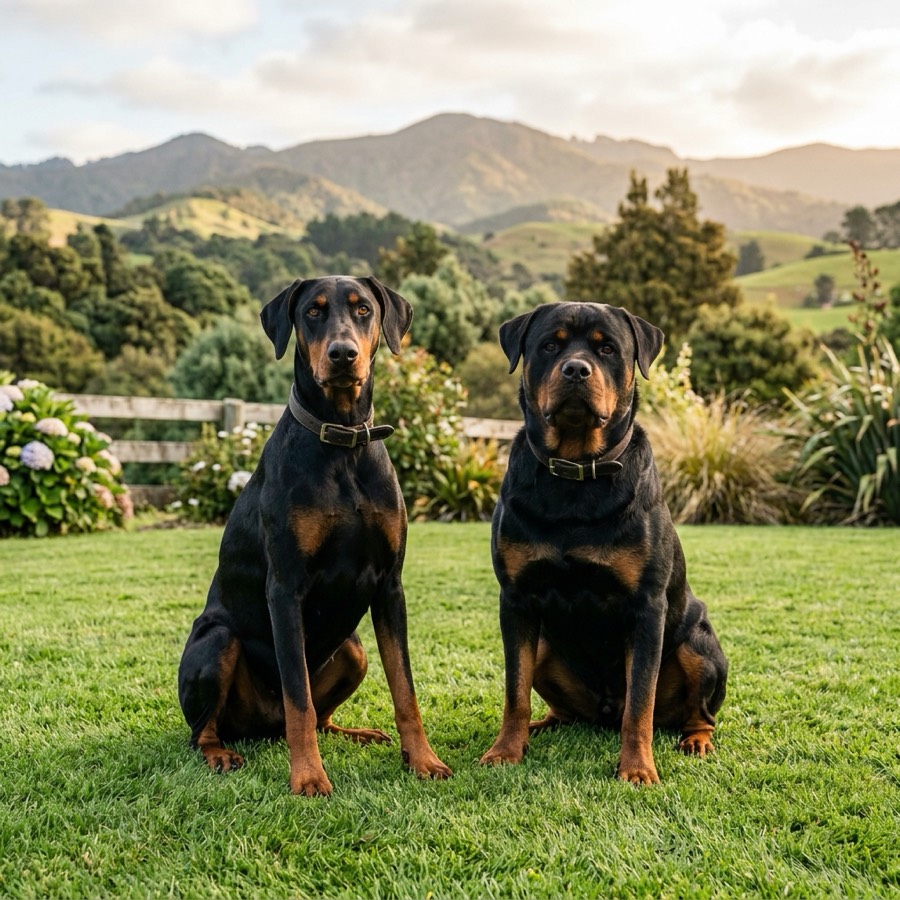
Dobermans are tall and athletic — a muscular, elegant dog built for speed and agility. Rottweilers are heavier, blockier and lower to the ground — built for power and endurance. A male Rottweiler can comfortably exceed 50 kg; a male Doberman typically sits around 35–40 kg.
For NZ households with smaller sections or townhouses, the Doberman's lean build can be an advantage. The Rottweiler's heavier frame needs more space and a confident handler to manage on-lead.
Temperament and family fit
Both breeds are affectionate and deeply bonded to their people — they are not "kennel dogs" and do not thrive isolated from the family. Both can be excellent with children when socialised from puppyhood and raised alongside them.
The Doberman tends to be more alert, reactive and on-edge — it's an instinctive guardian that notices everything and is quick to respond. This can come across as intensity or nervousness in under-socialised examples. The Rottweiler tends to be calmer and more deliberate — slower to react, more confident in its own skin, and often less sensitive to environmental triggers.
For a NZ family with young children and a busy household, the Rottweiler's calmer baseline can be easier to manage. The Doberman's intensity suits an experienced owner who wants an active, engaged dog and can match that energy.
Exercise and mental stimulation
The Doberman has a higher base energy level than the Rottweiler and needs more vigorous daily exercise — at least 1.5 to 2 hours, including off-leash running if possible. It excels in dog sports: tracking, Schutzhund, agility. Without adequate exercise and mental stimulation, Dobermans develop destructive behaviours.
The Rottweiler is no couch dog, but its exercise needs are somewhat more manageable — around 1 to 1.5 hours daily. It benefits from tasks: carting, tracking, obedience trials. A bored Rottweiler in a back yard will dig, chew and bark.
Both breeds need recall training and reliable leash manners to be safe in NZ public spaces. Council requirements for dangerous dogs can apply to individual dogs of any breed if incidents occur — see our dog registration NZ guide for your local rules.
Trainability
Both breeds rank among the most trainable dogs in the world, and historically both have been used in police and military work. They respond best to reward-based, consistent training — not harsh corrections, which can produce fearful or reactive responses.
The Doberman tends to be more "handler-sensitive" — it picks up on your mood and body language and responds quickly. This makes it highly responsive to good training but also quick to develop problem behaviours with inconsistent handling.
The Rottweiler is confident and independent-minded. It responds to clear, consistent leadership — it will test a handler it doesn't respect. Obedience training from puppy class onwards is non-negotiable for either breed.
Grooming
The Doberman wins on grooming hands down: a short, tight single coat that needs nothing more than a weekly wipe-down and a monthly bath. Minimal shedding, no seasonal blow-out.
The Rottweiler has a short double coat that sheds more heavily twice a year. A rubber grooming mitt or slicker brush weekly keeps shedding manageable. Neither breed needs professional grooming.
Health considerations
*General information only — for your dog's specific health needs, consult a NZ registered vet.*
Dobermans have a notable genetic predisposition to dilated cardiomyopathy (DCM), a heart condition, and Wobbler syndrome (cervical vertebral instability). Reputable NZ breeders should screen for DCM. Lifespan averages 10–13 years.
Rottweilers are prone to hip and elbow dysplasia, and have a higher cancer rate than average, contributing to their shorter average lifespan of 8–10 years. Buying from health-tested lines reduces (but cannot eliminate) these risks.
Both breeds benefit from pet insurance in NZ given the cost of veterinary care for large breeds.
Cost in NZ
Expect to pay $2,000–$3,500 for a Doberman and $2,000–$4,000 for a Rottweiler from a responsible New Zealand breeder. Show-line or working-line dogs from extensively health-tested parents sit at the top of those ranges.
Ongoing costs are broadly similar — both are large breeds with corresponding food, veterinary and training costs. The Rottweiler's larger frame means slightly higher food costs; the Doberman may incur cardiac screening costs as it ages.
NZ legal status
Neither breed is restricted under the Dog Control Act 1996 or the Dog Control Amendment Act 2003 — which restricts American Pit Bull Terrier type dogs, Japanese Tosa, Dogo Argentino and Brazilian Fila. Both Dobermans and Rottweilers are legal to own anywhere in New Zealand. Individual dogs can be declared dangerous or menacing by a council based on behaviour, regardless of breed.
Which breed suits you?
Consider a Doberman if:
- You are an experienced dog owner with time for 1.5–2 hours of daily active exercise
- You want a highly responsive, trainable dog that is "always on" and aware
- You can commit to consistent training and ongoing mental engagement
- Grooming convenience matters to you
Consider a Rottweiler if:
- You want a calmer, more deliberate temperament with high trainability
- You have a family with children and want a steadier baseline personality
- You can handle a heavier, stronger dog on-lead
- You accept a shorter average lifespan and commit to health screening
For either breed, puppy class from 8–12 weeks, ongoing obedience training and broad socialisation are non-negotiable. Both dogs need to be part of the family — not left alone in a back yard. See best guard and watch dog breeds NZ for other NZ-legal guardian breed options.
Quick takeaways
- Both Doberman and Rottweiler are legal in New Zealand and well-suited to experienced, committed owners
- Dobermans are taller, leaner, higher-energy and more handler-sensitive — ideal for active owners wanting a responsive working dog
- Rottweilers are heavier, calmer and more independent — steady family dogs that still need firm, consistent handling
- Both need early socialisation, puppy class, and daily exercise — neither suits a first-time owner
- Expect $2,000–$4,000 from a reputable NZ breeder; buy from health-tested lines only
- Grooming is minimal for both; the Rottweiler sheds more seasonally
Related reading
- Doberman Pinscher breed profile NZ
- Rottweiler breed profile NZ
- Best Guard & Watch Dog Breeds NZ
- Best Family Dog Breeds NZ
- Compare any two breeds side by side
- Dog Registration NZ: Council Checklist
---
References
- American Kennel Club (AKC), Doberman Pinscher Breed Profile: https://www.akc.org/dog-breeds/doberman-pinscher/
- American Kennel Club (AKC), Rottweiler Breed Profile: https://www.akc.org/dog-breeds/rottweiler/
- Merck Veterinary Manual, Hip Dysplasia in Dogs: https://www.merckvetmanual.com/musculoskeletal-system/arthropathies-and-related-disorders-in-small-animals/hip-dysplasia-in-dogs
- Dog Control Act 1996 and Dog Control Amendment Act 2003 (NZ), restricted and menacing dog provisions, checked 2026-06-05: https://www.legislation.govt.nz/act/public/1996/0013/latest/DLM374410.html
---
*This guide provides general breed-comparison information for NZ prospective dog owners. Health information is general only — consult a registered NZ vet for advice specific to your dog.*
Free PetMall tools
Related guides
petmall.co.nz
Shop at PetMall
The products below are practical support items for your pet. PetMall ships across New Zealand.
- Dog FoodStart with food that matches your dog's life stage and activity level — and change brands slowly over 7–10 days.
- Dog TreatsTraining rewards and everyday treats — small, soft pieces work best for consistent reinforcement.
- Dog ToysA small rotation of chew, fetch, and puzzle toys usually works better than buying a large variety at once.
- Dog GroomingA gentle brush and the right shampoo make maintenance easier — especially for dogs that get muddy on walks.
- Leads & HarnessesComfort matters: padded contact points and adjustable fit help reduce rubbing on longer walks or tramping weekends.
- Flea & Worm TreatmentFor NZ conditions, look for protection that fits your routine (monthly vs longer-lasting) and your dog's weight range.