Cornish Rex vs Devon Rex NZ: Curly-Coated Cats Compared
Cornish Rex or Devon Rex in New Zealand? Both have wavy coats and elfin features, but they differ in size, personality, warmth needs, and what daily life looks like. Here's how to choose.
Both the Cornish Rex and Devon Rex are famous for their short, wavy coats and otherworldly appearance — large ears, angular faces, and an almost alien-graceful build. They are often confused for each other, and even experienced cat people sometimes hesitate. They are distinct breeds with real differences in coat structure, temperament, and NZ management needs.
At a glance
| Cornish Rex | Devon Rex | |
|---|---|---|
| Weight | 2–4 kg | 2–5 kg |
| Lifespan | 11–14 years | 10–15 years |
| NZ price (breeder) | $1,200–$2,800 | Breeders quote on enquiry (Sept 2026) |
| Friendliness | ★★★★ | ★★★★★ |
| Trainability | ★★★★ | ★★★★ |
| Energy | ★★★★ | ★★★★ |
| Grooming needs | ★★ | ★ |
| Apartment life | ★★★★ | ★★★★★ |
| With kids | ★★★★★ | ★★★★★ |
| With other pets | ★★★★ | ★★★★ |
The key physical difference: coat genetics
Both breeds carry mutations that affect hair structure, but they are different mutations producing different coats.
Cornish Rex: Lacks guard hairs and awn hairs entirely. The coat consists only of down hairs — the soft, fine undercoat that other cats have beneath their outer coat. The result is an extremely short, dense, uniformly wavy coat that feels like velvet or chenille. The Cornish Rex's mutation is a simple recessive gene.
Devon Rex: Has all three hair types (guard, awn, and down), but all are shortened and softened by a separate gene mutation. The coat is wavier and slightly more variable in texture — some Devon Rex cats have a very fine, almost bald appearance on the head or ear tips, while others have denser waves. Devon Rex carry a different, independent mutation from the Cornish.
These are not variants of the same coat — they are independent genetic developments that happen to look similar.
Practical implication: The Cornish Rex coat is slightly denser and more uniform. The Devon Rex coat can be patchier in places, particularly in young cats, and individual variation is higher.
Temperament differences
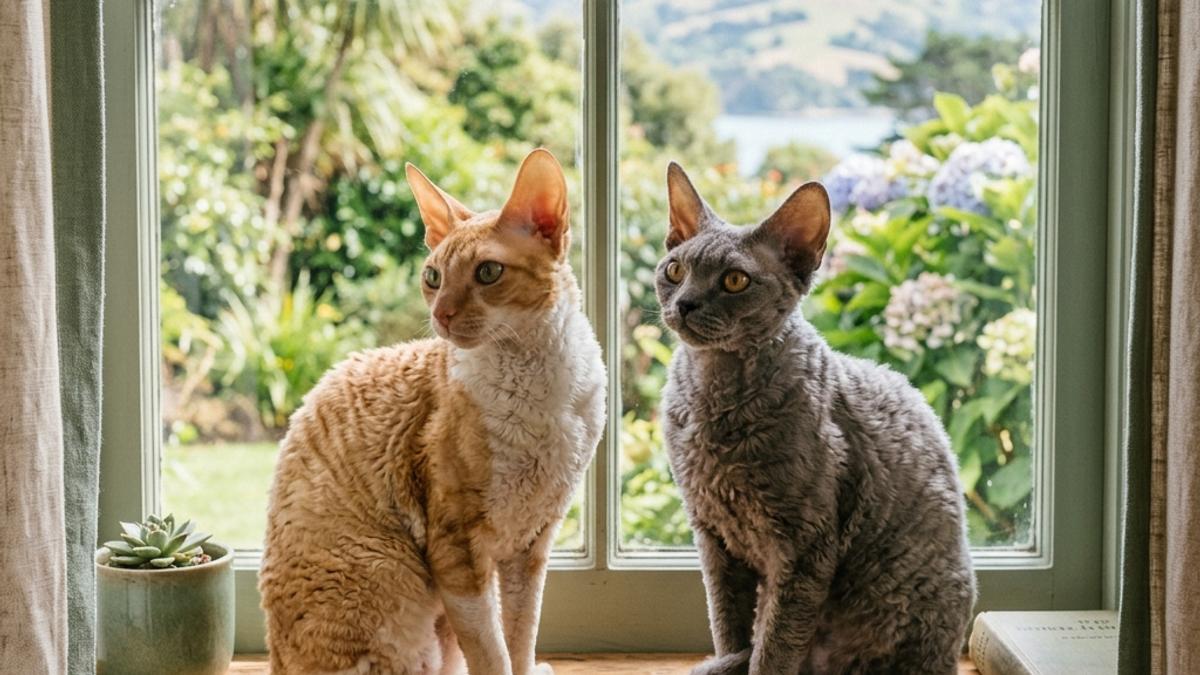
Both breeds are active, intelligent, and people-oriented. The difference is in degree:
Cornish Rex (friendliness 4/5): Playful, social, and affectionate — often described as "kitten-like" throughout their life. They enjoy play, seek human attention, and tend to be active and entertaining. They're slightly less intense about requiring constant human contact than Devons.
Devon Rex (friendliness 5/5): Nicknamed "poodle cats" for their tendency to bond with one person particularly strongly. Devons are often described as "velcro cats" — they want to be wherever you are, often on your shoulder, in your lap, or tucked under covers. They are the higher-scoring breed on apartment suitability (5/5 vs 4/5), which reflects their contentment in small spaces when they have their person nearby.
The Devon Rex's score difference on friendliness isn't dramatic, but experienced owners who've had both breeds consistently describe Devons as slightly more intensely attached.
Warmth needs in NZ
This is one of the most practically important considerations for NZ owners.
Both breeds have very little insulating coat and relatively low body fat. They feel the cold. In any NZ home during winter — particularly South Island winters — they need:
- Warm sleeping spots (a cave bed or heated mat is strongly recommended)
- Indoor access at all times
- A warm sleeping environment — an unheated room in a Wellington or Christchurch winter is genuinely too cold for these cats
NZ UV concern: Both breeds have thin coats that offer no protection against UV radiation. Large ears (a feature of both breeds) and sparsely covered areas are particularly vulnerable to sunburn and potentially skin cancer with prolonged sun exposure. In NZ's high-UV environment (especially October–April), limit sun exposure on windows, and for cats with access to sunny spots, consult your vet about UV-blocking film for windows in extreme cases.
Some owners put small cat jumpers on both breeds in New Zealand winters — this is practical, not merely decorative.
Grooming
Cornish Rex (grooming 2/5): Weekly gentle brush or wipe-down with a soft cloth. Does not shed much. Ears accumulate wax and need regular cleaning — the large ears trap more than smaller-eared breeds.
Devon Rex (grooming 1/5): Even lower maintenance — very little shed, minimal brushing required. The Devon's coat is so fine and short that over-brushing can actually thin it. A very gentle weekly rub-down is sufficient. Ear cleaning still important.
Both breeds are among the lowest-maintenance coats available in the cat world. If you're choosing between breeds partly on grooming convenience, both are excellent choices — the Devon has a marginal edge.
NZ apartment suitability
Both score well for apartments (Cornish Rex 4/5, Devon Rex 5/5). Their small size, low shedding, and people-focused personality make them well-suited to NZ city apartments and flats. They can thrive in Ponsonby or Wellington apartments provided they receive adequate play and human interaction.
One caveat: neither should be a solo cat in a home where the owner is away for 8+ hours a day. Both breeds are social enough that isolation causes stress. A second cat, or significant daily interaction, is important.
NZ availability and pricing
Both breeds are relatively uncommon in New Zealand compared to mainstream breeds. Registered breeders exist but are fewer than for, say, Ragdolls or British Shorthairs. Waiting lists are common. Prices: $1,200–$2,800 for the Cornish Rex; for the Devon Rex, most registered NZ breeders we checked don't publish a price and no kittens were advertised on TradeMe (Sept 2026), so ask the breeder directly.
Check New Zealand Cat Fancy for current registered breeder listings.
Which is right for you?
Choose a Cornish Rex if:
- You want the distinctively uniform, velvet-textured wavy coat
- You prefer a slightly less intense level of human attachment
- The specific Cornish silhouette appeals to you (leaner, more greyhound-like in structure)
Choose a Devon Rex if:
- You want a deeply loyal, people-focused cat that will be your constant companion
- You're in a small apartment and want the highest apartment-suitability rating
- You prefer the Devon's slightly more variable, softer coat texture
- You want very slightly lower grooming effort
Both are unsuitable if:
- You want a low-maintenance cat that doesn't require warmth provisions in NZ winter
- Your home is drafty or unheated in winter
- You want a more independent cat
Related guides
- Best first cat breeds NZ
- Best low-shedding cat breeds NZ
- Cat grooming at home NZ
- Cat bed types NZ
- Find a breed tool
- Compare breeds tool
---
Sources
- https://gccfcats.org/breeds/cornish-rex/
- https://gccfcats.org/breeds/devon-rex/
- https://www.merckvetmanual.com/circulatory-system/cardiomyopathy-in-dogs-and-cats/hypertrophic-cardiomyopathy-in-dogs-and-cats
- https://www.mpi.govt.nz/bring-send-to-nz/pets-travelling-to-nz/bringing-cats-and-dogs-to-nz/
Free PetMall tools
Related guides
petmall.co.nz
Shop at PetMall
The products below are practical support items for your pet. PetMall ships across New Zealand.
- Cat FoodStart with food that matches your cat's life stage — change brands slowly over 7–10 days to avoid digestive upset.
- Cat LitterClumping or crystal, most cats prefer an unscented litter and a clean tray — one tray per cat plus one spare is the NZ rule of thumb.
- Cat TreatsGreat for bonding and training — keep treats under 10% of daily calories to protect your cat's waistline.
- Cat ToysA small rotation of toys (feather wand, puzzle feeder, and comfort toy) usually works better than buying many at once.
- Cat GroomingRegular brushing cuts hairballs and shedding — essential for long-haired breeds like Ragdolls and British Longhairs.
- Flea & Worm TreatmentFor NZ conditions, choose protection that fits your cat's weight and lifestyle (indoor vs outdoor) and keep it regular.