British Shorthair vs Domestic Shorthair NZ: Pedigree Calm or Kiwi Classic?
British Shorthair vs Domestic Shorthair NZ comparison using PetMall profile data: temperament, cost, grooming and apartment fit.
British Shorthair vs Domestic Shorthair NZ is really a choice between predictability and flexibility. Choose a British Shorthair if you want a calm, plush, pedigree indoor cat. Choose a Domestic Shorthair if you want to match an individual cat's personality through adoption or rescue.
Both can suit New Zealand apartments and family homes. The better choice depends on budget, grooming tolerance, energy level, and whether you value breed consistency or individual fit.
Quick Comparison
| Factor | British Shorthair | Domestic Shorthair |
|---|---|---|
| PetMall profile page | British Shorthair | Domestic Shorthair |
| Size | 4-8 kg | 3-6 kg |
| Lifespan | 12-17 years | 12-18 years |
| Temperament | Calm, steady, affectionate without being needy | Variable, adaptable, affectionate or independent |
| Friendliness score | 4/5 | 4/5 |
| Trainability score | 3/5 | 3/5 |
| Energy score | 2/5 | 3/5 |
| Grooming score | 1/5 | 1/5 |
| Apartment score | 5/5 | 4/5 |
| With kids | 4/5 | 4/5 |
| With other pets | 3/5 | 3/5 |
| NZ purchase/adoption price | Varies by breeder, pedigree, age and availability | Adoption fees vary by shelter or rescue |
The Short Answer
Shortlist a British Shorthair if you want a quieter, rounder, lower-energy cat with a more predictable pedigree profile. PetMall profile data gives British Shorthairs 5/5 for apartment life, 2/5 for energy and 1/5 for grooming needs.
Shortlist a Domestic Shorthair if you want the everyday Kiwi cat: lower coat maintenance, wide personality variety, and the chance to choose an adult cat whose temperament is already visible. PetMall profile data gives Domestic Shorthairs 4/5 for apartment life, 3/5 for energy and 1/5 for grooming needs.
For a wider beginner shortlist, read Best First Cat Breeds NZ.
Pedigree Predictability vs Individual Match
The British Shorthair is the more predictable option. Its PetMall profile describes a calm, steady, generally quiet cat that is affectionate without being needy. That makes it attractive for apartment owners, work-from-home households and people who want a relaxed indoor companion.
The Domestic Shorthair is not one breed with one type. It is a non-pedigree short-coated cat with huge variation in colour, size, confidence, play style and affection level. That sounds less neat on paper, but it is a real advantage if you adopt through a shelter or rescue that can help match the individual cat to your home.
If you want a kitten with a specific look, breeder background and a more defined breed type, the British Shorthair may appeal. If you want to meet cats and choose by actual personality, the Domestic Shorthair often gives you more flexibility.
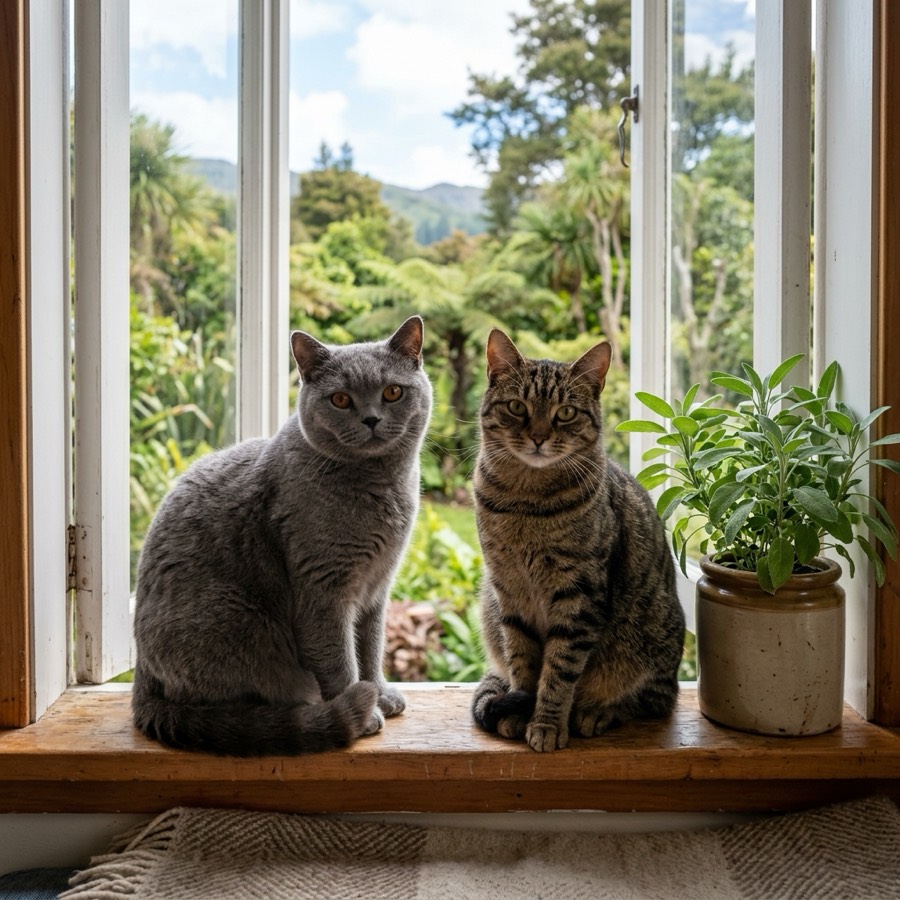
Apartment and Indoor Fit
Both cats can work well indoors. The British Shorthair has the stronger profile score for apartments at 5/5. It is usually calm, low-energy and content with a window perch, scratcher, hiding spaces and interactive play.
The Domestic Shorthair scores 4/5 for apartment life, but the individual cat matters more. A settled adult with a relaxed personality can be excellent in an Auckland apartment. A young high-energy cat may need more play, climbing and puzzle feeding than the score suggests.
SPCA New Zealand recommends keeping cats safe and happy at home through enriched indoor spaces, secure outdoor areas or catios. That advice fits both cats, especially in NZ suburbs where traffic, dogs, toxins, fights and native wildlife are part of the real-world picture.
Compare apartment options with Best Cat Breeds for Apartments NZ.
Grooming and House Mess
Both breeds score 1/5 for grooming needs in PetMall profile data, so neither is a heavy coat-care commitment.
British Shorthairs have a dense plush coat. The profile recommends weekly brushing, with more frequent brushing during spring and autumn shedding. That plush coat is one of the breed's charms, but it still drops hair on couches and clothes.
Domestic Shorthairs are usually simple to maintain. Short coats still benefit from brushing, especially for hairball control and bonding, but they are usually easier than semi-longhaired breeds.
For owners who want low coat admin, both are better than many longhaired cats. For an even broader low-care shortlist, see Low Maintenance Pets NZ.
Energy and Enrichment
The British Shorthair has the lower energy score, 2/5. That suits people who want a calm companion rather than a cat constantly asking for play. Low energy still needs management: measured food, interactive play, scratching, climbing and weight control.
The Domestic Shorthair scores 3/5 for energy, but again, personality varies. Some are couch companions. Some are busy hunters in a small body. Some love children, dogs and visitors; others prefer a quiet room and one trusted person.
Whichever cat you choose, build the home before the cat arrives: litter tray, scratchers, food and water stations, safe sleep spots, carrier training and daily play. Use Cat Toys NZ for enrichment ideas and Cat Food NZ for feeding basics.
Family and Other Pets
Both profiles score 4/5 with kids and 3/5 with other pets. That is a good sign, but introductions still matter.
A British Shorthair can be a calm family cat when children respect its space. It may not enjoy being carried around or treated like a toy, so adults need to teach gentle handling.
A Domestic Shorthair can be fantastic with children or other animals, but choose the individual. Ask the shelter, rescue or foster home what the cat is like with noise, handling, dogs, other cats and being left alone.
With either choice, provide escape routes, high resting places and quiet zones. Good cats are not made by forcing tolerance; they are supported by a home that lets them choose distance.
NZ Cost and Availability
PetMall profile data does not give a fixed NZD price for British Shorthairs; it says price varies by breeder, pedigree, age and availability, and owners should verify current NZ breeder or adoption listings. That is safer than repeating stale numbers.
Domestic Shorthair profile data says adoption fees vary by shelter or rescue, and owners should budget for desexing, microchipping, vaccination, parasite control, insurance, food, litter and vet care. In practice, the ongoing costs often matter more than the first fee.
Before choosing either cat, run the annual budget with Cost of Owning a Cat in NZ.
NZ Welfare Basics
MPI's Code of Welfare for Companion Cats applies to people responsible for companion cats in New Zealand. Breed choice does not replace welfare basics: food, water, shelter, health care, safe containment, normal behaviour outlets and prompt attention when something changes.
British Shorthairs can be prone to weight gain if food and play are not managed. Domestic Shorthairs are often adaptable, but still need microchipping, desexing, parasite control, dental care and a safe indoor/outdoor plan.
Keep the advice simple: match the cat to your household, then give that cat a safe, enriched life.
NZ Home Match
| Home situation | Better shortlist |
|---|---|
| Calm apartment or city flat | British Shorthair has the profile-score edge |
| Owner wants to adopt by personality | Domestic Shorthair |
| Very low grooming tolerance | Either |
| Owner wants a pedigree look and type | British Shorthair |
| Budget needs flexibility | Domestic Shorthair is often easier to source through rescue |
| Household with changing routines | Domestic Shorthair, if the individual cat is adaptable |
| Quiet home wanting a plush companion | British Shorthair |
Which One Should You Choose?
Choose the British Shorthair if you want a calm, plush, predictable indoor cat and are prepared to verify breeder quality, current NZD pricing and long-term health care.
Choose the Domestic Shorthair if you want flexibility, adoption options and the ability to choose by observed personality rather than breed expectation.
Do not choose either cat because it looks low effort. Choose the cat whose energy, confidence and social style fit your actual home.
Key takeaways
- British Shorthair vs Domestic Shorthair NZ is predictability vs individual matching.
- British Shorthairs score higher for apartment life and lower for energy.
- Domestic Shorthairs vary widely, which can help if adopting an adult cat.
- Both score 1/5 for grooming needs in PetMall profile data.
- Neither profile gives a fixed current NZD purchase price; verify live listings.
- Indoor enrichment, catios and welfare basics matter more than breed labels.
Related reading
- British Shorthair profile
- Domestic Shorthair profile
- Best First Cat Breeds NZ
- Best Cat Breeds for Apartments NZ
- Low Maintenance Pets NZ
- Cost of Owning a Cat in NZ
- Cat Food NZ
---
Reference sources
- PetMall breed profile data, British Shorthair, checked 2026-06-04: https://wiki.petmall.co.nz/cats/breeds/british-shorthair
- PetMall breed profile data, Domestic Shorthair, checked 2026-06-04: https://wiki.petmall.co.nz/cats/breeds/domestic-shorthair
- SPCA New Zealand, Keeping your cat safe and happy at home, checked 2026-06-04: https://www.spca.nz/advice-and-welfare/article/keeping-your-cat-safe-and-happy-at-home
- MPI New Zealand, Code of Welfare: Companion Cats, checked 2026-06-04: https://www.mpi.govt.nz/animals/animal-welfare/codes/all-animal-welfare-codes/code-of-welfare-companion-cats/
- PetMall Wiki, Best Cat Breeds for Apartments NZ, checked 2026-06-04: https://wiki.petmall.co.nz/guides/best-cat-breeds-nz-apartments
- PetMall Wiki, Cost of Owning a Cat in NZ, checked 2026-06-04: https://wiki.petmall.co.nz/guides/cost-of-owning-cat-nz
Free PetMall tools
Related guides
petmall.co.nz
Shop at PetMall
The products below are practical support items for your pet. PetMall ships across New Zealand.
- Cat FoodStart with food that matches your cat's life stage — change brands slowly over 7–10 days to avoid digestive upset.
- Cat LitterClumping or crystal, most cats prefer an unscented litter and a clean tray — one tray per cat plus one spare is the NZ rule of thumb.
- Cat TreatsGreat for bonding and training — keep treats under 10% of daily calories to protect your cat's waistline.
- Cat ToysA small rotation of toys (feather wand, puzzle feeder, and comfort toy) usually works better than buying many at once.
- Cat GroomingRegular brushing cuts hairballs and shedding — essential for long-haired breeds like Ragdolls and British Longhairs.
- Flea & Worm TreatmentFor NZ conditions, choose protection that fits your cat's weight and lifestyle (indoor vs outdoor) and keep it regular.