Papillon vs Pomeranian NZ: Two Small, Alert Toy Breeds With Different Family Suitability
Papillon or Pomeranian in New Zealand? Both are small, intelligent toy breeds — but they differ meaningfully on family compatibility and lifespan. Here's how to choose between them.
Papillons and Pomeranians are both small, alert, active toy breeds that suit NZ apartment living and attract owners who want a compact, intelligent companion. They share a broadly similar profile on paper — until you look at one specific score that separates them significantly in family contexts.
At a glance
| Papillon | Pomeranian | |
|---|---|---|
| Weight | 2–4.5 kg | 1.4–3.2 kg |
| Lifespan | 14–16 years | 12–16 years |
| NZ price (registered breeder) | Price on enquiry (registered breeders) | Price on enquiry (registered breeders) |
| Friendliness | ★★★★ | ★★★★ |
| Trainability | ★★★★ | ★★★★ |
| Energy | ★★★ | ★★★ |
| Grooming needs | ★★★ | ★★★ |
| Apartment life | ★★★ | ★★★ |
| With kids | ★★★★★ | ★★★ |
| With other pets | ★★★★ | ★★★★ |
The standout difference: compatibility with children
The Papillon scores 5/5 with children; the Pomeranian scores 3/5. This is the most practically significant difference between the two breeds, and it's often the deciding factor for families.
Why the difference matters:
Pomeranians (3/5 with kids) are small, alert, and not well-suited to rough handling. Their tiny size (1.4–3.2 kg) makes them physically vulnerable to a young child who grabs, squeezes, or drops them — and Pomeranians will use their teeth to express displeasure when uncomfortable. They can be excellent companions for adults and gentle older children who understand how to handle a small dog, but they're not the right choice for households with toddlers or boisterous young children.
Papillons (5/5 with kids) are more resilient in family contexts. While still small, they are robust for their size and generally more patient with the variability of family life. They're consistently described as adaptable and good-natured in busy households.
If your household includes young children, the Papillon is the clear choice. If your household is adults only or older children, this difference is less relevant.
Name and appearance
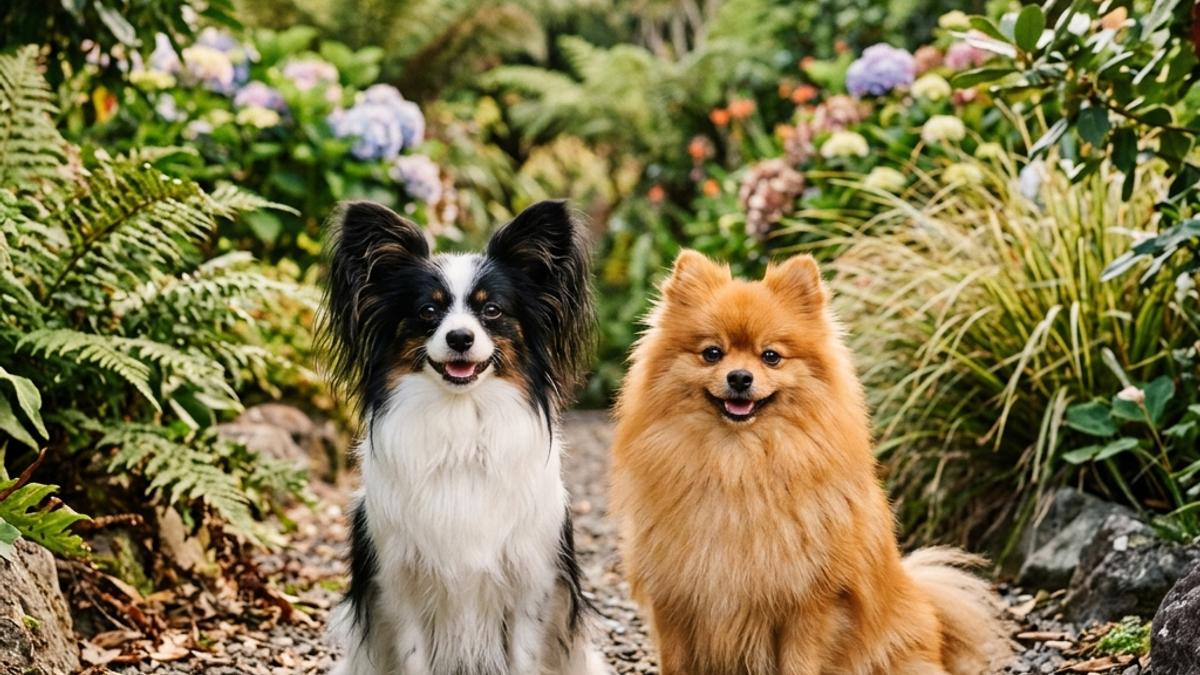
Papillon: "Butterfly" in French — named for the large, wing-shaped fringed ears. The Papillon can also be found in a drop-ear variety called the Phalène (from the French word for moth). The coat is silky, single-layered, and flowing, particularly around the chest and ears.
Pomeranian: Descended from large Nordic sled dogs in the Pomerania region (modern Germany/Poland), bred down to a tiny companion. The Pomeranian has a distinctive double coat with a dense undercoat that creates the characteristic fluffy, puffball appearance. The double coat sheds significantly.
Grooming comparison
Both score 3/5 — but the effort involved differs:
Papillon: A single-layer coat that is less prone to matting than a double coat. Weekly brushing maintains the coat; the ear fringing requires particular attention. The Papillon's coat doesn't have the undercoat shedding burden.
Pomeranian: A double coat with a dense undercoat. Sheds consistently, with heavy seasonal moults. Brushing 3–4 times weekly is realistic for a Pomeranian in good coat condition. Regular professional grooming helps manage the undercoat and maintain the characteristic shape.
For NZ owners who want a low-shedding toy breed, the Papillon has an advantage. If you want the distinctive fluffy Pomeranian look and accept the grooming cost, the Pom is the choice.
Lifespan
Papillon (14–16 years): One of the longer-lived small breeds available. An excellent track record for longevity with responsible breeding.
Pomeranian (12–16 years): Also long-lived for a dog, with a broad range. The upper end of 16 years is achievable; the lower end of 12 is more typical.
For a long-term companion, both breeds offer substantial lifespans compared to larger breeds — but the Papillon has a slightly longer minimum.
Energy and apartment life
Both score 3/5 energy and 3/5 apartment life — genuinely comparable for NZ apartments. Both need daily walks (20–30 minutes) and indoor play. Neither is a high-energy breed that needs extensive outdoor exercise, which suits NZ apartment and townhouse living well.
Note on barking: Both breeds can be alert, vocal watchdogs. In NZ apartment buildings, this may be a consideration. Early training to discourage excessive barking is worthwhile for both breeds.
NZ availability
Both breeds are available from registered NZ breeders, though neither is highly common.
Registered Papillon breeders quote on enquiry (no purebred Papillon puppies were advertised on TradeMe when we checked on 21 October 2026), and Dogs NZ-registered Pomeranian breeders also quote prices directly, so ask the breeder for a current quote and what it includes (Dogs NZ registration papers, microchip, first vaccination).
Which is right for you?
Choose a Papillon if:
- Your household includes young children (5/5 kid compatibility vs 3/5)
- You want a longer-lived breed with a minimum of 14 years
- You prefer a lower-shed single-layer coat
- You find the butterfly-ear appearance appealing
Choose a Pomeranian if:
- Your household is adults or older children only
- You love the distinctive double-coat fluffy appearance and don't mind the grooming commitment
- You prefer the more widely recognised, iconic Pomeranian look
Neither is ideal if:
- You want a large or medium dog
- You want a dog that tolerates rough handling by children (Pomeranian especially)
- You want a low-barking breed
Related guides
- Pomeranian vs Chihuahua NZ
- Best dog breeds for apartments NZ
- Best dogs for first-time owners NZ
- Dog brush types NZ
- Find a breed tool
- Compare breeds tool
---
References
- American Kennel Club — Papillon breed standard (the butterfly ears, the drop-eared Phalène variety, the single silky coat): https://www.akc.org/dog-breeds/papillon/
- American Kennel Club — Pomeranian breed standard (Nordic spitz ancestry, the double coat and its shedding): https://www.akc.org/dog-breeds/pomeranian/
- Merck Veterinary Manual — Patellar Luxation in Dogs and Cats (one of the most common orthopaedic conditions in toy and small-breed dogs; signs typically appear before one year of age): https://www.merckvetmanual.com/musculoskeletal-system/arthropathies-and-related-disorders-in-small-animals/patellar-luxation-in-dogs-and-cats
- Dog Control Act 1996 (NZ council registration and microchipping obligations): https://www.legislation.govt.nz/act/public/1996/0013/latest/whole.html
---
*Profile scores sourced from PetMall breed profiles. Both breeds require careful handling — their small size makes them vulnerable to accidental injury. NZ price ranges are indicative; confirm with current registered breeders.*
Free PetMall tools
Related guides
petmall.co.nz
Shop at PetMall
The products below are practical support items for your pet. PetMall ships across New Zealand.
- Dog FoodStart with food that matches your dog's life stage and activity level — and change brands slowly over 7–10 days.
- Dog TreatsTraining rewards and everyday treats — small, soft pieces work best for consistent reinforcement.
- Dog ToysA small rotation of chew, fetch, and puzzle toys usually works better than buying a large variety at once.
- Dog GroomingA gentle brush and the right shampoo make maintenance easier — especially for dogs that get muddy on walks.
- Leads & HarnessesComfort matters: padded contact points and adjustable fit help reduce rubbing on longer walks or tramping weekends.
- Flea & Worm TreatmentFor NZ conditions, look for protection that fits your routine (monthly vs longer-lasting) and your dog's weight range.