Pomeranian vs Chihuahua NZ: Which Tiny Companion Dog Is Right for You?
Pomeranian or Chihuahua? Both are tiny NZ companion dogs with big personalities. Compare temperament, grooming, cold-weather tolerance and NZ apartment suitability.
Two of the smallest dogs available in New Zealand — and both have personalities that make their owners forget their size completely. The Pomeranian and the Chihuahua are both bold, alert and deeply attached to their people. They're also both prone to the "small dog syndrome" trap where owners excuse behaviour in a tiny dog that would be unacceptable in a large one. The choice between them comes down to grooming commitment, cold tolerance and personality style.
Quick comparison
| Pomeranian | Chihuahua | |
|---|---|---|
| Weight | 1.4–3.2 kg | 1.5–3 kg |
| Coat | Long, thick double coat | Smooth (short) or longhair |
| Grooming | High — daily brushing | Low (smooth) to moderate (long) |
| Shedding | Moderate-high (seasonal blow-out) | Low (smooth) |
| Energy level | High | Moderate–high |
| Cold tolerance | Good (dense coat insulates) | Poor — very cold-sensitive |
| Barking | High — alert barker | High — alert barker |
| Good with kids? | Gentle children only | Gentle handling only — fragile |
| NZ price estimate | Price on enquiry (registered breeders) | Price on enquiry (registered breeders) |
| Lifespan | 12–16 years | 12–18 years |
Full profiles: Pomeranian · Chihuahua
Size and fragility
Both breeds are fragile at their small sizes — they can be seriously injured by jumping from heights (sofa arms, arms of people holding them), being stepped on or sat on, or rough handling. This makes both breeds unsuitable for homes with very young children who don't yet understand gentle handling.
Pomeranians in New Zealand range from 1.4–3.2 kg. Some breeders advertise "teacup" Pomeranians at even smaller sizes — these extremely small dogs carry higher health risks and a more fragile structure; approach these with caution.
Chihuahuas at 1.5–3 kg are similarly tiny. Some Chihuahuas have a soft spot (molera) on the top of their skull that never closes — this varies by individual and is not always present, but it means head impacts can be more serious.
Both breeds suit adult households or families with older children (10+) who understand gentle handling.
Personality: bold in a very small package
Pomeranian: Pomeranians are lively, curious, and extroverted. They tend to be outwardly confident — trotting towards people and new situations with their fluffy tail up. They're affectionate with their family, enjoy attention, and can be quite busy and active for their size. Some Pomeranians are bossy (attempting to direct larger dogs, "talking back" to owners) — this is an owner-training issue more than a breed fault. With clear, consistent boundaries from puppyhood, Poms are charming companions.
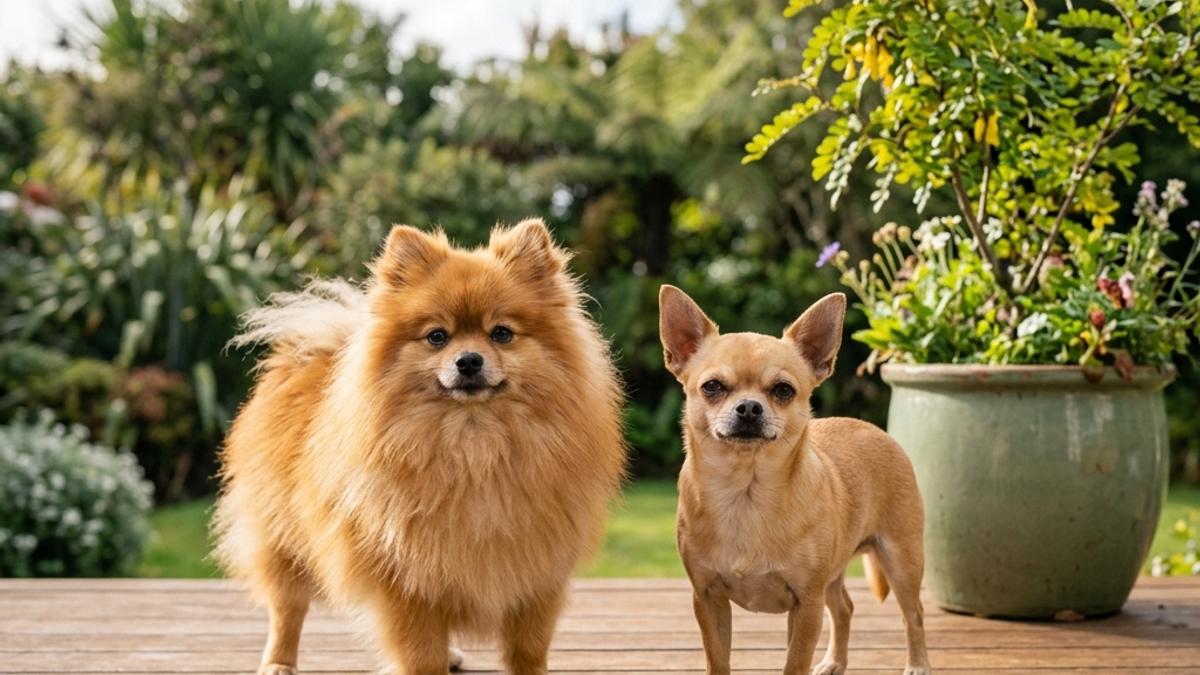
Chihuahua: Chihuahuas have a reputation as snappy or difficult — usually a product of owners who didn't train or socialise them and allowed small-dog behaviour. A well-socialised Chihuahua raised with boundaries is a loyal, alert and entertaining companion. Chihuahuas tend to bond very intensely with one or two people and can be reserved — even hostile — with strangers until satisfied they're safe. This loyalty is appealing to many owners; others find it limiting socially. Some Chihuahuas are genuinely anxious and benefit from careful, gentle handling and positive socialisation from puppyhood.
For NZ social households with visitors: the Pomeranian's more outward confidence is generally easier to manage with guests than a suspicious Chihuahua.
Barking
Both breeds are vocal alert dogs. They notice everything, announce it, and will repeat the announcement if you don't respond adequately. In NZ apartments with shared walls, both breeds require training from puppyhood to prevent nuisance barking. "Quiet" training is easier with a Pomeranian; Chihuahuas can be more persistent. Neither breed is suitable for an owner who cannot or will not address barking through training.
Grooming
Pomeranian: the dense double coat needs daily brushing to prevent matting and to manage shedding. Twice-yearly seasonal coat blows produce a surprising volume of fur from such a small dog. Professional grooming every 6–8 weeks (scissor trim to maintain the "lion cut" or natural round shape) is recommended. The coat is beautiful but it is a commitment.
Chihuahua (smooth coat): very low maintenance — weekly wipe-down and occasional bath. One of the easiest coats in the dog world.
Chihuahua (long coat): moderate — weekly brushing, professional groom every 3 months. The long-coat variety sheds more than the smooth.
If grooming is a deciding factor, the smooth-coat Chihuahua wins by a significant margin.
Cold weather and NZ climate
Pomeranian: the thick double coat provides good insulation. Pomeranians handle NZ winters better than most tiny dogs — including Central Otago and South Canterbury cold snaps that would genuinely distress a Chihuahua.
Chihuahua: genuinely cold-sensitive. Chihuahuas have very little body fat and a single or thin double coat. In NZ's cooler regions (Otago, Southland, Canterbury highlands, Wellington wind) Chihuahuas will need a dog coat for outdoor activities. Indoor heating is important. If you live in southern NZ, factor this cost and management requirement in.
Training
Both breeds benefit from early, reward-based training — and both suffer from owners who don't train them because "they're just small dogs."
The most common mistake with Pomeranians and Chihuahuas: allowing behaviour (barking at visitors, growling at people who come near their owner, jumping up, guarding food) that would be corrected immediately in a large breed. A 2 kg dog can still bite, can still be anxious and reactive, and still needs clear boundaries for its own wellbeing and safety.
See our stop dog barking NZ guide for reward-based methods that work with both breeds.
Health
*General information only — consult a registered NZ vet.*
Pomeranians are prone to tracheal collapse (a common small-breed issue worsened by collar use — harnesses are recommended for walking), patellar luxation, alopecia X (coat loss linked to hormonal issues) and dental crowding. Buy from hip/patellar-tested lines where available. Average lifespan 12–16 years.
Chihuahuas are prone to patellar luxation, dental disease (small mouths with crowded teeth are prone to periodontal disease — dental hygiene is important), hypoglycaemia in very small puppies, and heart valve disease (mitral valve) in older dogs. Their thin skull and delicate build increase injury risk. Average lifespan 12–18 years — one of the longest-lived dog breeds in the world.
Both breeds: use a harness, not a collar, for walking — tracheal collapse risk is real for both at their sizes.
Cost in NZ
Registered breeders of both breeds quote prices on enquiry (see Pomeranian breeders and Chihuahua breeders in NZ), so ask the breeder for a current quote and what it includes. Be wary of "teacup" or excessively small size advertising, which often accompanies irresponsible breeding practices.
Which breed suits you?
Choose a Pomeranian if:
- You want a confident, extroverted, fluffy companion that engages with people more readily
- You live in a cooler NZ region (Wellington, South Island) and want a dog with better cold tolerance
- You enjoy the grooming process and the distinctive Pomeranian coat
- You want a slightly more outgoing social style in your small dog
Choose a Chihuahua if:
- You prefer minimal grooming (smooth coat especially)
- You want a fiercely loyal, intensely bonded companion that focuses deeply on you
- You live in northern NZ (Auckland, Northland, Waikato) where cold tolerance matters less
- You appreciate the Chihuahua's intensity and independence in a tiny package
Quick takeaways
- Both are bold, alert, vocal tiny dogs that need training from puppyhood — size doesn't excuse behaviour
- Pomeranians are more outwardly confident and social; Chihuahuas bond more intensely to one person
- Pomeranians have significant grooming needs; smooth-coat Chihuahuas have very little
- Chihuahuas are genuinely cold-sensitive — NZ South Island owners need to plan for dog coats and heating
- Both need harnesses (not collars) for walking given tracheal collapse risk
- Both are long-lived breeds — 12–18 years is a serious commitment
Related reading
- Pomeranian breed profile NZ
- Chihuahua breed profile NZ
- Best Small Dog Breeds NZ
- Best Dog Breeds for Apartments NZ
- Stop a Dog Barking NZ
- Find your perfect breed
---
References
- American Kennel Club — Pomeranian breed standard, checked 2026-08-26: https://www.akc.org/dog-breeds/pomeranian/
- American Kennel Club — Chihuahua breed standard, checked 2026-08-26: https://www.akc.org/dog-breeds/chihuahua/
- Merck Veterinary Manual — Patellar Luxation in Dogs and Cats, checked 2026-08-26: https://www.merckvetmanual.com/musculoskeletal-system/arthropathies-and-related-disorders-in-small-animals/patellar-luxation-in-dogs-and-cats
---
*This guide provides general breed-comparison information for NZ prospective dog owners. Health information is general only — consult a registered NZ vet for advice specific to your dog.*
Free PetMall tools
Related guides
petmall.co.nz
Shop at PetMall
The products below are practical support items for your pet. PetMall ships across New Zealand.
- Dog FoodStart with food that matches your dog's life stage and activity level — and change brands slowly over 7–10 days.
- Dog TreatsTraining rewards and everyday treats — small, soft pieces work best for consistent reinforcement.
- Dog ToysA small rotation of chew, fetch, and puzzle toys usually works better than buying a large variety at once.
- Dog GroomingA gentle brush and the right shampoo make maintenance easier — especially for dogs that get muddy on walks.
- Leads & HarnessesComfort matters: padded contact points and adjustable fit help reduce rubbing on longer walks or tramping weekends.
- Flea & Worm TreatmentFor NZ conditions, look for protection that fits your routine (monthly vs longer-lasting) and your dog's weight range.