Hamster Cage Tips for Beginners (NZ): Size, Bedding & Wheel
Hamsters cannot legally be kept in New Zealand — MPI does not allow them in. Read the NZ legal position first, then the housing numbers that matter: 100x50cm floor, 25cm bedding, 30cm wheel.
The quick answer: the biggest hamster welfare problem is that most cages sold are far too small. Hamsters need much more floor space than people expect, deep bedding to burrow, and a large solid-surface wheel. Get a big enough enclosure with the right kit and a hamster thrives; cram it into a tiny barred cage and it suffers. Hamsters are also solitary — most species must live alone.
⚠️ First, the New Zealand reality: you cannot legally get a hamster here. Hamsters are not an approved import species. MPI allows only rabbits and guinea pigs (from Australia) and chinchillas (from Great Britain) to be brought in as pet rodents and lagomorphs, and states plainly that hamsters, gerbils, mice and rats cannot be brought into New Zealand. There is no lawful domestic source either — New Zealand has no established pet hamster population — so a hamster offered for sale here would not have a lawful origin. This page is kept because "what about hamsters?" is one of the most-asked NZ small-pet questions, and for readers keeping hamsters overseas. If you are choosing a small pet in New Zealand, start with Exotic Pets Banned in NZ and the legal options in Small Pets and Exotics NZ. The rules, the reasons and the legal alternatives are set out in full in Are hamsters legal in NZ?.
Beginner tips: the numbers that matter
Most beginner mistakes are really just buying to the wrong numbers. These are the figures to shop against:
| What | Target | Why |
|---|---|---|
| Floor space | 100 x 50 cm minimum, unbroken | PDSA's stated minimum — most cages sold in pet shops fall well short |
| Enclosure height | At least 15 cm, 20 cm+ better | Merck — you need the headroom to actually hold deep bedding in |
| Bedding depth | At least 25 cm | PDSA — burrowing is core behaviour, not optional enrichment |
| Wheel diameter | 30 cm+ Syrian, 20 cm+ dwarf, solid surface | PDSA — a too-small wheel forces a permanently arched back |
| Room temperature | 17–26 °C (a steady 18–21 °C is ideal) | Merck safe range; PDSA ideal range |
| Hamsters per cage | One — always for Syrian and Chinese | Merck — housed singly except for breeding |
A practical NZ note: 100 x 50 cm barred cages are hard to find here and expensive when you do. Many Kiwi keepers use a large plastic storage tub or a glass tank with a mesh lid instead — it is usually the cheapest way to hit the floor-space and the bedding-depth numbers at the same time.
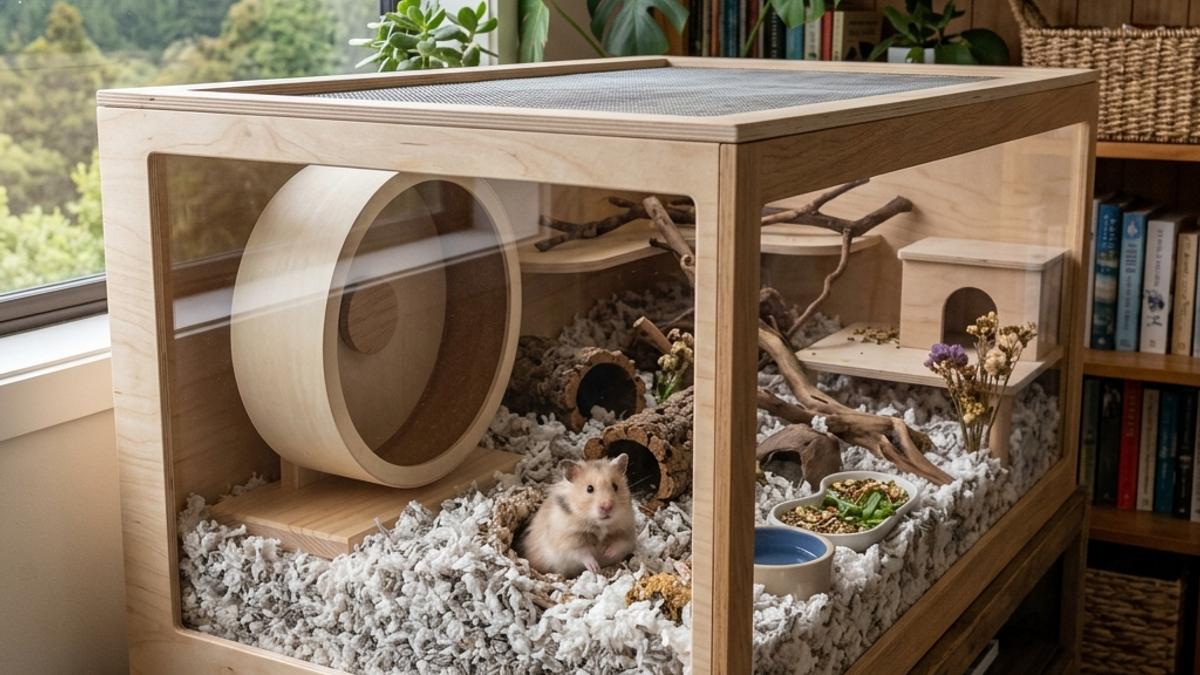
Cage size — go big
- Choose the largest continuous floor space you can — far bigger than typical pet-shop cages. A large glass tank/enclosure or a big bin-style cage often beats small barred cages.
- Floor space matters more than levels — hamsters run and forage on the ground.
- Bar spacing must be small enough that a hamster (especially a dwarf) can't squeeze through or get stuck.
What goes inside
- Deep bedding (at least 25 cm) for burrowing — this is essential natural behaviour, not optional. Use paper-based or other safe bedding. Avoid pine and cedar shavings (harmful) and fluffy "cotton wool" nesting (can wrap around limbs or be swallowed).
- A large, solid (not barred or wire) wheel — too-small wheels force a painful arched back. The wheel should let the hamster run with a flat back.
- A hide/house, chew items (their teeth grow continuously), and a sand bath for cleaning.
- Food bowl and a water bottle or bowl.
- Tunnels and clutter for enrichment and foraging (scatter some food to forage).
Placement and care
- A quiet spot, out of direct sun and draughts, at a stable room temperature. Hamsters are crepuscular/nocturnal — don't site them where night activity disturbs sleep, and don't wake them constantly by day.
- Spot-clean daily; do a fuller clean periodically but don't strip the whole cage at once — keep some used bedding so it still smells like home (a total clean stresses them and triggers re-scenting).
Solitary by nature
Syrian hamsters must live alone — they fight, sometimes fatally. Some dwarf species can *sometimes* be kept in pairs, but it's risky and often ends in separation. When in doubt, house one hamster per cage.
Quick takeaways
- Most sold cages are too small — get the largest floor space you can.
- Deep bedding (~20–30 cm) for burrowing is essential.
- Use a large solid-surface wheel; avoid pine/cedar and fluffy nesting.
- Provide a hide, chews, sand bath, food and water.
- Syrians must live alone; house one per cage unless you really know the species.
Shop related categories at PetMall
Looking for a large enclosure, solid wheel, bedding and accessories in New Zealand? Browse the PetMall small pet range for current options and nationwide delivery.
Related reading
References
- MPI, Bringing pets to NZ (other than cats and dogs) — only rabbits and guinea pigs from Australia and chinchillas from Great Britain may be imported; hamsters, gerbils, mice and rats cannot be brought into New Zealand, checked 2026-07-29: https://www.mpi.govt.nz/bring-send-to-nz/pets-travelling-to-nz/bringing-pets-to-nz-other-than-cats-and-dogs
- Merck Veterinary Manual, Providing a Home for a Hamster, checked 2026-07-18: https://www.merckvetmanual.com/all-other-pets/hamsters/providing-a-home-for-a-hamster
- VCA Animal Hospitals, Owning a Pet Hamster, checked 2026-07-18: https://vcahospitals.com/know-your-pet/owning-a-pet-hamster
- PDSA, The Ideal Home for Your Hamster, checked 2026-07-27: https://www.pdsa.org.uk/pet-help-and-advice/looking-after-your-pet/small-pets/the-ideal-home-for-your-hamster
Important notice
*General husbandry information for NZ owners. A hamster that stops eating, loses weight or seems unwell should see a small-animal-savvy NZ vet.*
Free PetMall tools
Related guides
petmall.co.nz
Shop at PetMall
The products below are practical support items for your pet. PetMall ships across New Zealand.