Dog Collar Types NZ: Flat, Martingale, Head Collar & Anti-Pull — How to Choose
Which dog collar is right for your NZ dog? Compare flat buckle, martingale, head collar and anti-pull options — when to use each and what to avoid.
The right collar (or harness) for your dog depends on three things: your dog's size and neck shape, their leash manners, and what you're using it for. A flat buckle collar is fine for ID tags and a well-trained dog on a loose lead. A dog that pulls hard needs something that redirects pulling without putting pressure on the throat. Here's what's available in NZ and who each type suits.
Note: collars are for ID tags and restraint; for walking a dog that pulls, a harness or head collar is usually a safer option. See our dog leads, harnesses and collars guide NZ for a full breakdown of lead and harness types.
Flat buckle collar — the everyday standard
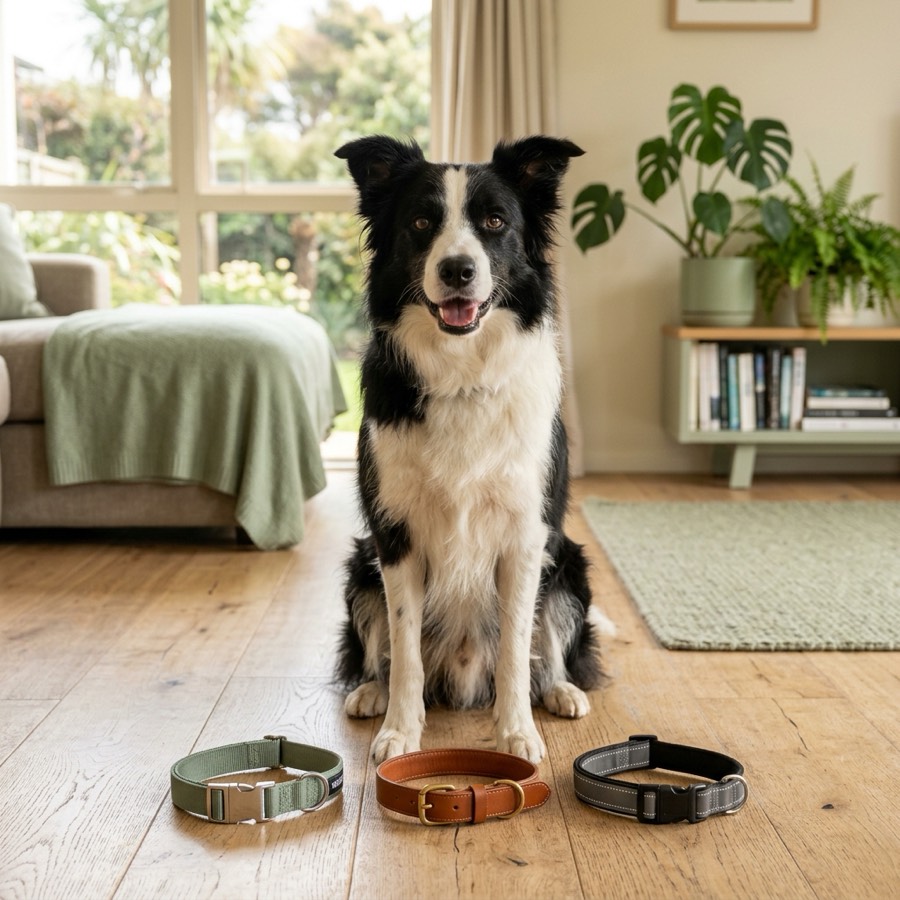
The flat buckle collar (also called a snap-buckle or quick-release collar) is the most common collar type in NZ. It sits around the neck at a consistent width, with either a plastic quick-release clip or a metal buckle.
Best for:
- Everyday ID tag wearing
- Dogs with reliable leash manners
- Puppies learning to accept a collar
Fit rule: you should be able to slip two fingers comfortably under the collar. Too loose and it slips off; too tight and it restricts breathing. Recheck fit as puppies grow — check weekly during the first year.
Avoid for: dogs that pull hard — a tight buckle collar puts direct pressure on the trachea, which can cause coughing and long-term damage in heavy pullers.
Martingale collar — for sighthounds and slip-resistant fit
A martingale (or limited-slip) collar has two loops: a main loop and a smaller control loop. When a dog pulls, the control loop tightens the main loop — but only to the point the collar fits snugly, not enough to choke. It releases pressure as soon as the lead goes slack.
Best for:
- Sighthound breeds (Greyhound, Whippet) whose heads are narrower than their necks, making standard collars easy to slip
- Dogs that tend to back out of standard collars
- NZ owners who want more security at leash attachment without a choke-style collar
Not the same as a choke chain: a properly sized martingale cannot over-tighten beyond a snug fit. This makes it safer than chain slip collars, which have no stop point.
Head collar (Halti, Gentle Leader) — redirects pullers without throat pressure
A head collar fits over the muzzle and behind the ears, attaching to the lead under the chin. When your dog pulls forward, the head is turned gently back toward you — the same principle a halter uses on a horse. It does not muzzle the dog; they can eat, drink, pant and bark normally.
Best for:
- Large, strong dogs that are learning loose-lead walking
- Dogs where a standard collar or front-clip harness hasn't worked
- NZ owners who want directional control without a tight collar on the throat
What to expect: most dogs resist the head collar for the first few sessions — pawing at it, stopping, shaking their head. This is normal. With consistent reward-based conditioning (giving treats every time they walk without pawing at it), most dogs accept it within one to two weeks. See our guide on how to stop a dog pulling NZ for step-by-step loose-lead training.
Not suitable for: brachycephalic (flat-faced) breeds like Bulldogs and Pugs, or dogs with certain neck conditions. Check with your vet if unsure.
Slip lead — quick restraint, not for everyday walking
A slip lead is a single rope loop that tightens when pulled, used widely in NZ by vets, dog rescue organisations and breeders for quick restraint or moving an unfamiliar dog safely. It sits high on the neck, just behind the ears, which reduces slipping.
Best for: temporary restraint or moving a dog in a professional context. Not suitable for everyday walking or as a training tool — there is no stop point when the dog pulls forward.
Breakaway collar (safety collar) — for cats and supervised dogs
Breakaway collars release under pressure, so a dog cannot choke if the collar catches on something. They are common for cats but also sold for dogs. Not suitable as a walking collar because they release intentionally — they're a safety ID collar for wearing at home, not on a lead.
What about harnesses?
Harnesses distribute pressure across the chest and shoulders rather than the throat, making them a better choice for:
- Pulling dogs (front-clip harnesses actively discourage pulling)
- Small breeds with delicate tracheas (Chihuahuas, Toy Poodles, Pomeranians)
- Brachycephalic breeds
- Dogs with tracheal or neck conditions
There is measured evidence behind this. A 2025 study in *Veterinary Medicine and Science* found that collars significantly raised intraocular pressure during exercise in every dog tested — and in brachycephalic dogs even while stationary — while harnesses did not raise it in either group. For a dog with glaucoma, a thin or damaged cornea, or any condition where extra eye pressure is risky, that difference is a reason to walk on a harness.
A harness is not a collar — it doesn't replace an ID tag setup. Most NZ owners use a flat buckle collar for the tag and a harness for walking. See our leads and harnesses guide NZ for harness types.
NZ legal requirement: ID tag on collar
Under the Dog Control Act 1996, all registered dogs in NZ must wear a registration tag. That tag must be on the dog in a public place. A flat buckle collar is the most practical way to carry it. If your dog wears a harness for walks, they still need a collar with their registration tag — or use a collar-and-harness combo.
Your council issues the registration tag each year after registration. For details on registration costs and requirements by region, see our dog registration NZ guide.
Which collar should I start with?
| Situation | Recommended starting point |
|---|---|
| Puppy being collar-trained | Lightweight flat buckle collar for ID; introduce harness for walks |
| Adult dog with good leash manners | Flat buckle collar is fine |
| Sighthound or collar-slip risk | Martingale collar |
| Dog that pulls and hasn't responded to harness | Head collar (with conditioning) |
| Small or flat-faced breed | Harness (not collar) for walking |
| ID tag only, not for walking | Flat buckle breakaway collar at home |
Quick takeaways
- Flat buckle collars are the NZ standard for everyday ID tag wearing
- Martingales are ideal for sighthounds or dogs that slip out of standard collars
- Head collars (Halti/Gentle Leader) redirect pulling without throat pressure — they need conditioning, not just putting on
- Harnesses are better than collars for most walking situations, especially for pullers and small breeds
- NZ law requires your dog to wear their council registration tag in a public place
- Never use choke chains or prong collars as a first-line training tool — positive reinforcement methods achieve better long-term results
Related reading
- Dog Leads, Harnesses & Collars Guide NZ
- How to Stop a Dog Pulling on the Lead NZ
- Dog Registration NZ: Council Checklist
- Best Dogs for First-Time Owners NZ
- Dog breeds in NZ
Shop dog collars at PetMall
Looking for dog collars in New Zealand? PetMall stocks flat, martingale and head collar options with nationwide delivery.
---
References
- Dog Control Act 1996 (New Zealand), registration and tag requirements, checked 2026-06-05: https://www.legislation.govt.nz/act/public/1996/0013/latest/DLM374410.html
---
*This guide provides general information for New Zealand dog owners. For advice about your dog's specific health or training needs, consult a registered New Zealand vet or certified dog trainer.*
- Bailey et al., *Effect of a Collar and Harness on Intraocular Pressure and Respiration Rate of Brachycephalic and Dolichocephalic Dogs*, Veterinary Medicine and Science, 2025, checked 2026-08-02: https://pmc.ncbi.nlm.nih.gov/articles/PMC12036695/
Related guides
petmall.co.nz
Shop at PetMall
The products below are practical support items for your pet. PetMall ships across New Zealand.
- Leads & HarnessesComfort matters: padded contact points and adjustable fit help reduce rubbing on longer walks or tramping weekends.
- Dog FoodStart with food that matches your dog's life stage and activity level — and change brands slowly over 7–10 days.
- Dog TreatsTraining rewards and everyday treats — small, soft pieces work best for consistent reinforcement.
- Dog ToysA small rotation of chew, fetch, and puzzle toys usually works better than buying a large variety at once.
- Dog GroomingA gentle brush and the right shampoo make maintenance easier — especially for dogs that get muddy on walks.
- Flea & Worm TreatmentFor NZ conditions, look for protection that fits your routine (monthly vs longer-lasting) and your dog's weight range.