Cat Litter Box Types NZ: Open, Hooded, Top-Entry and Self-Cleaning Compared
Which type of litter box is right for your NZ cat? Compare open trays, hooded boxes, top-entry designs and self-cleaning models — what each does, who they suit, and what to avoid.
The type of litter box matters for whether your cat will actually use it. The wrong type — or a box that doesn't suit your cat's preferences or your home's layout — is one of the most common reasons cats start toileting outside the box. Here's what each type does and how to choose for a NZ home.
The most important rule first
Whatever type you choose, location and cleanliness matter more than type. A cat that won't use a litter box is almost always responding to:
- A dirty box (cats are fastidious; a box not scooped daily is often refused)
- A bad location (near food, in a busy area, or too enclosed for a nervous cat)
- A traumatic association (if the cat was scared near the box once, it may avoid it)
Solve those first. If those are fine, then the type becomes the relevant variable.
The four main types
1. Open/uncovered litter tray
The basic open-top rectangular tray — the default type sold at nearly every NZ pet shop.
Pros:
- Easy for the cat to get in and out — important for elderly cats, kittens, or large-bodied breeds (Maine Coon, Ragdoll, British Shorthair at 7–8 kg)
- The cat can easily survey the surroundings while toileting — relevant for nervous cats who want to see approaching threats
- Easy to clean — no lid to remove
- Cheapest option
Cons:
- Litter scatter: cats often kick litter out of the tray, especially vigorous diggers. A high-sided open tray (sides 15–20 cm) reduces this significantly.
- Odour visible to the room: without a lid, smells escape more directly
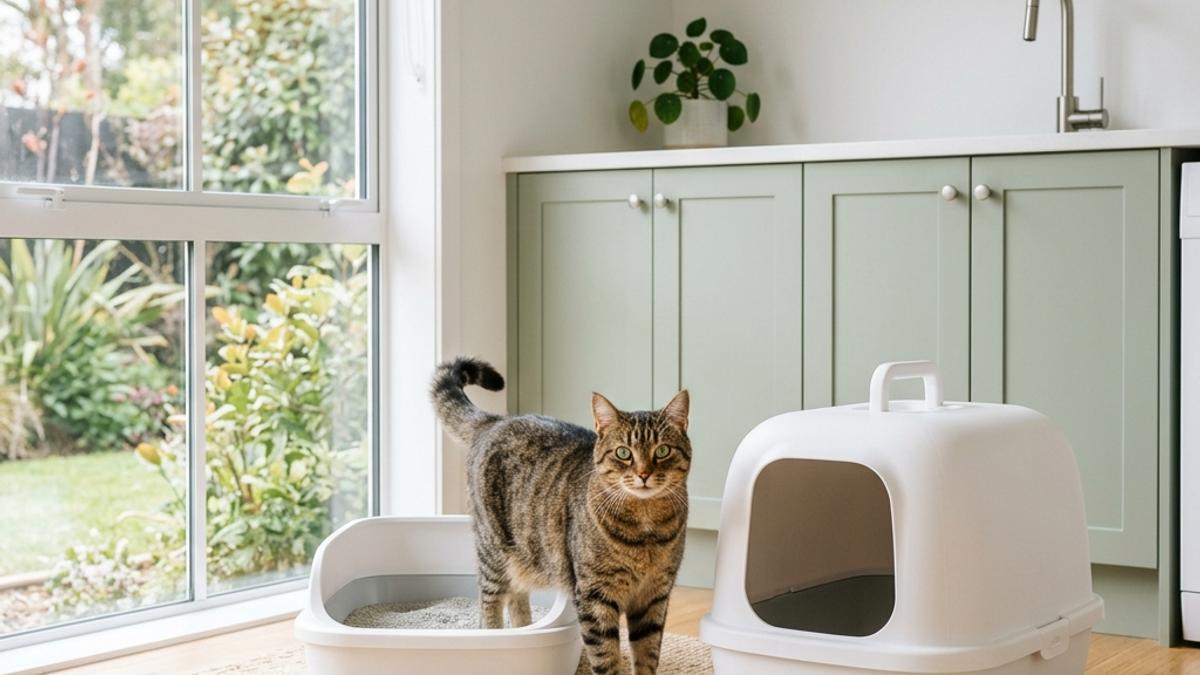
When to choose: For most cats, especially kittens learning to use the box, elderly cats, large breeds, and nervous cats that dislike enclosed spaces. A high-sided open tray is a solid default for most NZ households.
NZ apartment note: In small apartments, the odour visibility of an open tray is more noticeable — a hooded or top-entry box may be worth considering.
2. Hooded/covered litter box
A hooded box has an enclosed body with a swinging flap door or open entrance at the front.
Pros:
- Reduces odour escaping into the room
- Reduces litter scatter (walls contain kicked litter)
- Some cats prefer the privacy of a covered space
Cons:
- The most important con: Cats can become trapped inside with their own smell, especially if the box isn't cleaned daily. Ammonia from urine concentrates rapidly in an enclosed space — from the cat's perspective, it's like being locked in a small, unventilated toilet. Many cats will refuse a hooded box that isn't cleaned frequently enough.
- The hood also traps odour *for the human* — the smell isn't in the room, but opening the lid can release a concentrated blast
- Some large cats (Maine Coon, Ragdoll, Norwegian Forest Cat) find standard hooded boxes too small — they must be able to turn around easily
- The flap door can deter shy or timid cats
When to choose: For confident cats in households where cleaning is done daily. Not recommended for timid cats, elderly cats with mobility limitations, or households where daily cleaning isn't realistic.
3. Top-entry litter box
A fully enclosed box with the entrance on the top — the cat jumps in from above.
Pros:
- Maximum litter scatter control — litter doesn't fly out the sides; the cat's paws wipe somewhat on the top grate as they exit
- Good odour containment
- Dogs cannot access the contents (a consideration in multi-pet NZ households)
- Looks more contained and aesthetically tidy
Cons:
- Not suitable for kittens, elderly cats, or cats with mobility issues — jumping in and out requires confidence and physical ability
- Can be stressful for nervous cats who feel cornered with no visual escape route
- Some cats simply refuse them on principle — you can't predict this until you try
- Cleaning requires removing the entire lid, which is less convenient than scooping from the front
When to choose: Adult, confident, physically able cats in households where litter scatter and dog access to the box are concerns. Try a top-entry box as a second box rather than replacing the existing one — if the cat takes to it, great; if not, you haven't removed the box they were using.
4. Self-cleaning (automatic) litter boxes
Self-cleaning boxes use a motor and sensor or rake mechanism to sift or roll waste into a covered compartment after the cat leaves. The waste is sealed until the human empties the compartment.
Available types in NZ:
- Rake-type: A timed or sensor-triggered rake scoops clumped waste into a covered drawer
- Rotary/globe-type: The box rotates to sift waste into a sealed compartment
- AI-sensor types: Premium models that track usage per cat, send app notifications, and detect changes in toilet habits (marketed as early health warning tools)
Pros:
- Reduces how often you need to manually scoop (but you still empty the waste compartment regularly)
- Can be useful for owners who work long hours and can't scoop at fixed times
- Premium models offer usage tracking — potentially useful for multi-cat households or cats with urinary tract concerns
Cons:
- Price: Entry-level self-cleaning boxes start around $150–$300 NZD; premium models (Litter-Robot, PetSnowy, etc.) can cost $1,000–$2,000+ NZD
- Noise: Most motors and raking mechanisms make some noise — timid cats may be frightened by the sound and refuse the box
- Mechanical failure: Moving parts fail. If the mechanism breaks, you have an expensive litter box that isn't self-cleaning.
- Requires clumping litter only — non-clumping litters, crystal litters, and most non-standard litters don't work with rake or rotary mechanisms
- Still requires regular emptying — the "self-cleaning" part means scooping happens automatically, not that the waste disappears
When to consider: If you have multiple cats and a budget for it, a self-cleaning box can reduce daily manual scooping. Introduce it as a second option alongside an existing box until the cats are comfortable with it.
How many litter boxes does a cat need?
The standard recommendation in the AAFP/ISFM house-soiling guidelines is one box per cat, plus one extra. For one cat: two boxes. For two cats: three boxes.
In a NZ apartment, this may feel like a lot — but the logic is sound. If one box becomes dirty, there's always an alternative. Cats that share a single box in multi-cat households often show stress behaviours and may start toileting elsewhere.
Placement tips for NZ homes
- Not near food or water: Cats instinctively separate toileting areas from eating areas
- Not in a busy thoroughfare: A box in the middle of a hallway is a box that's avoided when the house is active
- At least one box per floor: In multi-level NZ homes
- Not near noisy appliances: The spin cycle of a washing machine nearby can cause box avoidance
- Apartments: A box tucked in a bathroom or laundry works well if ventilation is adequate
Quick takeaways
- Open high-sided tray is the default best choice for most NZ cats — simple, accessible, easy to clean
- Hooded box suits confident cats if cleaned daily; not for timid or large cats
- Top-entry suits adult, mobile cats where litter scatter and dog access are concerns — introduce as an additional option
- Self-cleaning reduces manual scooping but is expensive, mechanical, and needs careful introduction
- Whatever type: daily scooping, good location, and one box per cat plus one are more important than the type itself
Related guides
---
References
- MPI New Zealand, Code of Welfare for Companion Cats, checked 2026-06-05: https://www.mpi.govt.nz/animals/animal-welfare/codes/all-animal-welfare-codes/code-of-welfare-companion-cats/
- AAFP/ISFM Guidelines for Diagnosing and Solving House-Soiling Behavior in Cats (peer-reviewed, J Feline Med Surg via PMC), checked 2026-08-04: https://pmc.ncbi.nlm.nih.gov/articles/PMC11148882/
---
*This guide provides general care information for NZ cat owners. For behaviour issues or health concerns related to litter box use, consult a registered New Zealand vet.*
Related guides
petmall.co.nz
Shop at PetMall
The products below are practical support items for your pet. PetMall ships across New Zealand.
- Cat LitterClumping or crystal, most cats prefer an unscented litter and a clean tray — one tray per cat plus one spare is the NZ rule of thumb.
- Cat FoodStart with food that matches your cat's life stage — change brands slowly over 7–10 days to avoid digestive upset.
- Cat TreatsGreat for bonding and training — keep treats under 10% of daily calories to protect your cat's waistline.
- Cat ToysA small rotation of toys (feather wand, puzzle feeder, and comfort toy) usually works better than buying many at once.
- Cat GroomingRegular brushing cuts hairballs and shedding — essential for long-haired breeds like Ragdolls and British Longhairs.
- Flea & Worm TreatmentFor NZ conditions, choose protection that fits your cat's weight and lifestyle (indoor vs outdoor) and keep it regular.