Best Dog Muzzles NZ (2026): Types, Fit & the Law
Compare the best dog muzzles in New Zealand for 2026. Explore basket vs nylon types, sizing, positive training steps, and Dog Control Act requirements.
Dog muzzles are among the most misunderstood pieces of canine equipment. For many dog owners, seeing a muzzled dog in a public park conjures unfair assumptions about aggression. In reality, modern dog muzzles serve as essential, humane safety tools used by responsible handlers across New Zealand for training, veterinary examinations, public transit compliance, and statutory management.
Whether you are preparing a reactive rescue dog for busy walking trails, navigating legal classifications under New Zealand legislation, or preventing an indiscriminate scavenger from ingesting harmful items along coastal walkways, selecting the correct muzzle style is critical for both welfare and safety. A properly designed muzzle should never feel like a punishment; it should provide your companion with security and freedom of respiration while keeping the community safe.
---
When Are Dog Muzzles Needed in New Zealand?
Muzzles are utilised across New Zealand households and professional canine environments for a wide range of practical reasons:
- Veterinary Visits and Emergency Triage: Even gentle dogs may snap or bite defensively when injured, experiencing intense pain, or undergoing uncomfortable clinical procedures. Having a dog pre-trained to wear a muzzle reduces panic during medical emergencies.
- Scavenging Prevention: New Zealand beaches, bush reserves, and rural tracks often contain hazardous marine carcasses, discarded bones, toxic fungi, or regional pest control baits. For dogs with compulsive scavenging habits, a basket muzzle acts as a protective barrier without restricting physical activity.
- Reactivity and Behaviour Management: When rehabilitating dogs that display fear-reactivity towards unfamiliar dogs or humans, a muzzle provides a vital safety buffer that allows owners to conduct gradual desensitisation training with peace of mind.
- Statutory Legal Compliance: Under New Zealand dog control laws, certain classifications require dogs to wear a compliant muzzle whenever they enter public spaces.
---
Legal Requirements Under the Dog Control Act 1996
In New Zealand, dog ownership is regulated nationwide under the Dog Control Act 1996, alongside regional council dog control bylaws. Dog owners must understand the specific statutory definitions surrounding mandatory muzzling:
1. Menacing Dog Classifications (Section 33E)
A territorial authority can classify a dog as menacing because of its behaviour (section 33A) or because it belongs to a breed or type listed in Schedule 4 of the Act (section 33C).
Once a dog is classified as menacing, section 33E says the owner must not allow it to be at large or in any public place or private way without a muzzle, unless it is confined completely within a vehicle or cage. The muzzle must prevent the dog from biting but allow it to breathe and drink without obstruction. The council can decide that a dog or class of dog need not be muzzled in specified circumstances — the Act gives a dog show as its example.
Official legislation reference: Dog Control Act 1996 Section 33E.
2. Dangerous Dog Classifications (Section 32)
Under section 31, a council must classify a dog as dangerous if its owner has been convicted of a dog-attack offence under section 57A, if sworn evidence of aggressive behaviour gives the council reasonable grounds to believe the dog is a threat to people or animals, or if the owner admits this in writing. Under section 32, a dangerous dog must be both muzzled and on a leash whenever it is at large or in a public place or private way, unless it is confined completely within a vehicle or cage. The only exception to the leash requirement is a dog exercise area specified in a council bylaw made under section 20(1)(d) — the muzzle requirement still applies there.
Official legislation reference: Dog Control Act 1996 Section 32.
Because regional rules differ between district councils, dog owners should check our comprehensive overview of NZ pet laws and rules and verify specific local schedules directly with their territorial authority.
---
Basket Muzzles vs Fabric Sleeve Muzzles
Understanding the mechanical distinction between muzzle styles is the single most important lesson in canine equipment selection:
| Feature | Basket Muzzle (Rubber / Plastic) | Fabric Sleeve Muzzle (Nylon) |
|---|---|---|
| Primary Design | Rigid cage creating open air pocket | Tight band enclosing jaws |
| Panting Ability | Full mouth opening allowed | Mouth held firmly closed |
| Drinking Ability | Yes, can lap water easily | No, water access blocked |
| Treat Delivery | Easy through basket slats | Impossible |
| Suitable Wear Time | Walks, exercise, travel | A few minutes, under constant supervision |
| Meets the Act's breathe-and-drink standard? | Yes, when correctly sized | No — the dog cannot drink |
Basket Muzzles: The Gold Standard for Welfare
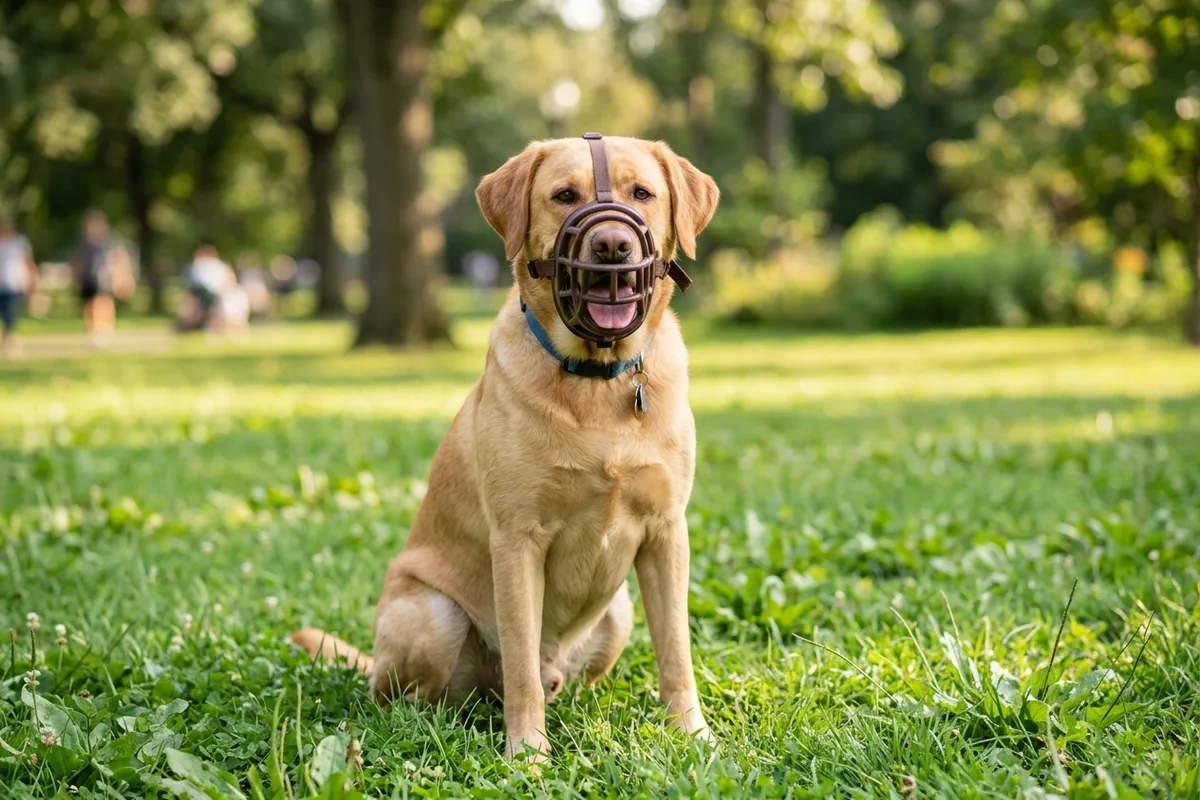
A basket muzzle surrounds the snout with a rigid, lattice-like cage made of rubber, plastic, or wire. It creates a protective perimeter around the teeth while leaving generous vertical space beneath the lower jaw. Because dogs regulate their internal temperature primarily through respiratory panting rather than sweating, maintaining full panting clearance is mandatory during physical exercise. Basket muzzles also allow handlers to pass training treats through the front grids, making behaviour modification possible.
Fabric Sleeve Muzzles: Emergency Use Only
Soft nylon fabric sleeves wrap tightly around the dog's muzzle to clamp the jaws shut. While widely sold in pet shops, fabric sleeves are designed exclusively for short veterinary examinations or emergency first-aid handling lasting a few minutes, under constant supervision. Exercising a dog in a nylon sleeve poses severe risks of heatstroke and respiratory distress because the dog cannot pant or lap water.
---
Best Dog Muzzles in New Zealand (2026 Picks)
In the New Zealand market, basket muzzles run roughly $26–$110 depending on size and construction material, whereas basic fabric sleeve muzzles start around $13 (checked September 2026).
1. Best Overall Basket Muzzle: Baskerville Ultra Dog Muzzle
A rubber basket muzzle sold in six sizes:
- Baskerville Ultra Size 1: $56.99 (checked September 2026)
- Baskerville Ultra Size 2: $63.99 (checked September 2026)
- Baskerville Ultra Size 3: $67.99 (checked September 2026)
- Baskerville Ultra Size 4: $89.99 (checked September 2026)
- Baskerville Ultra Size 5: $99.99 (checked September 2026)
- Baskerville Ultra Size 6: $109.99 (checked September 2026)
Why it's our top pick: It is a basket design, so a correctly sized one lets your dog pant, drink and take treats through the basket — the same breathe-and-drink standard the Dog Control Act sets for menacing and dangerous dogs. Six sizes make a good fit easier across breeds; check the manufacturer's size chart against your dog's measurements before buying.
2. Best Budget Basket Muzzle: Trixie Plastic Basket Muzzle
- Trixie Plastic Basket Muzzle (L–XL, 35cm): $25.99 (checked September 2026)
Why it's here: For handlers requiring an affordable basket option for occasional transport or low-intensity walks, the Trixie offers a lightweight lattice build. The open grid facilitates natural breathing and panting, making it an ethical alternative to soft sleeves at a budget-friendly price point.
3. Best Short-Term Emergency Handling Muzzle: Pet One Adjustable Nylon Muzzle
- Pet One Adjustable Nylon Muzzle (Small): $12.74 (checked September 2026)
Why it's here: A soft nylon muzzle is compact enough to keep in a first-aid kit or glovebox for a few minutes of supervised handling, such as nail clipping or bandaging a wound. It must never be used for walking, running, or extended confinement.
---
Sizing and Fit Guide: The Panting Room Principle
Achieving an accurate fit is vital. A muzzle that rubs against the nose bridge causes chafing, while a basket that is too shallow prevents cooling panting:
- Measure Snout Length: Measure along the top of the nose bridge from just below the eyes to the tip of the nose, then compare with the manufacturer's size chart. The basket should not press on the end of the nose.
- Measure Snout Circumference: Measure around the widest part of the snout, just below the eyes.
- Calculate Panting Depth: This is the most crucial calculation. While the dog is panting after exercise, measure the vertical distance from the top of the nose bridge to the bottom of the open lower jaw. The muzzle basket must accommodate this full vertical expansion. If the bottom of the basket restricts the jaw from opening fully, your dog cannot cool itself effectively.
- Strap Adjustment: The neck strap should fit securely behind the ears. You should be able to slide one finger comfortably between the strap and the dog's neck, ensuring the muzzle cannot be dislodged over the head.
---
Step-by-Step Positive Desensitisation Training
Never force a muzzle onto an unprepared dog. Rushing the process creates negative associations and fear. As recommended by the SPCA New Zealand, handlers should introduce the equipment using gradual, reward-based positive reinforcement:
- Exploration and Neutral Association: Place the muzzle on the floor alongside high-value treats. Allow your dog to sniff and explore the equipment voluntarily. Reward every curious interaction with enthusiastic praise and treats.
- Targeting and Nose Insertion: Smear dog-safe peanut butter or meat paste inside the tip of the basket. Hold the muzzle open and let your dog willingly insert its nose into the basket to lick the reward. Repeat this exercise over several days until your dog eagerly pushes its nose into the muzzle.
- Fastening the Clasp Briefly: Once your dog comfortably holds its snout inside the basket for 10–15 seconds, bring the straps around behind the neck and fasten the buckle. Immediately feed several treats through the front slats, then unclip and remove the muzzle.
- Building Duration Indoors: Gradually increase the duration the muzzle remains fastened from thirty seconds to several minutes while engaging in pleasant indoor activities, such as target games or trick training.
- Moving to Outdoor Walks: Take your dog on regular walks wearing the muzzle, combining it with proven loose-lead exercises from our guide to stopping dogs pulling on lead. For broader breed guidance and canine care resources, explore our dogs knowledge hub.
---
Frequently Asked Questions
Is wearing a dog muzzle cruel?
No. Wearing an appropriately sized basket muzzle is entirely humane and safe. A modern basket muzzle allows normal breathing, panting, drinking, and eating. Cruelty arises only when an inappropriate restrictive sleeve is used for extended periods, or when equipment is forced onto an animal without gradual positive acclimatisation.
Can a dog drink water with a basket muzzle on?
Yes. Quality basket muzzles, such as the Baskerville Ultra and Trixie plastic models, allow the dog to submerge the bottom of the basket into a water bowl and lap water freely.
How long can a dog wear a basket muzzle at one time?
A dog can comfortably wear an appropriately sized basket muzzle for the duration of a standard walk, hike, or training session, provided the weather is moderate and clean drinking water remains accessible. However, muzzles should never be worn continuously inside the home unsupervised.
---
Sources
- https://www.legislation.govt.nz/act/public/1996/0013/latest/DLM375112.html
- https://www.legislation.govt.nz/act/public/1996/0013/latest/whole.html
- https://www.spca.nz/advice-and-welfare/article/training-your-dog-to-wear-a-muzzle
Related guides
petmall.co.nz
Shop at PetMall
The products below are practical support items for your pet. PetMall ships across New Zealand.
- Leads & HarnessesComfort matters: padded contact points and adjustable fit help reduce rubbing on longer walks or tramping weekends.
- Dog FoodStart with food that matches your dog's life stage and activity level — and change brands slowly over 7–10 days.
- Dog TreatsTraining rewards and everyday treats — small, soft pieces work best for consistent reinforcement.
- Dog ToysA small rotation of chew, fetch, and puzzle toys usually works better than buying a large variety at once.
- Dog GroomingA gentle brush and the right shampoo make maintenance easier — especially for dogs that get muddy on walks.
- Flea & Worm TreatmentFor NZ conditions, look for protection that fits your routine (monthly vs longer-lasting) and your dog's weight range.