Are Axolotls Legal in NZ? Yes — What to Know Before Buying
Are axolotls legal in NZ? Yes! Explore New Zealand exotic amphibian regulations, why axolotls are captive-bred locally, cold-water tank care, and legal facts.
Yes, axolotls are completely legal to own, buy, sell, and breed as companion pets in New Zealand. Commonly referred to as the Mexican walking fish, axolotls (*Ambystoma mexicanum*) represent one of the few exotic amphibian species firmly established within New Zealand's domestic pet trade. They are widely available through specialty aquarium shops and local breeders across the country without requiring a Department of Conservation (DOC) permit.
The quick answer: Can you keep an axolotl as a pet in New Zealand?
If you are looking to set up an aquatic habitat for an axolotl in New Zealand, you can proceed without legal impediment. Axolotls are fully permitted for private hobbyists, schools, and home aquarists.
Because axolotls are fully aquatic, fascinating to observe, and display unique biological regenerative abilities, they have enjoyed enduring popularity in New Zealand for decades.
However, prospective keepers must understand that while private ownership is unrestricted, strict biosecurity rules prohibit importing new live amphibians from abroad, and releasing any captive axolotl into New Zealand waterways is a serious statutory offence.
Legal status: Captive breeding vs offshore import bans
To understand the regulatory landscape surrounding axolotls in New Zealand, it is helpful to look at how biosecurity and conservation laws apply to amphibians:
1. Established domestic captive populations
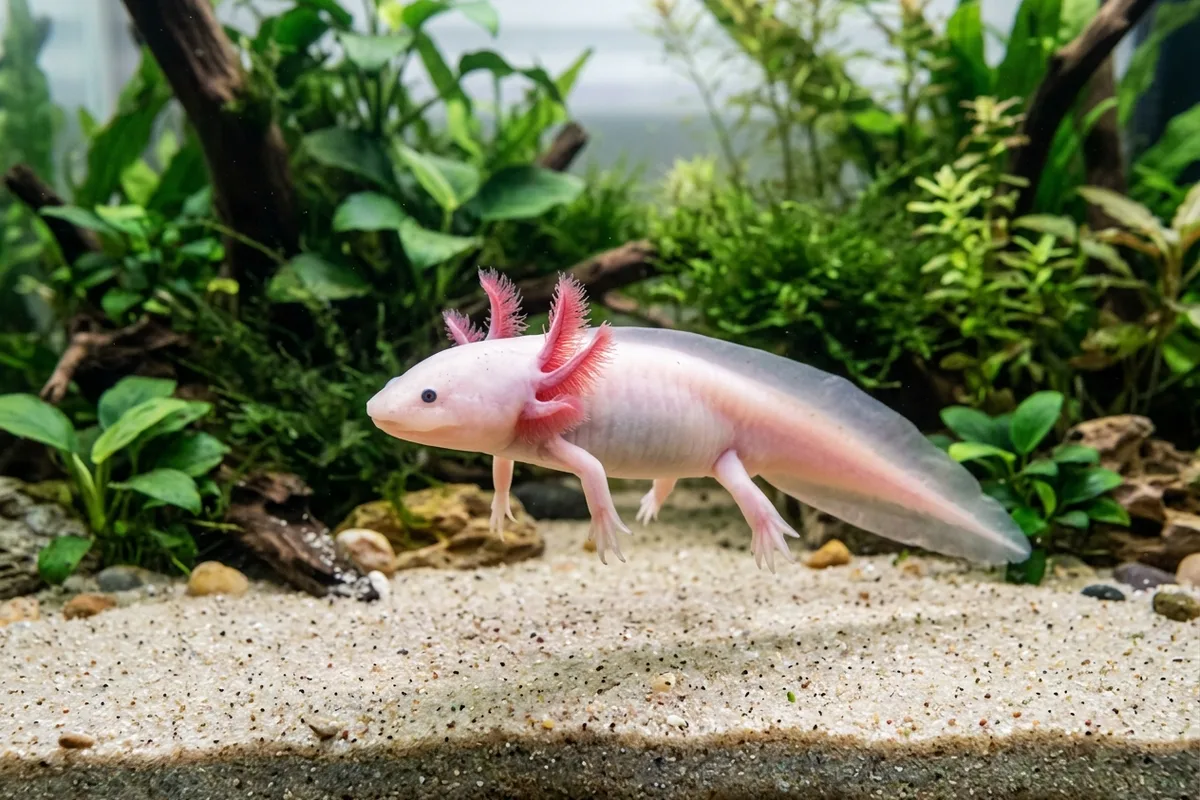
The axolotls kept in New Zealand descend from stock brought into the country decades ago, long before the current import settings applied. These captive populations have reproduced reliably across generations in home aquariums, providing a consistent domestic supply of various colour morphs—including wildtype, leucistic (pink with black eyes), albino, and melanoid.
2. Strict prohibition on live amphibian imports
MPI's pet import page lists just three pet species that can be brought into New Zealand besides cats and dogs — chinchillas from Great Britain, and rabbits and guinea pigs from Australia. Amphibians are not on that list, so there is no pet import pathway for axolotls at all. This means:
- No live pet imports: you cannot bring an axolotl (or its eggs) into New Zealand as a pet. Any live-animal import outside an approved import health standard requires MPI authorisation, and none exists for pet amphibians.
- Biosecurity protection: These restrictions protect New Zealand's vulnerable ecosystems from devastating foreign pathogens, such as the chytrid fungus (*Batrachochytrium dendrobatidis*), which has severely impacted amphibian populations globally.
- Local self-sufficiency: The New Zealand hobby relies entirely on ethical, domestic captive breeding.
To review official import pathways for exotic companion species, visit the MPI non-cat and non-dog pet import page.
Wildlife Act 1953: Native protection vs exotic pets
A frequent point of inquiry among wildlife enthusiasts is whether the Department of Conservation (DOC) regulates axolotls under native wildlife legislation.
Here is how New Zealand conservation law distinguishes between native and exotic species:
- Native wildlife protected: New Zealand has three surviving native frog species — Archey's frog, Hamilton's frog and Hochstetter's frog (the Maud Island frog was formerly counted as a fourth, but is now treated as the same species as Hamilton's frog). All are absolutely protected native wildlife under the Wildlife Act 1953, and it is an offence to catch, hold or disturb them without an explicit DOC permit.
- Axolotls are introduced exotics: Because axolotls originate from Mexico and are an introduced exotic species, they do not fall under native wildlife conservation protections. No DOC permit is required to keep or breed captive axolotls.
- Releasing one is an offence, not a grey area: section 26ZM of the Conservation Act 1987 provides that no person shall transfer live aquatic life or release live aquatic life into any freshwater except in accordance with that section — which requires prior ministerial approval. Moving live aquatic life between the North and South Islands needs approval too. In plain terms: tipping an unwanted axolotl into a stream, pond or drain is illegal, and MPI specifically warns that pets released into the wild can spread disease and parasites to native species. Rehome through aquarium stores, enthusiast groups or rescue networks instead.
For more detail on the native species these rules protect, see the Department of Conservation's page on New Zealand's native frogs (pepeketua).
Essential tank setup and cold-water care in New Zealand
While axolotls are hardy amphibians, they have specific environmental needs that require dedicated equipment.
1. Strict cold-water temperature requirements
Axolotls are cold-water creatures that naturally thrive in cool, high-altitude lake waters.
- Ideal water temperature: Between 14°C and 18°C.
- Dangerous thermal stress: Temperatures exceeding 20°C cause chronic stress, fungal infections, and loss of appetite. Temperatures above 24°C are rapidly fatal.
- Managing Kiwi summers: During warmer summer periods in New Zealand, aquarists must keep tanks in the coolest room of the house, use aquarium cooling fans, or install a dedicated water chiller unit.
2. Tank size and filtration
An adult axolotl can reach 20–30 centimetres in length and produces substantial biological waste:
- Minimum tank volume: A standard 75–100 litre (approx. 20–30 gallon) aquarium for a single adult.
- Low-flow filtration: Axolotls have delicate external feathery gills that are easily stressed by strong currents. Sponge filters, or canister filters with a baffled spray bar, are ideal.
- Water quality is the other half of the job: the Merck Veterinary Manual's amphibian husbandry guidance is that water must be free of chlorine, ammonia, nitrite, pesticides and heavy metals, and that tap water should be dechlorinated (circulating it through a carbon filter for at least 24 hours works) before it goes anywhere near an amphibian. Test temperature, pH, ammonia, nitrite and nitrate weekly with an aquarium kit — most axolotl illness traced back to husbandry starts here, not with the food.
3. Substrate safety: Fine sand or bare bottom
Axolotls hunt by creating suction to engulf their food. If kept on gravel or small stones, they will inevitably ingest the substrate, leading to fatal gastrointestinal impaction. Aquariums must feature either very fine silica sand (which passes safely through the digestive tract) or a smooth bare glass bottom.
4. Solitary housing and tank mates
Axolotls must never be housed with fish. Fish will continually nip at the axolotl's external gills, causing severe stress and physical damage. Furthermore, axolotls will attempt to swallow any fish small enough to fit into their mouths, posing choking hazards. Axolotls thrive best when housed individually or in carefully monitored same-sized pairs in spacious tanks.
To explore reptile and amphibian housing principles, see our complete NZ pet reptiles legal guide and our overview of small pets and exotics in NZ.
Where to find an axolotl in New Zealand
Prospective keepers in New Zealand can source axolotls through:
- Specialist Aquarium Retailers: Independent aquatic centres and major pet supply retailers regularly stock domestically bred juveniles.
- Private Hobbyist Breeders: Local aquarium societies and online enthusiast communities offer direct access to experienced keepers who can provide detailed history on water parameters and feeding routines.
To review complete species anatomy, feeding regimens, and water parameters, explore our detailed axolotl species profile.
Summary: Responsible axolotl keeping in NZ
Axolotls are unique, fully legal, and captivating aquatic pets in New Zealand. By maintaining cool water temperatures, providing a gentle filtration system on safe substrate, and committing to lifelong captive care, aquarists can enjoy these remarkable amphibians responsibly.
Sources
- Ministry for Primary Industries (MPI) — Bringing pets to NZ (other than cats and dogs): https://www.mpi.govt.nz/bring-send-to-nz/pets-travelling-to-nz/bringing-pets-to-nz-other-than-cats-and-dogs
- Ministry for Primary Industries (MPI) — Stopping pets becoming pests (why released pets become pests): https://www.mpi.govt.nz/biosecurity/biosecurity-and-your-pets/
- Department of Conservation (DOC) — New Zealand native frogs / pepeketua (three surviving native species): https://www.doc.govt.nz/nature/native-animals/reptiles-and-frogs/frogs-pepeketua/
- New Zealand Legislation — Conservation Act 1987, section 26ZM (transfer or release of live aquatic life): https://www.legislation.govt.nz/act/public/1987/0065/latest/DLM106010.html
- Merck Veterinary Manual — Environment and Husbandry for Amphibians (water quality, dechlorination, monitoring): https://www.merckvetmanual.com/exotic-and-laboratory-animals/amphibians/environment-and-husbandry-for-amphibians
- New Zealand Legislation — Animal Welfare Act 1999, section 10 (physical, health, and behavioural needs): https://www.legislation.govt.nz/act/public/1999/0142/latest/DLM50298.html
Related guides
petmall.co.nz
Shop at PetMall
The products below are practical support items for your pet. PetMall ships across New Zealand.
- Food & FeedingMatch diet to species — feeders, supplements, and the right calcium/D3 dusting keep NZ reptiles healthy.
- Heating & LightingUVB and a proper heat gradient are the foundation of reptile health — get this right before anything else.
- Reptile SuppliesSubstrate, hides, and enclosure gear — stable conditions are the foundation of reptile health in NZ.