Adopting a Retired Racing Greyhound in NZ (2026): What Changed and How It Works
Adopting a retired racing greyhound in NZ after the 2026 ban: how the Greyhound Transition Agency works, GAP's $450 fee, cat testing, cold, and vet must-knows.
Commercial greyhound racing in New Zealand ended on 1 August 2026, with the last race day held on 31 July. Roughly 1,400 dogs were still in the industry at that point, and they are now moving into pet homes through a single coordinated national programme rather than through the old club-by-club rehoming arrangements.
If you have been thinking about a greyhound, this is the most straightforward moment there has ever been to adopt one in New Zealand — the dogs are available, the rehoming pipeline is funded, and the agencies are actively matching. What follows is how the new system works, what adoption actually costs, and the breed-specific things (cold, leads, cats, and some genuinely unusual blood results) that a first-time greyhound owner needs to know before applying.
---
The 2026 closure and the Transition Agency
The closure was made law by the Racing Industry (Closure of Greyhound Racing Industry) Amendment Act, which amends the Racing Industry Act 2020 to end commercial greyhound racing from 1 August 2026. The same legislation set up a Greyhound Racing Transition Agency — it operates publicly as the Greyhound Transition Agency — as a time-limited body responsible for rehoming the dogs, supporting people leaving the industry, and closing the industry down in an orderly way, including winding up Greyhound Racing New Zealand and the clubs.
The agency is not permanent. It is anticipated to be disestablished on 31 July 2029, with the ability to extend that by Order in Council to no later than 31 July 2031. The statutory framework and those dates are set out on the Department of Internal Affairs racing policy page.
Rehoming itself runs through the agency's Greyhound Rehoming Project, which coordinates carers, foster placements and adoption agencies nationally. The programme is funded by TAB NZ rather than from general taxation. For background on how we got here, see our earlier report on the end of greyhound racing in New Zealand.
---
Where to actually apply
The Transition Agency does not place dogs itself. It routes every adopter to one of three trusted adoption agencies, all listed on the Greyhound Rehoming Project site:
- Greyhounds as Pets (GAP) — the nationwide rehoming charity, with the largest network and the most established process.
- May Hounds — an independent nationwide charity that uses foster care to transition dogs into family homes.
- Nightrave Greyhounds — a volunteer rehoming and training organisation offering adoption plus ongoing support.
The process and the fee
GAP's adoption process runs in four steps: you complete the online application (they aim to confirm within 48 hours), you have a conversation with the rehoming team — often including a home visit with a volunteer and their own greyhound — the team then does the matching, and finally you meet your dog, sign the contract and take them home.
The adoption fee is $450. GAP's dogs go to a vet for a health check, desexing and microchipping, and their vaccinations and council registration are brought up to date before adoption. You go home with an adoption pack and a pet passport recording vaccinations, desexing and the registration tag. For a dog that arrives desexed, chipped, vaccinated and registered, $450 is well below what the same starting position costs on a puppy — see our cost of owning a dog in NZ breakdown for the comparison.
Matching is done on temperament and household fit — routine, hours away from home, other pets, children — not on which dog you liked the look of online. Listings carry icons showing whether a hound is cat trainable, currently in foster, already has a home lined up, or would prefer a quieter household.
---
Cats, small animals and other dogs
Greyhounds are bred to chase a lure, and that instinct does not switch off at retirement. But prey drive varies a lot between individual dogs. The rehoming project's position is unambiguous: every greyhound is assessed before rehoming, and only dogs assessed as suitable are placed in homes with cats.
So if you have a cat, say so on the application — it changes which dogs you will be shown, not whether you can adopt. The same applies to chickens, rabbits and small pets. With other dogs, greyhounds usually do well; they have lived alongside other greyhounds their whole lives, though they may need time to read the body language of very different breeds. GAP asks adopters to use a muzzle when introducing a greyhound to new dogs or other animals during the settling-in period.
---
The first three weeks: what settling in actually looks like
This is the part most adoption guides skip, and it is where new greyhound owners get into trouble. Almost every retired racer has lived rurally in a kennel, on a fixed daily routine, with other greyhounds nearby. Stairs, glass doors, lino floors, televisions, vacuum cleaners and being alone are all brand-new. GAP's guidance is that it takes at least three days for a new greyhound's stress levels to come back to normal, and their settling advice reflects that:
- No walks for the first three days. After that, start somewhere quiet — away from traffic, crowds and other dogs.
- Use a crate, playpen or baby gate when you cannot supervise, and leave the dog alone when they are on their bed, sleeping, eating, or resting. Greyhounds are used to undisturbed kennel sleep.
- Keep them off the furniture for the first three weeks while house rules are being learned.
- Lead on, always, in unfenced areas — a harness and long line gives freedom to sniff without the risk.
- Supervise all interactions with children, at the dog's pace.
Rushing this stage is what produces lead reactivity and freezing on walks — both largely preventable if the dog is not asked to process new things while still stressed. GAP publishes step-by-step behaviour guides on its about greyhounds page covering crate training, toileting, being left alone, and cat training.
---
Daily life with an ex-racer
Exercise: far less than people expect
Greyhounds are sprinters, not endurance dogs. One or two 20-minute walks a day, plus a bit of play, is enough for most retired racers, with a longer outing at weekends if you enjoy that; younger dogs need more. The rest of the day they will happily sleep. They do not need a big section — many live well in townhouses and apartments, provided any outdoor space is securely fenced. GAP's guidance is a fence of about 1.5 m with no gaps or weak points, strong enough to take a dog leaning or jumping on it (GAP FAQs).
Off-lead is the one hard rule
A greyhound can reach around 60 km/h and is the fastest of all dog breeds. Recall does not compete with a chase instinct at that speed, and a dog that takes off across an Auckland or Christchurch arterial does not get a second chance. Never let a retired racer off-lead outside a fully fenced area. Under the Dog Control Act 1996, every dog must be under control in public, be registered with the council from three months of age, and — for dogs first registered from 1 July 2006 — be microchipped.
Cold: a real NZ issue, not a fashion statement
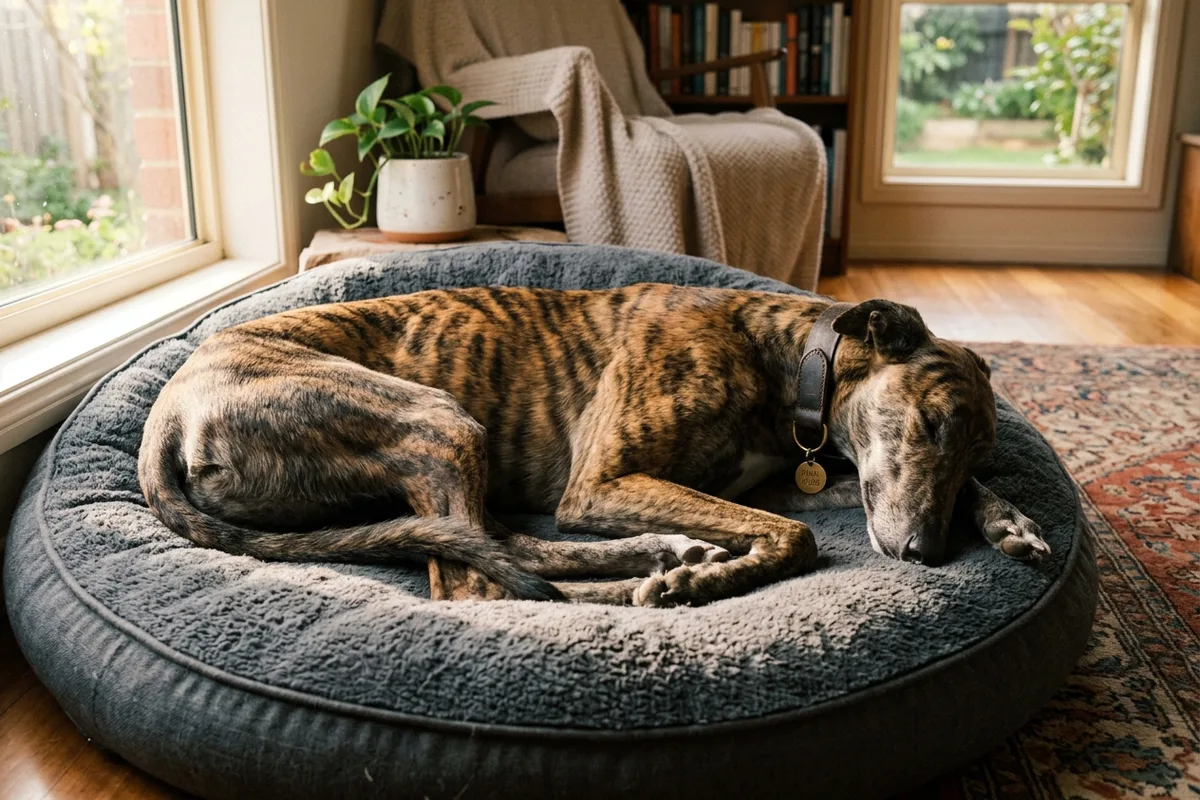
Sighthounds carry roughly 17% body fat, against about 35% in an average dog, and a greyhound's single-layer coat has no insulating undercoat. In an uninsulated Kiwi villa in July, that matters. Fleece pyjamas or a house coat indoors and a waterproof coat for wet walks are not indulgent — they are how these dogs stay comfortable through a Wellington or Dunedin winter. A deep, well-padded bed matters for the same reason: greyhounds are bony, and thin bedding on a hard floor causes pressure sores on hocks and elbows.
For breed characteristics and comparisons, see our Greyhound breed profile, the Greyhound vs Italian Greyhound guide, and Saluki vs Greyhound.
---
Tell your vet you have a greyhound
Greyhounds are physiologically unusual, and a vet who does not see many of them can misread a healthy dog as a sick one. Raise these three things at your first appointment.
1. Their blood results are meant to look abnormal
New Zealand's veterinary laboratories now issue greyhound-specific haematology reference intervals. Awanui Veterinary's greyhound reference interval update (based on a peer-reviewed study of 199 greyhounds) shows how far the breed sits from standard canine ranges:
| Measure | Greyhound | Standard dog |
|---|---|---|
| Haematocrit (PCV) | 0.49 – 0.65 L/L | 0.40 – 0.55 L/L |
| Haemoglobin | 166 – 226 g/L | 136 – 196 g/L |
| White cell count | 3.6 – 8.4 ×10⁹/L | 4.9 – 15.6 ×10⁹/L |
| Platelets | 89 – 237 ×10⁹/L | 200 – 500 ×10⁹/L |
Read against the standard intervals, a perfectly healthy greyhound looks polycythaemic with neutropenia and thrombocytopenia. The practical consequence runs the other way too: a PCV that sits mid-range for an ordinary dog may represent genuine anaemia in a greyhound. Ask your clinic to flag the breed on the lab request.
2. Anaesthesia needs a sighthound protocol
Sighthounds metabolise some induction agents slowly because of reduced hepatic enzyme activity. Thiobarbiturates should be avoided; propofol, ketamine or etomidate are used instead, though recovery from propofol can still be slower than in other breeds. This is standard knowledge in veterinary anaesthesia — see Clinician's Brief on breed-specific anaesthesia — but it is worth confirming before a routine dental or desexing procedure.
3. They lose heat fast on the table
The same 17% body fat plus thin skin means greyhounds cool down quickly under general anaesthesia. Active warming before, during and after a procedure is the mitigation; a clinic used to sighthounds will already do it.
On the positive side, greyhounds are largely free of many heritable conditions that trouble other purebreds — hip dysplasia among them — thanks to greater genetic variability in the racing population, and they typically live 10 to 12 years at an average adult weight of about 30.5 kg.
---
Budgeting
The $450 fee is the small part. Plan for:
- Setup: a deep, supportive bed; fleece and waterproof coats; a wide martingale collar (a greyhound's neck is wider than its head, so an ordinary flat collar slips off); a harness and long line; a muzzle for introductions.
- Ongoing: food, monthly flea and worm treatment, annual council registration, and dental care — dental disease is common in dogs coming off a racing diet.
- Veterinary: either a genuine emergency fund or pet insurance. Our cost of owning a dog in NZ guide has current NZ figures.
---
Is a greyhound right for you?
Adopt one if you want a quiet, affectionate, low-exercise indoor dog and you can commit to lead discipline and a warm bed. Think harder if you want a dog that will run off-lead on the beach, hike all weekend, or dote on you constantly — greyhounds are more independent than that, and the agencies are candid about it. They are also sensitive dogs, poorly suited to chaotic households without a quiet space to retreat to.
For the roughly 1,400 dogs now leaving the track, the difference between a good placement and a returned one is almost always the adopter's expectations, not the dog. Go in knowing what you are getting, and you get one of the easiest large dogs in New Zealand to live with.
---
Sources
- Greyhound Transition Agency. About us — statutory mandate and the Greyhound Rehoming Project, checked 2026-08-27: https://greyhoundrehoming.org.nz/about
- Greyhound Rehoming Project. About greyhounds — exercise, space, cats, children, other dogs, checked 2026-08-27: https://greyhoundrehoming.org.nz/greyhounds
- Department of Internal Affairs. Racing policy — Racing Industry (Closure of Greyhound Racing Industry) Amendment legislation, closure from 1 August 2026, agency disestablishment, checked 2026-08-27: https://www.dia.govt.nz/resource-material-our-policy-advice-areas-racing-policy
- Greyhounds as Pets. Adoption process and $450 adoption fee inclusions, checked 2026-08-27: https://greyhoundsaspets.org.nz/adoption/adoption-process
- Greyhounds as Pets. About greyhounds — settling-in guidance, checked 2026-08-27: https://greyhoundsaspets.org.nz/info-resources/about-greyhounds
- Greyhounds as Pets. Health matters — breed fast facts (speed, weight, lifespan, heritable disease), checked 2026-08-27: https://greyhoundsaspets.org.nz/info-resources/health-matters
- Greyhounds as Pets. FAQs — exercise and fencing guidance, checked 2026-08-27: https://greyhoundsaspets.org.nz/info-resources/faqs
- Awanui Veterinary. Greyhound haematology reference interval update (Campora et al. 2011, 199 greyhounds), checked 2026-08-27: https://www.awanuivets.co.nz/greyhound-haematology-reference-interval-update/
- Clinician's Brief. Breed-specific anaesthesia — sighthound body fat, hepatic metabolism, thiobarbiturates, checked 2026-08-27: https://www.cliniciansbrief.com/article/breed-specific-anesthesia
- New Zealand Legislation. Dog Control Act 1996, checked 2026-08-27: https://www.legislation.govt.nz/act/public/1996/0013/latest/whole.html
- Inside Government NZ. "1,400 greyhounds looking for homes as racing formally ends today" (Racing Minister's figure, 31 July 2026), checked 2026-08-27: https://insidegovernment.co.nz/1400-greyhounds-looking-for-homes-as-racing-formally-ends-today/
Related guides
petmall.co.nz
Shop at PetMall
The products below are practical support items for your pet. PetMall ships across New Zealand.
- Dog FoodStart with food that matches your dog's life stage and activity level — and change brands slowly over 7–10 days.
- Dog TreatsTraining rewards and everyday treats — small, soft pieces work best for consistent reinforcement.
- Dog ToysA small rotation of chew, fetch, and puzzle toys usually works better than buying a large variety at once.
- Dog GroomingA gentle brush and the right shampoo make maintenance easier — especially for dogs that get muddy on walks.
- Leads & HarnessesComfort matters: padded contact points and adjustable fit help reduce rubbing on longer walks or tramping weekends.
- Flea & Worm TreatmentFor NZ conditions, look for protection that fits your routine (monthly vs longer-lasting) and your dog's weight range.