Persian vs Birman NZ
Persian vs Birman NZ: compare grooming, temperament, family fit and indoor suitability for calm long-haired cats.
The quick answer: choose the Persian if you want a very calm indoor cat and are happy with serious grooming. Choose the Birman if you want a gentle, social long-haired cat that usually feels a little more interactive and less extreme in coat care.
Quick comparison
| Factor | Persian | Birman |
|---|---|---|
| Best fit | Quiet, grooming-committed homes | Gentle family or companion homes |
| Energy | Low | Low-medium |
| Grooming | High | Moderate-high |
| Social style | Calm, soft, less athletic | Affectionate, social, gentle |
| Watch-outs | Mats, face care, low activity | Coat care, indoor boredom |
Persian: calm and high maintenance
The Persian profile suits calm homes where grooming is part of the routine. It is not the best match for owners who want athletic climbing, rough play or a low-maintenance coat.
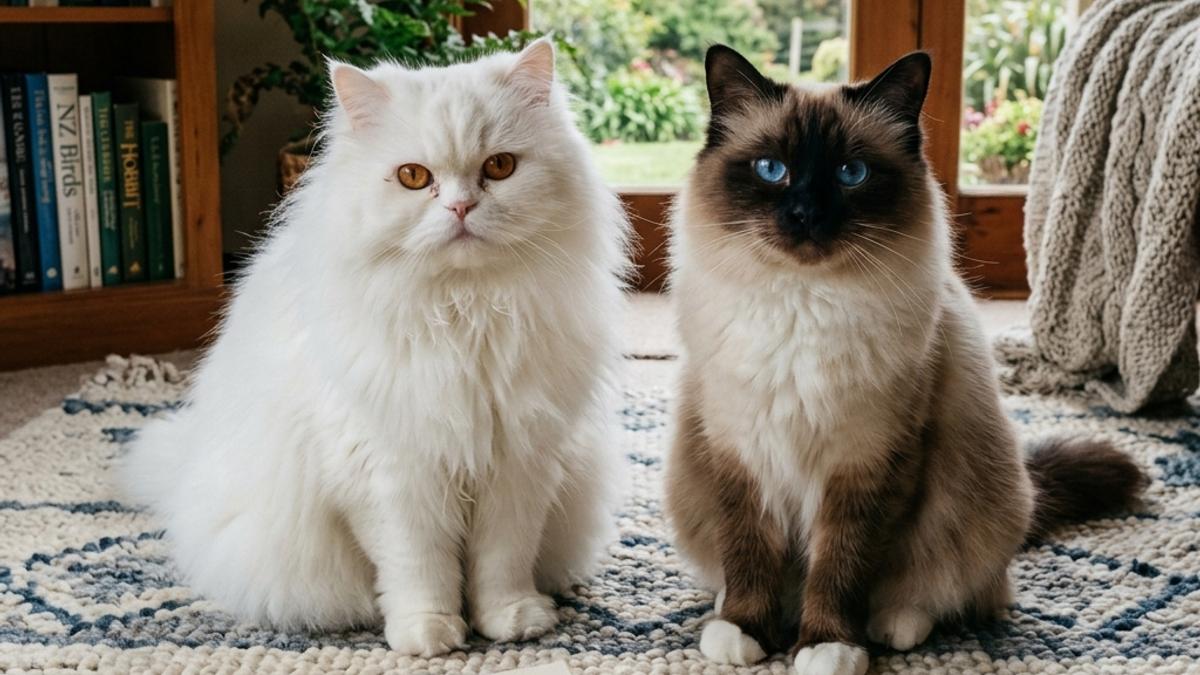
Birman: gentle and social
The Birman profile suits owners who want a sweet, people-oriented cat with a softer family rhythm. It still needs grooming and indoor enrichment, but it is often less demanding than a Persian coat.
NZ home fit
Both cats suit indoor homes or secure catios. In damp flats, long coats can mat quickly if grooming slips. Provide scratching posts, calm resting places, play sessions and clean litter routines.
Which should you choose?
Choose Persian if ultra-calm temperament and daily grooming are part of the appeal. Choose Birman if you want a gentle long-haired cat with a more social household presence.
Health watch-outs before you choose
Coat care is the obvious difference between these two. The less obvious one — and the one that costs money — is what each breed is predisposed to.
Persian: kidneys and face shape. Autosomal dominant polycystic kidney disease (ADPKD) is the best-documented inherited disease in Persians and Persian-derived breeds, caused by a single PKD1 variant; one copy is enough for a cat to be affected. Prevalence surveys of Persian populations have repeatedly come back in the 20–30%+ range. A DNA test settles it from a kitten's first days, while ultrasound is unreliable until around 10 months of age — so ask a NZ breeder for the parents' PKD DNA results, not for "the vet checked them".
Facial conformation is the second Persian question. A peer-reviewed study of owner-reported data found that the flatter the face (shorter nose position and muzzle ratios), the worse the reported breathing, alongside the tear overflow and dental crowding that go with the same skull shape. If you want a Persian, the moderate "doll-face" type is the kinder choice — and in a humid Auckland or Northland summer, a heavily flat-faced cat has less margin.
Birman: get the heart looked at. A Royal Veterinary College screening study of 162 Birmans found cardiomyopathy in about 10% of them, most commonly hypertrophic cardiomyopathy (HCM) at nearly 7%, and 82% of the HCM cats were male. That is not a reason to avoid the breed, but it is a reason to ask a breeder whether their cats are echo-screened, and to have any murmur in a young Birman investigated by a vet properly rather than written away as innocent.
Related reading
References
- TICA, Persian, checked 2026-06-13: https://tica.org/breed/persian/
- TICA, Birman, checked 2026-06-13: https://tica.org/breed/birman/
- Journal of Feline Medicine and Surgery (2022), Prevalence of polycystic kidney disease in Persian and Persian-related cats — PKD1 10063C>A, autosomal dominant, DNA testing from day one vs ultrasound unreliable before ~10 months, checked 2026-08-27: https://pmc.ncbi.nlm.nih.gov/articles/PMC10812362/
- PLOS ONE (2016), Farnworth et al., Flat feline faces: is brachycephaly associated with respiratory abnormalities in the domestic cat? — shorter nose position and muzzle ratios associated with worse owner-reported respiratory scores, checked 2026-08-27: https://journals.plos.org/plosone/article?id=10.1371/journal.pone.0161777
- EveryCat Health Foundation (study W15-044, Royal Veterinary College), Cardiomyopathy in Birman cats — 162 Birmans screened, ~10% cardiomyopathy, ~7% HCM, 82% of HCM cats male, checked 2026-08-27: https://everycat.org/cat-health/cardiomyopathy-in-birman-cats-2/
Free PetMall tools
Related guides
petmall.co.nz
Shop at PetMall
The products below are practical support items for your pet. PetMall ships across New Zealand.
- Cat FoodStart with food that matches your cat's life stage — change brands slowly over 7–10 days to avoid digestive upset.
- Cat LitterClumping or crystal, most cats prefer an unscented litter and a clean tray — one tray per cat plus one spare is the NZ rule of thumb.
- Cat TreatsGreat for bonding and training — keep treats under 10% of daily calories to protect your cat's waistline.
- Cat ToysA small rotation of toys (feather wand, puzzle feeder, and comfort toy) usually works better than buying many at once.
- Cat GroomingRegular brushing cuts hairballs and shedding — essential for long-haired breeds like Ragdolls and British Longhairs.
- Flea & Worm TreatmentFor NZ conditions, choose protection that fits your cat's weight and lifestyle (indoor vs outdoor) and keep it regular.