Burmese vs Tonkinese NZ
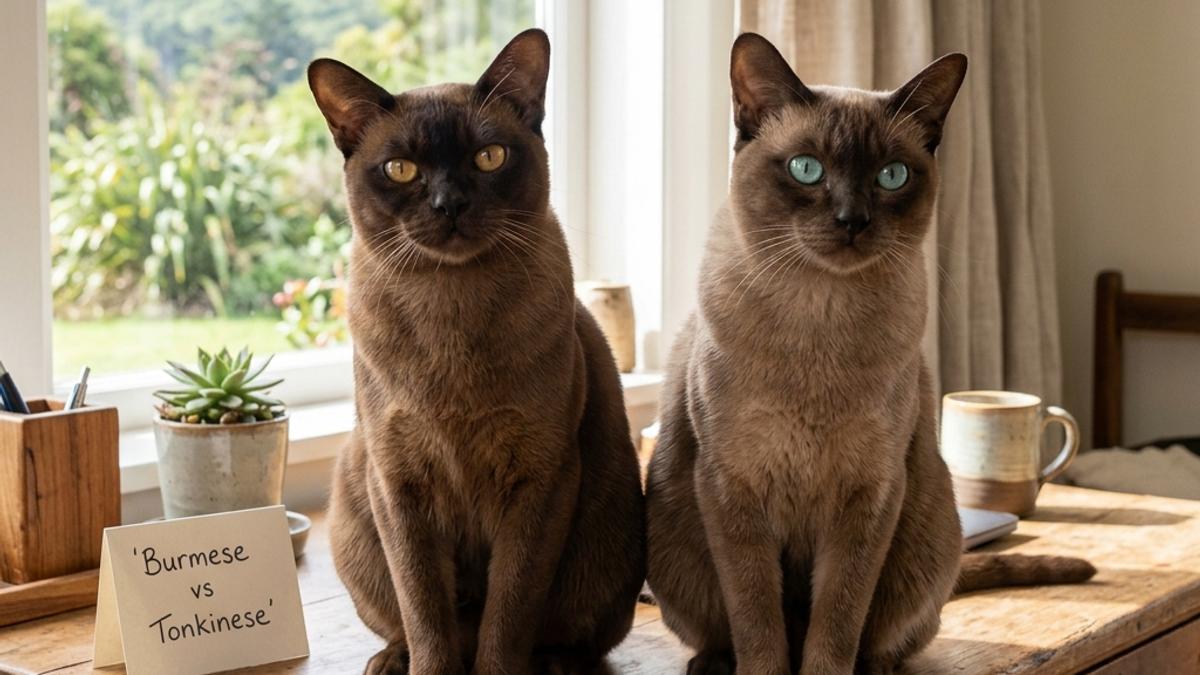
Burmese vs Tonkinese NZ: compare sociability, noise, activity, indoor fit and family suitability.
The quick answer: choose the Burmese if you want a very people-focused, affectionate cat that likes being involved. Choose the Tonkinese if you want a playful, social cat with more Siamese-family sparkle. Neither is ideal for owners who want a distant, low-interaction pet.
Quick comparison
| Factor | Burmese | Tonkinese |
|---|---|---|
| Best fit | Affectionate companion homes | Playful, social, interactive homes |
| Energy | Medium | Medium-high |
| Noise | Can be chatty | Often vocal and expressive |
| Coat | Short, easy care | Short, easy care |
| Watch-outs | Clinginess, boredom | Noise, mischief, need for company |
Burmese: affectionate and close
The Burmese profile suits owners who want a cat that follows household life closely. It can be a strong match for people who are home often and enjoy daily interaction.
Tonkinese: lively and social
The Tonkinese profile suits homes that like active, playful cats. It needs enrichment, company and patient owners who enjoy a cat with opinions.
NZ home fit
Both can suit apartments if play, climbing and scratching are provided. Indoor living works well, but boredom can turn into noise, pestering or mischief. Consider two compatible cats if the home is empty for long workdays.
Which should you choose?
Choose Burmese if you want affectionate closeness. Choose Tonkinese if you want a more lively, chatty and playful social cat.
Health watch-outs before you choose
Both breeds are short-coated and easy to look after day to day. The Burmese line behind them carries two inherited issues that matter more in New Zealand than almost anywhere else, because our Burmese come out of Australian and British breeding rather than North American lines.
Diabetes. Burmese cats in Australia, Britain and Europe are around four times more likely to develop diabetes mellitus than cats generally — a predisposition that has not been found in the genetically distinct North American Burmese population. The trait appears to be polygenic rather than a single gene, so there is no simple carrier test to ask a breeder for. What you can do is control the modifiable half: keep the cat lean, avoid free-feeding a bored indoor cat into obesity, and take increased drinking and urination in a middle-aged Burmese seriously rather than waiting. Ongoing insulin, glucose curves and monitoring are among the more expensive chronic conditions a NZ cat owner can end up funding.
Hypokalaemic polymyopathy. This one does have a DNA test. A mutation in the WNK4 gene causes potassium to be lost through the kidneys; affected cats — typically young — show episodic weakness, a characteristic drooping of the head and neck, and a reluctance to walk. It is inherited recessively, so both parents must carry it, and a buccal-swab PCR test identifies carriers reliably. Ask any Burmese or Tonkinese breeder whether the parents have been tested; because Tonkinese are a Burmese-derived breed, the question is fair for both.
Neither issue makes these poor pets. They make the breeder conversation a specific one instead of a vague "are they healthy?".
Related reading
References
- TICA, Burmese, checked 2026-06-13: https://tica.org/breed/burmese/
- TICA, Tonkinese, checked 2026-06-13: https://tica.org/breed/tonkinese/
- Scientific Reports (2020), Mapping the genetic basis of diabetes mellitus in the Australian Burmese cat — ~4× risk in Australian, British and European Burmese but not North American lines; polygenic inheritance, checked 2026-08-27: https://pmc.ncbi.nlm.nih.gov/articles/PMC7644637/
- JFMS Open Reports (2021), A novel hypokalaemic polymyopathy … in a young Burmese cat — WNK4 mutation causing urinary potassium wasting, buccal-swab PCR testing of carriers, weakness below 3.0 mEq/L, checked 2026-08-27: https://pmc.ncbi.nlm.nih.gov/articles/PMC8411637/
Free PetMall tools
Related guides
petmall.co.nz
Shop at PetMall
The products below are practical support items for your pet. PetMall ships across New Zealand.
- Cat FoodStart with food that matches your cat's life stage — change brands slowly over 7–10 days to avoid digestive upset.
- Cat LitterClumping or crystal, most cats prefer an unscented litter and a clean tray — one tray per cat plus one spare is the NZ rule of thumb.
- Cat TreatsGreat for bonding and training — keep treats under 10% of daily calories to protect your cat's waistline.
- Cat ToysA small rotation of toys (feather wand, puzzle feeder, and comfort toy) usually works better than buying many at once.
- Cat GroomingRegular brushing cuts hairballs and shedding — essential for long-haired breeds like Ragdolls and British Longhairs.
- Flea & Worm TreatmentFor NZ conditions, choose protection that fits your cat's weight and lifestyle (indoor vs outdoor) and keep it regular.